Tuesday 10th February 2026
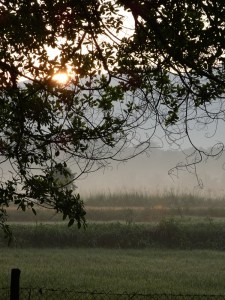
We are sat on our balcony watching the sunrise; it is a little before 7am. It is misty; although we can hear the dawn chorus we haven’t spotted any birds as yet.
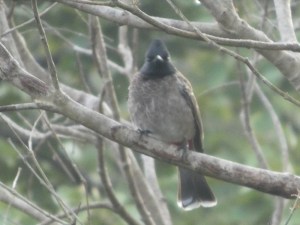
While drinking my morning cuppa, and simultaneously looking for birds, I also read again our notes on Polonnaruwa. I did manage to snap a bird!
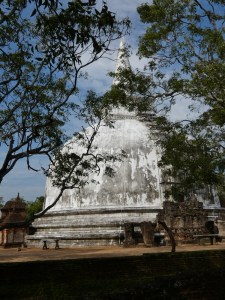
The ancient Buddhist city was for a brief time in history, the island’s capital. It is home to Sri Lanka’s finest shrines and stupas and is now a UNESCO Heritage Site.
The four of us already knew the dos & don’ts of Buddhism in Sri Lanka. It is considered a great offence to put your back to a Buddha Statue. However, we have not experienced this particular rule in other Buddhist countries that we have visited.
It is a relief, however, that there aren’t lots ofpeople posing at these sacred sites. Theravada Buddhism is practised in Sri Lanka.
It was a couple of hours driving to the ancient city, even though the journey is only 65 kilometres. The scenery was, once again, captivating. We travelled along the side of a river for a long while, and saw a couple of rope bridges which link villages. There were lots of green-yellow fields, rice paddies and we came across bullocks and cows at the side of the road.
Our driver stopped at one point as he saw a man was coaxing a monitor lizard from a small stream using a stick with some food on the end of it. A few tourists were taking photographs. It was an Asian water monitor lizard and had yellow markings.
Polonnaruwa is huge, covering an approximate area of 300 acres. Dave & I were originally planning on hiring a tuk tuk, and our friends were going to hire bikes.
However, Anura said he would take us around the site; each separate area had a car park and a couple of eateries.
After visiting the so called Southern-Site, we stopped for coffee at a hotel named the Ecko Lodge, which is situated on the edge of what once was the biggest manmade lake in the world.
It is named the Sea of Parakrama, and is actually a gigantic reservoir constructed in the 12th century! It is a beautiful place to stop.
The hotel itself was built back in 1870. It hosted Queen Elizabeth ІІ and Prince Phillip during their 1954 tour of Ceylon.
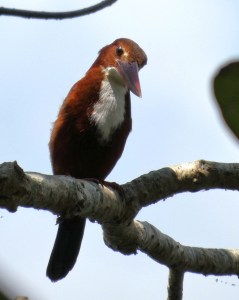
As we were just about to leave, a stunning bird with bright blue wings flew into a nearby tree. When it was perched on the tree, we could not see the bird’s wings. We waited a while, hoping to see its wings again, but it wasn’t in a hurry, and we had an ancient royal city to visit!
Sri Lanka is rich in birdlife, and we have already seen Indian, white and grey herons, various kingfishers, peacocks, lapwings, plovers, doves, mynah birds, Indian mynah birds, bee eaters and various others that we couldn’t identify
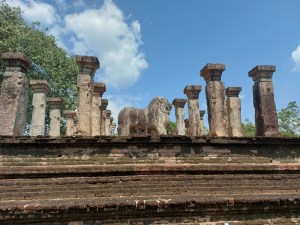
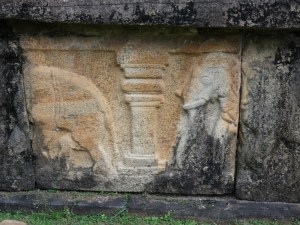
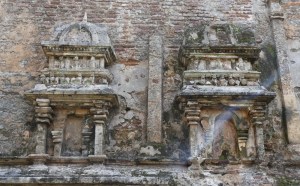
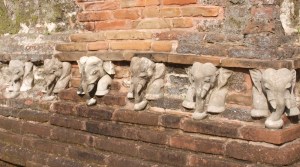
Apart from the ‘must see sites’ of this city, which was constructed between the 10th and 12th centuries, there are numerous relief carving friezes that are wrapped around some of the palaces and audience halls. There are also many stone pillars still intact with various decorations and inscriptions.
Sinhalese Art (Sri Lanka) and Dravidian Styles (South Indian) make up the fusion of architecture in Polonnarwuwa.
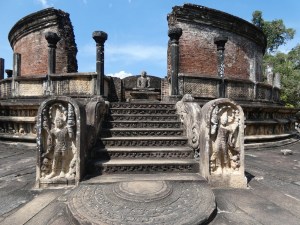
One of the main places to visit is the so called ‘Quadrant’. This was named by British archaeologists in the 19th century, due to it being ‘square like’ with a perimeter of stone walls. It is this name that is more often used today.
Its ancient name is Dalada Maluwa, which translates as Terrace of the Temple of the Tooth.
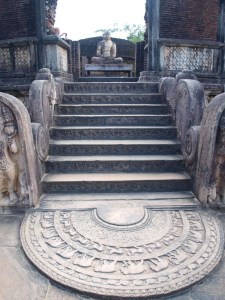
Many people say that the Vatadage (circular building) within the Quadrant is Sri Lanka’s most stunning structure. It is believed that it was built to hold the relic of the tooth of the Buddha.
It has four entrances, each has a seated Buddha statue and an intricately carved moonstone, also known as a Sandakada Pahana. It is believed that when one steps onto or over the moonstone, the mind of the person will become focused on worshipping.
Hats and shoes must be removed before entering this sacred site. Anne and I both found the moonstone interesting, and although not usually souvenir buyers, we both purchased a small carved memento.
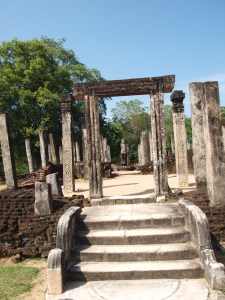
Polonnaruwa
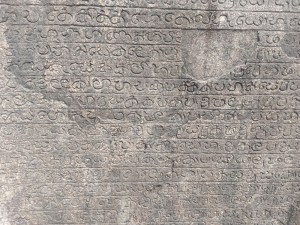
The Hatadage also situated within the Quadrant is another sacred shrine that probably once held the tooth relic. An inscription in medieval Sinhalese is carved onto a stone slab just inside its entrance. The Buddha statues are positioned so they line up with the Buddha statues at the Vatadage.
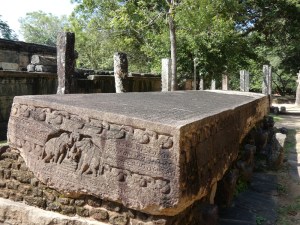
The skilfully inscribed stone slab (Gal Pota) tells the story of King Nissanke Malla’s reign of Polonnaruwa during the 12th century.
The slab is over 8 metres long and weighs a colossal 25 tonnes.
It’s name means Stone Book.
Each section we visited seemed to be more impressive. There are incredible sights to see in this once important capital from antiquity.
The outstanding highlight of the day, for me, was part of the Northern Site that contains the Gal Vihara (Rock Monastery). Four huge statues of Buddha have been carved from a single piece of granite. This is truly an incredible sight to see.
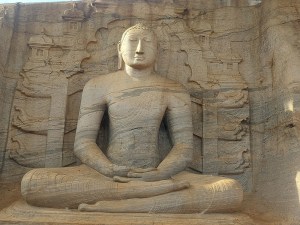
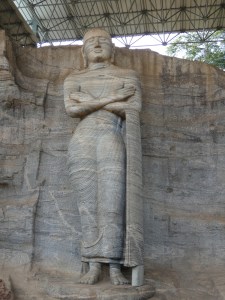
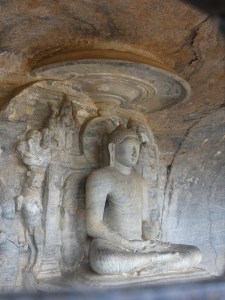
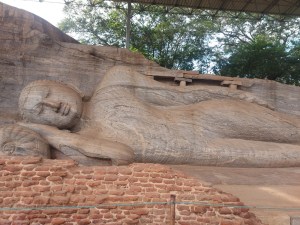
The smallest of these Buddhist statues has a man-made artificial cave built around it with bars protecting it from touching hands.
These awe-inspiring sculptures carved from solid rock are approximately 860 years old. These are well-preserved, and seemingly untouched by time. They now have some shelter above them to protect them from the elements.
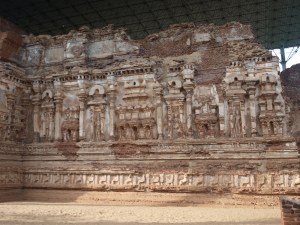
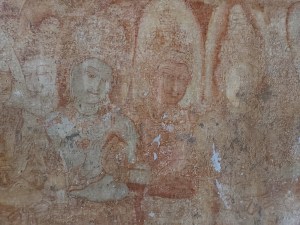
Another breathtaking wonder for me was the finely chiselled Thivanka Image House. The sacred Buddhist site contains wall paintings depicting the Buddha’s past lives known as the ‘Jataka Tales’.
The delicate and expert craftsmanship of this ancient site is beyond spectacular.
On the road back to the hotel we saw a herd of water buffalo including a baby.
A few miles later, we stopped to watch a huge bull elephant at the side of the road. He was busy bashing greenery, that he held in his trunk, to clean it and to remove the dirt from its roots before eating it.
Dave and I hadn’t stopped to eat all day, and Pete and Anne had only had a couple of biscuits. After sorting some bits in the rooms in preparation for our early start the following morning, we all met up again, more than ready for our evening meal.
Today’s visit to Polonnarwaru was an unforgettable glimpse into an ancient world.
Previous Next

 lindaruddstravels.com