Saturday 7th February 2026
Millennnium Elephant Park
While the four of us were having breakfast, Dave received a text from Danesh to say that sadly his mother-in-law had passed away during the night. The company was sending us a new driver and Danesh would meet us at the hotel at 9am to introduce us to him.
Anura, a Buddhist, was our new driver. Dave and I were sad that we were losing Danesh, as we had got on with him really well and we enjoyed his company. Danesh advised us that if all went to plan he would join us in Kandy in four days time.
We were soon on our way to Pinnawala where there is an elephant orphanage. Our hotel this evening will be at the riverside where the elephants bathe several times daily.
En route we would visit the Millennium Elephant Park which apparently was best for activities, like walking with the elephants and bathing them.
The journey was interesting, winding roads, green countryside, tiny colourful-fronted wooden shops and absolutely crazy driving!
Periodically, locals were selling various products at tables along the roadside, the women often tried to flag us down.
Although we had all visited predominately Buddhist countries previously, none of us had ever seen the striped Buddhist flags. We saw many today, they were flying outside Buddhist temples, and there was always one close by.
Anura asked if we liked cashew nuts as we were passing through ‘cashew nut country’. We all do, so he stopped at one of the many outlets. Two ladies had huge baskets of warm salted cashew nuts, they were delicious!
Plain cashews were available and various other varieties including salted and spicy were also for sale. We all purchased some; a while later I said that we should have asked to see how they were prepared, to see the trees etc. It was too late by then of course!
Arriving at the Millennium Elephant Park, we paid for the package to walk, feed and bathe an elephant. I was a little disappointed when the guy that was assigned to us informed us that they had six elephants. I had imagined many more but it seemed that everywhere we looked there was an elephant and the visit turned out to be fantastic.
There was a small outside museum with a skeleton of one of the huge mammals at its centre. There was lots of information about the Sri Lankan elephant, its size etc. An elephants skin is 2.5cm thick and we learnt that chains do not hurt the gentle giants. They are used to restrain the animals, when necessary, to protect the public, property or themselves from danger.
We were introduced to Seedave, a beautiful 10year old male elephant.
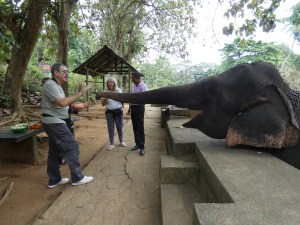
Each of us fed Seedave, then we went for a walk with him through the forest.
For safety reasons we had to stay a minimum of 2 metres behind Seedave.
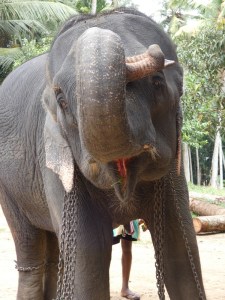
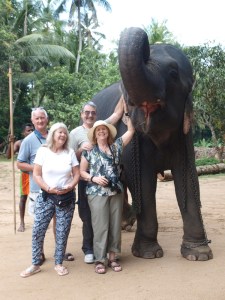
During the walk, we came across an elephant that was chained to a tree, and we were warned not to proceed further. Indeed, a sign stated ‘Musth elephant, do not come closer!’
The bull elephant had long tusks and apparently was going through a period of ‘musth’. Musth occurs in male elephants over the age of 15 years and continues annually until they reach between 55 and 60. The period of musth can last between 2 and 4 months depending on their age.
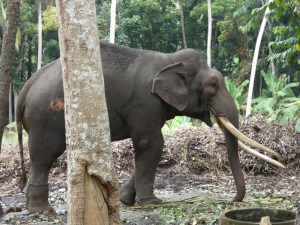
Musth is an increased level of testosterone, which when the animals are in their prime can reach up to 60 times the usual level. This huge surge of hormones increases the bulls’ aggression, irritability and gives it an increased urge to mate.
The animals become unpredictable, and stop obeying their mahouts’ commands. One of the tell-tale signs that ‘musth’ is occurring is a dark fluid leaking between their eyes and ears from their temporal glands.
After the walk we went to the river to bathe Seedave. We had brought a change of clothes and swim shoes, but everything happened so quickly that Anne and I just rolled up our trousers and stepped into the river barefoot.
Seedave’s mahout and another guy were also in the river. We washed the elephant with coconut shells. It was such a wonderful experience!
Anne was slightly put off when Seedave did a ‘trumpety trump’, but me, well I could have stayed there all day. I just loved bathing him, constantly chatting to him too while doing so.
Now and again, the mahout instructed us to pour more water over the happy elephant before we continued scrubbing. Seedave was clearly loving his bath. A couple of times he took some water in his trunk and splashed us a little, he was a cheeky boy!
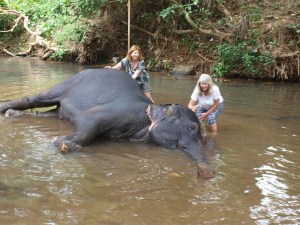
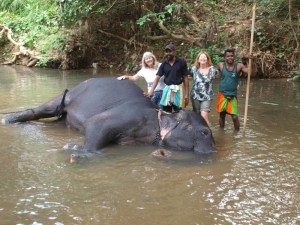
Regrettably, after a while, it was time to get out of the river. This experience was a big tick off my bucket list.
One of the guys pointed out a cannonball tree, he took one of the large but delicate flowers and opened it up. He continued to tell us that Buddha was born under a cannonball tree and that a part of the flower symbolised Buddha’s tooth, another part represented monks.
While it was an interesting story, somehow we doubted it as we had previously heard other stories relating to Siddhartha Gautama’s (Buddha) birth.
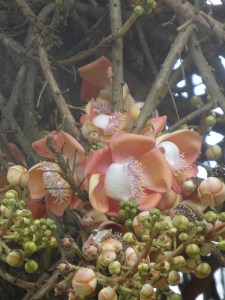
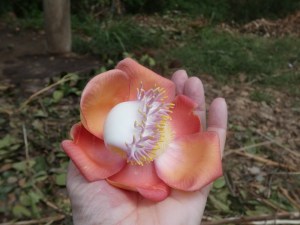
Research revealed that Buddha (although he was born a royal prince) was actually born under a tree, but the tree was a sai tree. Apparently, it is often mistaken as a cannonball tree and this is the reason that many temple grounds have cannonball trees.
Pinnawala was our next and final destination of the day. Even though we had a hotel by the river booked, we had to pay a fee to enter the area. Dave set off to pay the fees accompanied by a security guard while the rest of us waited in the minibus.
While we waited we saw elephants crossing the main road, and walking down a side street to the river. It was bath time! As soon as Dave returned with our tickets we drove down to the riverside, checked into the hotel, quickly threw our luggage into the rooms and went to watch the elephants.
Research revealed that Buddha (although he was born a royal prince) was actually born under a tree, but the tree was a sai tree. Apparently, it is often mistaken as a cannonball tree and this is the reason that many temple grounds have cannonball trees.
Pinnawala was our next and final destination of the day. Even though we had a hotel by the river booked, we had to pay a fee to enter the area. Dave set off to pay the fees accompanied by a security guard while the rest of us waited in the minibus.
While we waited, we saw elephants crossing the main road, and walking down a side street to the river. It was bath time! As soon as Dave returned with our tickets we drove down to the riverside, checked into the hotel, quickly threw our luggage into the rooms and went to watch the elephants.
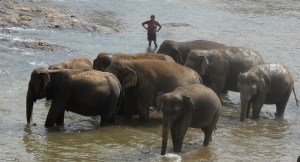
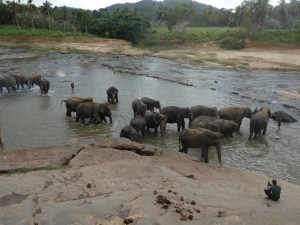
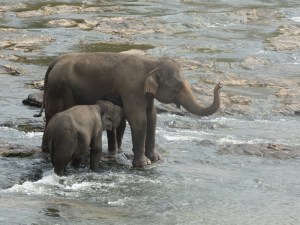
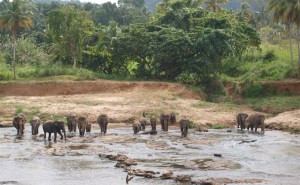
The river scenes with the elephants were absolutely spectacular to see. There were also many birds including ibis, egrets, herons and cormorants.
After we had booked to come to Pinnawala, we did see a couple of reviews suggesting cruelty to the animals. We can report that we saw no mistreatment of the animals and enjoyed every moment of our stay in such a stunning setting.
We stayed by the riverside until the mahouts accompanied the elephants back up the steep road.
At the hotel, we were on half board basis and the four of us met up later for a buffet dinner which included both Sri Lankan and Western dishes.
Previous Next

 lindaruddstravels.com