
Friday 15th February 2019
Shatabdi Express Train: The Golden Temple: Palki Ceremony
Well, what an experience that was! It is just after 7.20am and we are on the Shatabdi Express train from Delhi to Amritsar.
The short fifteen minute journey from the hotel to the railway station took us through a grotty and dirty area; rubbish was piled at the side of the streets.
Although it was early there was already a lot of traffic on the roads.

A cow walked slowly down the middle of the road adding to the traffic chaos.
The animal being sacred to Hindus would not be chastised or hurried along; the people would patiently wait for it to move.
Many small eateries were open; some I suspect are open 24 hours. People stood queuing at many of them.
As we neared the station the traffic came to a complete standstill for a few minutes. Then the driver attempted to stop at the station but train staff and armed police waved us on. “We cannot stop here” our escort from the travel company said, “something is happening”. A couple of moments later he learnt that the president was due to arrive to inaugurate a new train.
The driver managed to pull over a few metres further along. As we opened the car doors a stench of ammonia hit me, holding my breath I strode over the pile of rubbish in the gutter. Dave and I retrieved our luggage from the boot and headed to the station trying not to lose sight of our guide. The usual entrance to the station was cordoned off due to the VIP visit. Everyone was therefore forced to push through one metal security screening gate.
The queue was ten people wide so you can imagine the pushing and shoving people were doing. All cases and large bags had to go onto the security belt check too. Some people were just walking up the side of the queue.
It seemed that everyone was in a mad rush, like us they had a train to catch!
Suitcases were being thrown over our heads onto the belt and then the people were forcibly pushing their way through the metal detector gate.
A well dressed man pushed me aside but apologised profusely when I said “excuse me!” in a loud voice.
Dave commented on how ridiculous the situation was. A lady said it was due to extra security because of a terrorist attack that had happened the previous day. Apparently 40 soldiers were killed on the Pakistan border. But, there didn’t appear to be any security, I’m not sure if there was anyone behind the security belt and ten cases piled high on it couldn’t possibly be checked.
I heaved my suitcase onto the belt and pushed my way through the detector. I cannot believe it was working with so many people pushing through it at the same time! We breathed a sigh of relief when we saw our guide waiting for us with our suitcases, he somehow had managed to reclaim them for us and we didn’t have to fight for them.
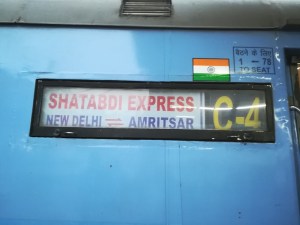
Following our guide who was striding quickly ahead, we reached the train with just a couple of minutes to spare.
An elderly gentleman who was sat in one of our reserved seats argued with our guide for a short while before moving to another seat.
For quite a few miles, as we travelled out of Delhi, our view through the smog was of squalor – ramshackle abodes, derelict buildings with washing hanging out and rubbish heaps.
We passed some wasteland with many people squatting, defecating. Cows and pigs with their piglets were on adjacent wasteland.These scenes were punctuated with the occasional green field with cultivated orange and yellow flowers, no doubt for the numerous garlands and offerings at the temples.
We spotted a couple of buzzards perched on the tree tops and one or two different types of ibis.
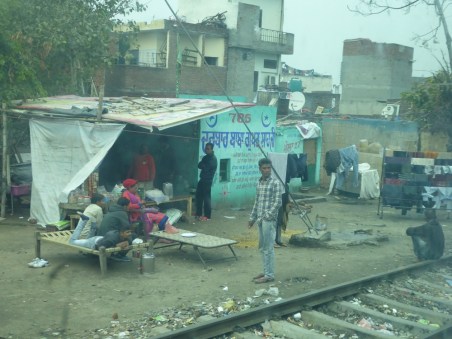
An hour into the journey we were still passing views of squalor; many folk were living in shanty towns.
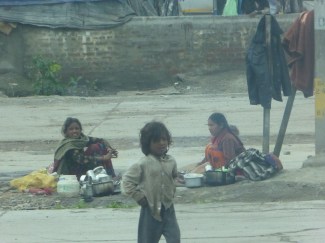
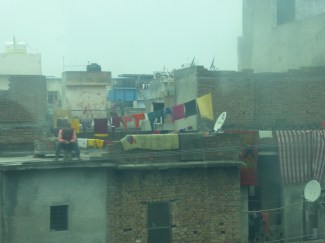
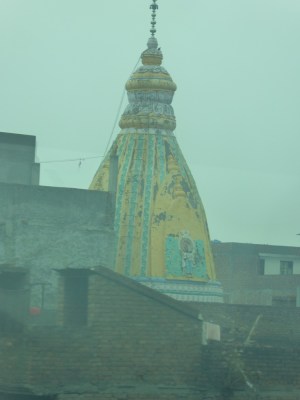
An occasional body of water flashed by offering us glimpses of different varieties of birds.
Colourful Temples were situated periodically, close to the makeshift homes.
A couple of hours into the journey the dense smog finally lifted. The squalor in which people were living continued at various levels. Some were living in makeshift tents, made from material or tarpaulin; others had made derelict buildings their homes. Some folk appeared to live perilously close to the tracks.
Stopping at the various stations gave us views of the many different folk patiently waiting.
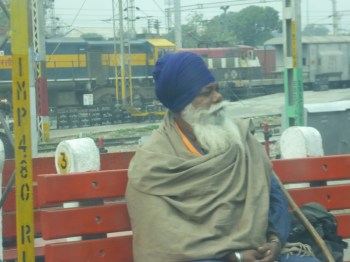
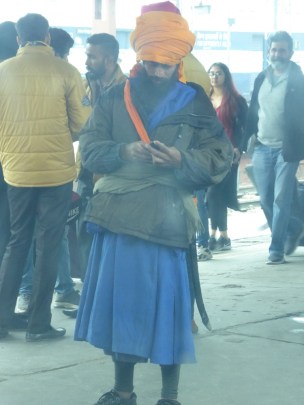
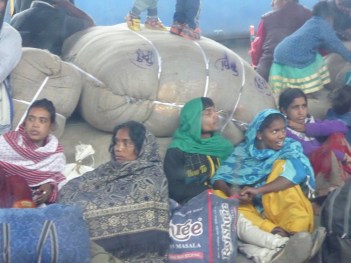
The train was clean and comfortable. However, we refused all the offers of food and drink that our ticket included on the seven hour journey. Our fellow passengers tucked into veggie burgers, chips and peas and were offered teabags and flasks of hot water.
As we got off the train a young guy directly in front of us asked “Mr David?”. “Gosh we are so easy to spot” I remarked, but thinking about it I didn’t notice any other Europeans on the train.
We followed our guide, Babu, through the crowded station and into the heaving car park dodging cars and tuk tuks and declining offers from other guides and tuk tuk drivers. On the way to the hotel we stopped to pop into a shop and Vikki, our driver, said that he was a Hindu and added that Babu was a Sikh. “Really?” I asked surprised. “But he doesn’t wear a turban” I queried. Vikki grinned mischievously and said that it was because he was a model boy. When Dave and Babu joined us I relayed the story to Dave. “He means a modern boy” interrupted Babu. “No, I mean model boy because you are cute!” Vikki said teasing him and roaring with laughter!
Vikki lives in Amritsar and Babu lives in one of the outlying villages.
Amritsar is in the North West of India in the state of Punjab. It is situated just 25km east of the Pakistan border.
Babu confirmed that the atrocity that happened yesterday killed 40 soldiers and hospitalised a further 18 soldiers. The terrorist attack occurred on the India-Pakistan border 200km away from Amritsar.
The Amritsar Ramada is a pleasant hotel and it is just a fifteen minute walk to the Golden Temple. After a quick unpack and a quick sandwich in the hotel’s cafe bar we set off. There were a couple of tuk tuks directly outside the hotel but their drivers didn’t push us when we told them that we preferred to walk.
60% of the city’s population are Sikhs but not all males choose to wear a turban.
The streets were busy and noisy with the traffic and the numerous blaring horns. Entering the pedestrian area the hustle and bustle together with the noise subsided. The city is impressive with its eye catching architecture and statues.
We can only assume that not many European people roam the streets in Amritsar as within the first few minutes of being there I was approached for a selfie three times!


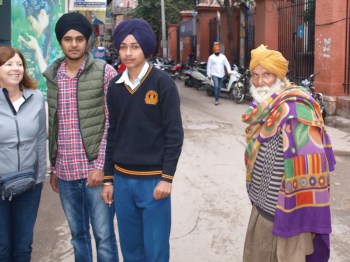

Our favourite is of course the one where the curious passerby joined in.
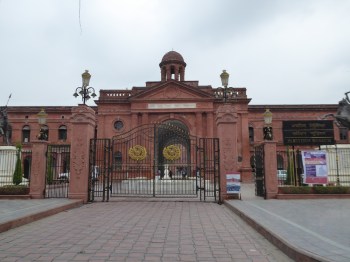
We passed the ‘Partition Museum’ that is housed in the town hall. The museum holds documents and other memorabilia relating to the separation of what was known as ‘British India’ into India and Pakistan.
The reason we decided to add Amritsar into our itinerary was to visit the Golden Temple. As we approached the famous site we saw a police patrol with a machine gun protruding from an armoured vehicle.
The Golden Temple, the Harmandir Sahib (abode of God) is the holiest Gurdwara and therefore the most revered in Sikhism. Gurdwara is the name given to Sikh places of worship and literally translates to ‘doorway of God’. Gurdwaras are open to people of all faiths and also to people without religious beliefs.
It was completed in 1604 and the stairway to the entrance descends downwards to symbolise a humble way of living.
We removed our footwear and washed our hands; we know the drill now! We passed by the tall Sikh guards who were keeping an eye on the entrance and walked through the footbath.
Wow! A sacred lake surrounds the Golden Temple, there is a tiled walkway around the lake, and ornate white buildings make up the perimeter.
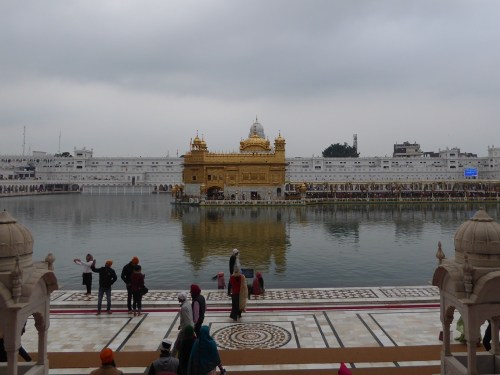
Some men were bathing in the holy waters; there is a sealed off area for females to enable them to bathe in privacy.
The setting is serene and breathtaking. We queued amongst the many pilgrims on the ‘Guru’s Bridge’ to enter the Golden Temple.
Gold embossing decorates many of the interior walls; others are inlaid with semi precious stones depicting birds, animals and flowers.
It was very crowded on the ground floor where the musicians were playing and the holy book was being read. We went up the stairs; many folk were seated on the floor of the gallery silently listening to the singing of the kirtans.
Standing at the gallery rail for a while, we too listened to the music and watched the scenes below. The Sikh’s holy book is the Guru Granth Sahib, the huge book is carried into the temple early each morning and Sikh devotees read it continually throughout the day.
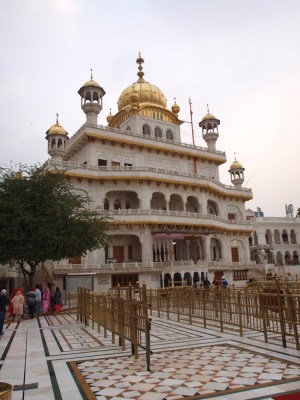
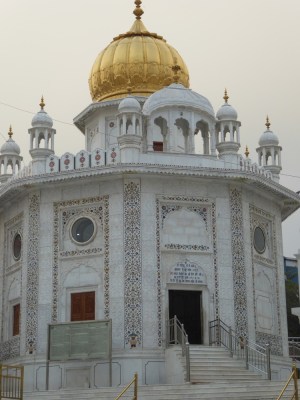
Wandering around the breathtaking complex we admired the many other ornate buildings before we returned to our hotel.
After an early dinner we met our guide Babu at 8.45pm to return to the Golden Temple for the Palki Ceremony.
The temple was illuminated and looked stunning against the night sky. We took a couple of photographs before a Sikh guard holding a spear asked us and everyone else to refrain from taking any more. Babu said that sometimes this happens when people start posing and he added that he had seen a couple kissing while being photographed. “This is a temple” he said indignantly “not the Taj Mahal!”
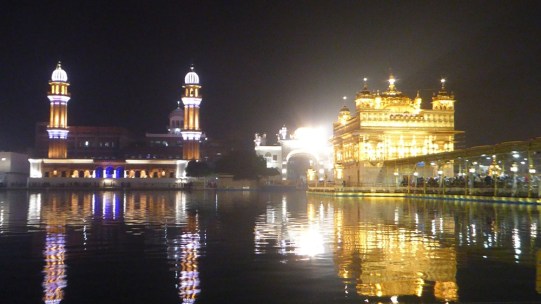
‘The Palki Ceremony’ is when the ‘Guru Granth Sahib’ is put away for the evening; this is often referred to as the ‘putting to bed’ ceremony. Indeed, the book is ceremoniously placed in its own special room for the night.
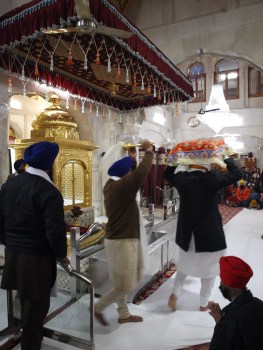
However, Babu took us first to where another custom was taking place. This was the ‘putting to bed’ of the second most important book in Sikhism, the Dasam Granth.
In one of the white marble buildings, a few people sat behind a cordoned off area. However, we were in the main area extremely close to where the ceremony was taking place.
A Sikh was speaking and another was meticulously folding material around the book. A further Sikh stood wafting what appeared to be an enormous white haired fly swatter over the Holy Scriptures.
“What’s that for?” I whispered to Babu. “Flies!” he said. “It is made from real beard hair” he added!
He spoke with one of the tall guards who said to us “you are most welcome here, take photographs or videos if you wish” and he motioned for us to move closer! How lucky we are! What an amazing opportunity to see this ceremony.
The book was finally placed on a cushion which a Sikh carried above his head to where it would be placed for the night.
Outside, we stood watching the palanquin being prepared. The word palki translates to palanquin. Two long-bearded Sikhs sat cross legged on the floor painstakingly pulling, smoothing and straightening the material that they had placed in the palanquin. They then repeated their actions with an embroidered layer of material. Cushion covers were put on cushions and plumped up before being precisely placed. It was then decorated with flower garlands. All this was done with great care and reverence.
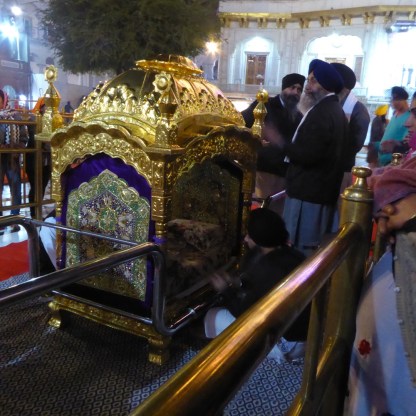
A couple of older Sikhs nodded at some younger ones authorising them to carry the palki, they looked surprised and honoured, then one, two and three, and up onto the men’s shoulders it was lifted and carried across the bridge to the temple.
Our guide informed us that prayers would be said inside the temple for ten minutes or so as the sacred scriptures were being placed in the palki. It would be then carried back across the bridge and finally placed in the building, (where the first ceremony occurred) behind glass.
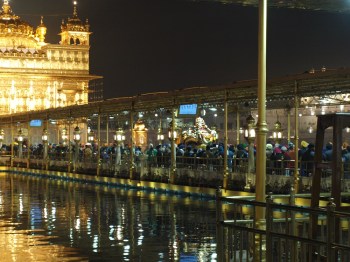
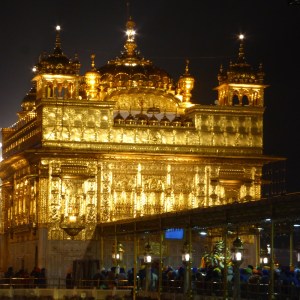
We stood enjoying the breathtaking setting and waited for the ceremony to continue.
Many people were surrounding the palki as it was brought back carrying the Guru Granth Sahib; they appeared to be jostling to hold onto the palki or each other. The book was then placed on one of the Sikhs heads and the Sikh ran up the stairs into the building followed by many other Sikhs who would watch it being ‘put to bed’. This ceremony takes place every night and a similar one takes place every morning.
Quite a few people were sleeping under the shelter of some of the colonnaded buildings. Babu explained that these folk were pilgrims who perhaps only had one or two days in Amritsar so they stayed at the temple in order to worship for as many hours as possible.
The walk back to our hotel took us just twenty minutes. We chatted to a Sikh couple in the lift as we were going to our room. In excellent English the man enquired where we were from. “England” we both replied. He said that they were from Delhi but had lived in Ealing in London for nine years before they had decided to return home. He then added “we have come to the Holy City for just one night to ask for blessings”.

 lindaruddstravels.com