Thursday 14th February 2019
Delhi – Humayun’s Tomb : Gurudwara Bangla Sahib : Red Fort
Valentine’s Day in Delhi!
Unfortunately, we woke to a grey smoggy sky and heavy rain. Today is a free day and we had intended to visit places under our own steam. However, as we would be wet through before we even reached the local metro station we decided to change our plan. We contacted our travel company and arranged a car.
Our driver, Ram, a Hindu, finally arrived at the hotel around 11am and we immediately set off to Humayun’s Tomb.

The Mughal Emperor Humayun’s mausoleum was ordered to be constructed by his grieving widow, Hamida Banu Begum.
The tomb has in fact over one hundred graves within it, earning it the name of the ‘Dormitory of the Mughals’.
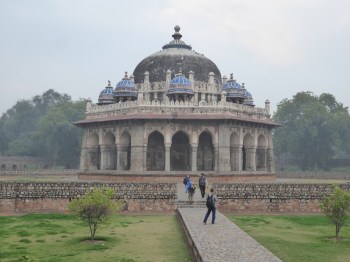
Within the grounds there is an appealing octagonal building which is the final resting place of an Afghani noble man.
Set in a sunken garden the tomb of Isa Khan was built in 1547. It also contains the bodies of his wife, their three children and his brother, according to the friendly security guard.

Hundreds of noisy school kids came running out of the building laughing and smiling, confidently answering our ‘Hi’ and ‘Hello’ greetings.
One or two ‘high fived’ Dave while another one or two asked for selfies with us. These happy kids were, we guessed, from the government school.
The private school kids were much more studious, listening attentively to their English speaking professor and frantically scribbling in English in their notebooks.
It was still raining and we had donned our cagoules while walking around the impressive site.
There were numerous squirrels running around the lawned gardens and climbing the trees.
We informed Ram that we wished to visit the Sufi Mosque next. Our guide had advised against visiting this yesterday, saying that it was down a narrow lane and that lots of people would pester us for cash.
The entrance to the narrow lane was packed solid with tuk tuks and therefore our driver couldn’t stop. He drove a short distance away and suggested we reach the mosque by taking a different route.
We headed down a different colourful alley, small stalls were offering different foods, and we noticed the chapatti maker, again cooking the bread on the base of the pan. There were also a couple of small cafes.
A small grubby and scruffy little boy stuck his hand out in front of us and then grabbed hold of my jacket for a second.
Suddenly, there was a bit of a commotion. Someone was yelling and then we saw a small elderly bearded man threatening an equally small man with his walking stick. We then realised why, the man was urinating extremely close to the elderly man and his blanket!
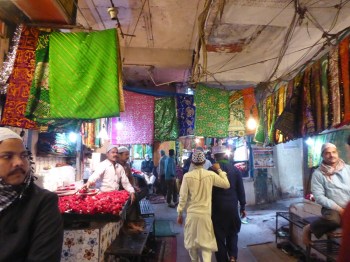
Entering a market area we continued our search for the mosque.
Vibrant coloured scarves were being sold on a stall which stood close to a butcher where huge slabs of meat hung. We stopped and asked for directions.
A man at another stall stopped us and advised us that we must remove our shoes. He handed Dave a skull cap and passed a scarf to me. I didn’t want to leave my shoes so we decided to carry them. Covering our heads, we walked in the direction the man had pointed, tentatively trying not to step into too many of the puddles. Another stall holder stopped us and insisted (once more mainly by miming as we had no common language) that we leave our shoes; he showed us other footwear that was under his table. We left our shoes and he pointed upwards to a white tiled stairway. The way to the mosque, we assumed…
At the top of the stairs we entered an office. A man with a long white beard and wearing an orange headdress sat on a large cushion in the corner of the room.
“Mosque?” we enquired. But the man clearly didn’t understand us and we were obviously not in a mosque. We muttered our apologies and left.
As we crouched to retrieve our shoes, we noticed a sign above the door to the stairway ‘Spiritual Centre-any help you need’, so maybe the bearded man did speak our lingo. However, the brightly coloured mosque that we had read about was clearly not here, but, we wondered, who did the other shoes belong to?
The ’Sufi Mosque’ – Hazrat Nizamuddin Dargah is actually a mausoleum. Dargah is a word to describe a shrine built over the grave of a revered religious person, often a Sufi saint. Unfortunately it seems that we will have to keep it on our list for next time!
We retraced our steps, returning our headwear and shrugging our shoulders at the stall holder who looked puzzled and clearly wondered why we were back so quickly.
There were a lot of parked tuk tuks without drivers or passengers. We passed one or two beggars and two or three guys attempted to sell us what appeared to be business cards as we walked back to the car. We still have no idea what the cards were.
Quite a few homeless people were sat huddled together on this warm but wet morning, one poor chap was shuffling along on his bottom, a blanket draped over his shoulders.
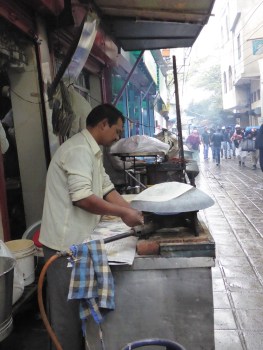
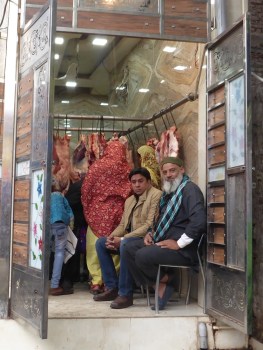
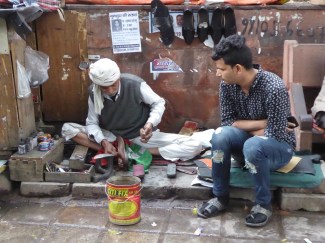
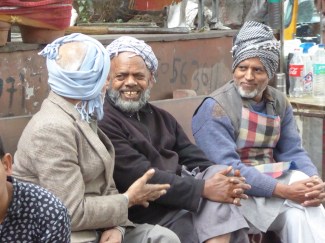
Life in the Muslim Quarter
Our next stop was one of the most prominent Sikh temples in Delhi. Ram parked the car in the huge underground car park of the Gurudwara Bangla Sahib. The huge white building trimmed with gold is quite an impressive sight.
Ram led us to the cloakroom where the three of us removed our shoes; we then washed our hands and walked through a foot bath to cleanse our feet before entering the temple. Our feet needed cleaning after walking barefoot through the wet alleyways! Sikhs usually wash before entering the temple; some believe it enhances their ability to feel God’s energy.
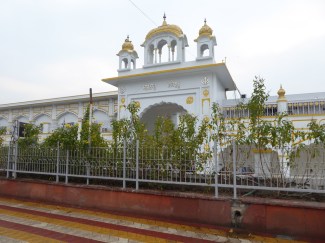
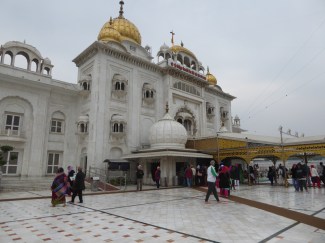

We entered through the marble archway. It is inlaid with semi precious stones including malachite, agate and jasper, creating an intricate and beautiful floral design.
A sign placed immediately before the main entrance to the temple advised ‘Selfies and family photos are not permitted inside the temple’. A good idea, one should not have to dodge selfie sticks in a holy place!
A band plays within the temple. Its members change every 2 hours and kirtans (Sikh devotional songs) are sung for 24hours continuously.
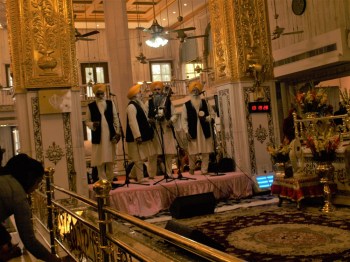
The musicians wear white kurta pyjama sets covered by brown waistcoats, their heads are topped with gold-coloured turbans.
They play a tabla which is a percussion instrument and a keyboard that although much smaller is similar to a piano.
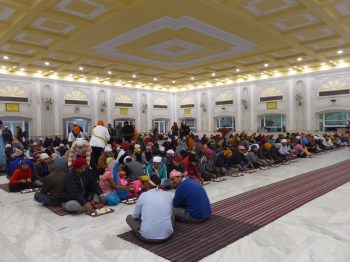
100,000 meals are cooked in the huge kitchen and provided without charge during any 24 hour period.
Donations towards the cost of the food are often made and all Sikhs volunteer 20% of their income to the temple.
Food is served to anyone that turns up; the majority of the people that were eating today didn’t appear to be in need.
Ram confirmed that the temple would feed the hungry people from the slums, or the homeless, (although of course it would be difficult for some of the disabled to get to the temple) the tourists and the rich. One’s faith is immaterial.
There were many folk eating in the large hall. The majority were seated on the floor, but a few were sat on chairs. The place was silent, each person held a metal compartmented rectangular tray. The servers walked along the rows ladling food into each compartment and handing chapati bread out.
We went to the kitchen, wow, it was amazing. Cross legged ladies and one seated white bearded gentleman rolled out tiny rounds of dough into chapatis. “You make?” the young pretty lady wearing a bright purple scarf asked. I sat next to her and she placed a piece of dough in front of me and handed me a small wooden rolling pin. She added my rough attempts to her perfectly formed piles.
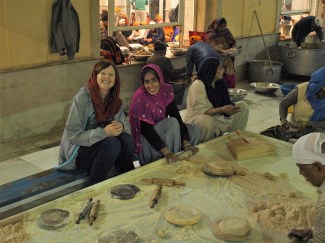
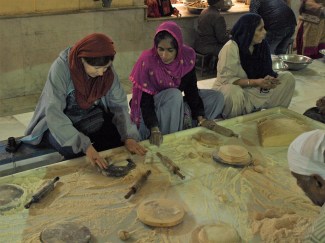
A female threw the flatbreads on a 3 metre by 1.5 metre heated hotplate. A young man using a long cooking implement moved them first onto the grill section until they puffed up, and then flipped them over. Huge metal pots held copious amounts of vegetables and bubbling dahl.
Everyone appeared happy with their chores; they were all smiling and friendly and welcomed us.
We wandered back into the marble courtyard which was now wet from the rain and a little slippery. Two men, using long handled window cleaning gadgets were pushing away the surface water.
Before continuing to the Red Fort; we stopped for a bite to eat at the aptly named ‘Luteyens’ restaurant.
Our guide yesterday had advised that we visit the fort at Agra, as apart from the Taj Mahal there isn’t much else to visit. However, there were a couple of places in the Red Fort that we had marked to see if we had the time and we have…
Yesterday with the smog, the structure appeared almost ghost like; today however, we can see its clarity and the deep red of the stone.
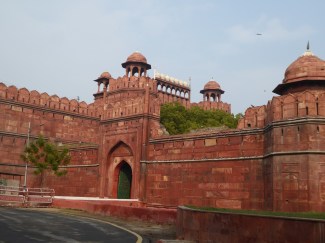

Built in the mid 17th century this is a magnificent edifice from times gone by. The fortified palace was constructed when the Mughal Emperor decided to move the capital of his empire from Agra to Delhi.
We purchased our tickets and passed through security directly into an open square; I noticed a rifle pointing directly at the entrance from behind a camouflaged screen.

Walking through ‘Chhatta Chowk’ (which roughly translates to covered market) we saw many souvenirs for sale including the usual bangles, bracelets and pashminas.
There were also artisans at work producing wooden carvings and one or two were painting or sketching some of the remarkable sights to be seen around the city.
At the end of the arcade the place opened up into a large lawned area with small buildings dotted around.
The now familiar Indian palm squirrels that resemble chipmunks and are indeed in the same family were chasing each other around the lawns and up and down trees.
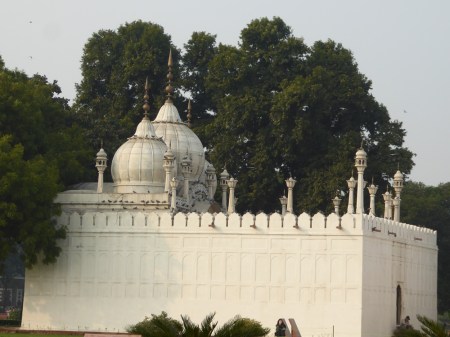
One of the buildings that we wished to see in the Red Fort was the Moti Mosjid, otherwise known as the Pearl Mosque. All those years ago the Emperor had just a few steps to take from his palace to his private mosque. Unfortunately, it is surrounded by a high wall and entrance to the mosque at the time of our visit was not permitted.

The Diwan I Khas is a stunning building, its carved archways and pillars inlaid with semi precious stones. Once upon a time, it was a reception hall used for receiving state guests. Unfortunately, it stands completely open and the stonework is not protected from the elements.
I noticed a guy attempting to take a photograph of me; he was pretending to take a selfie holding his telephone high. When I moved, he moved. It was quite funny. When he turned around, I just laughed and said “why didn’t you just ask?”
Some young girls shyly asked me to join them for a selfie, as did a mixed group of young people. I confess that I have taken quite a few surreptitious shots so far and I believe I have captured some beautiful faces.

As we were thinking of leaving the fort, I spotted a large bird on top of a heap of branches through my camera lens. I showed Dave what I could see with the camera at full zoom.
We headed back to where we could see it more closely and were rewarded with the sight of flying buzzards as well as the ibis.
Heading back to the hotel we commented on the numerous hospitals and clinics that we had seen in Delhi since we arrived.
It is Valentine’s Day and apart from the usual wares of sweets, drinks and paper tissues, bunches of red roses were also thrust up at the window whenever the car came to a halt at a traffic light. Yesterday we were surprised to be offered English books; a biography of Michelle Obama was at the top of the precarious pile that the small girl was balancing.
Ram, our driver was born close to Calcutta and was educated at a Mother Teresa school. He is married and has two daughters who attend the local government school. “Private schools are very expensive”, he told us. His wife like the majority of Indian women is a housewife.
After dropping us off at the hotel, he would return the car to the company garage and then take the metro home. He added that houses in the centre of Delhi are very expensive and that he and his family live way out on the outskirts of this sprawling city.
We ate our evening meal in the hotel as we have done the last couple of evenings.
Previous Next

 lindaruddstravels.com