Wednesday 19th November, 2025
Bratislava Castle : Konditorei Kormuth : Papilonia : Primate Palace : Handsome Iggy : The Blue Church
It was minus 2 degrees Celsius when we woke. Dressed warmly in layers we ventured outside and started our day by walking up to the castle.
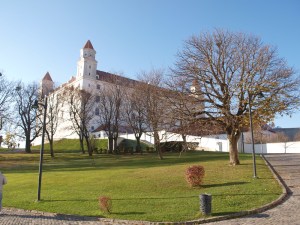
The castle dates back all the way to the 9th century with many changes over the years. In the early 19th century, it burnt down and its reconstruction didn’t start until the mid 20th century.
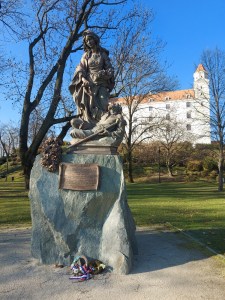
The statue in front of the castle depicts Saint Elizabeth, a Hungarian Princess who married Louis IV. After his death she devoted the remainder of her life to caring for the sick and helping the poor. She died at the young age of 24 and was canonised a few years later.
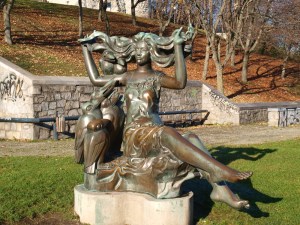
Another interesting statue portrays a woman with long flowing locks, seated next to some ravens.
It is known as ‘The Bratislava Witch’ or alternatively ‘The Girl with Ravens’.
This statue is dedicated to the women who were burnt alive accused of witchcraft.
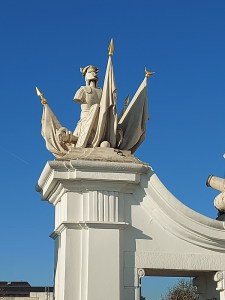
Leopold’s Gate is a stunning baroque ceremonial entrance gate to the castle. The sculptures atop the gate depict Greco-Roman armour.
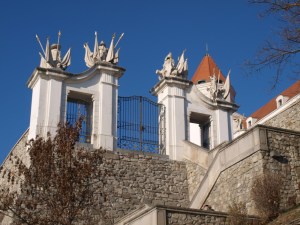
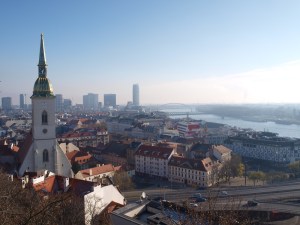
The castle grounds have spectacular views of the city below, including the River Danube.
Spanning the Danube is one of the largest hanging bridges in the world.
The landmark bridge is more often referred to as the ‘UFO Bridge’ due to its UFO shaped building observation deck which sits on top of the bridge pylon.
The futuristic building also has bars and a restaurant.
It was time for a coffee and we knew exactly where we were going. So we headed back down to the old town in search of the ‘Konditorei Kormuth’ patisserie.
Konditorei is a German word meaning confectionary or patisserie. Kormuth is the name of the family who own the business. The owner spent more than ten years transforming it into the wonderful place that it is today.
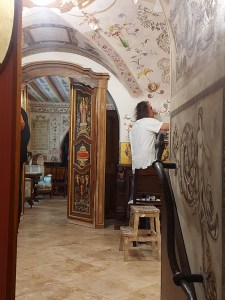
He commissioned Renaissance style frescos and sourced antiques, clocks and ornaments that portray the history of Bratislava.
When we first entered the confectionary we both assumed it had originally been a church or museum. We learnt, however, that although the building dates back to the 18th century, its uses were commercial or residential.
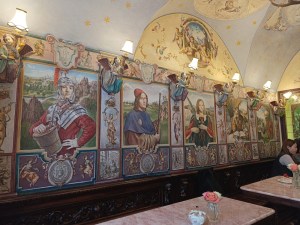
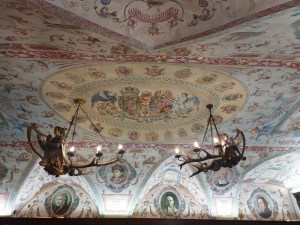
The colourful frescos in one room illustrate saints, including a painting of the city’s Saint Elizabeth (mentioned earlier) and also Empress Maria Theresa (Habsburg Monarchy). In another room, the spectacular artwork shows famous people from the area.
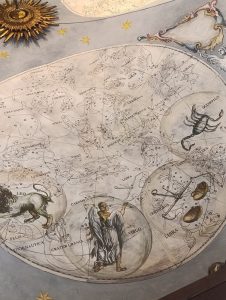
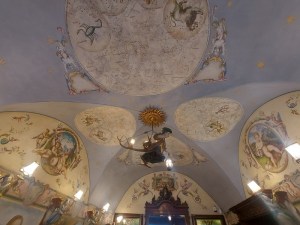
Scenes of constellations, celestial bodies and zodiac signs decorate the ceiling. Apparently they are intended to represent the link between time, destiny and human life.
All the artwork has been completed by skilled contemporary artists. The café opened in 2017.
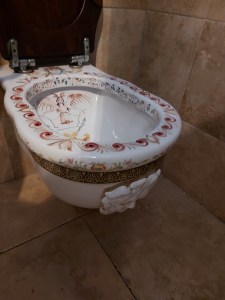
When I was doing research, I came across a recommendation advising that the downstairs of the building where the restrooms are situated was not to be missed. So, off I went down stairs to have a peak! The stairwell had an interesting stained glass window.
The bathroom fittings, have also been sourced with great care.
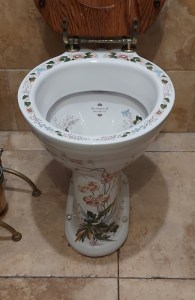
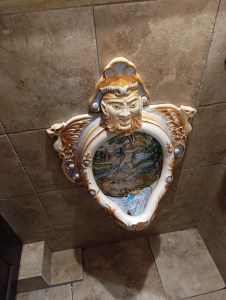
Back upstairs, a large and extremely tempting array of cakes were in the display cabinet. All of the confectionary is created from traditional Austro-Hungarian recipes.
The drinks and cakes are served in hand painted gold rimmed glasses and on fine porcelain china.
Another room is currently being decorated, they are hoping that it will be completed before Christmas. The remainder of the property will remain private.
While we were in the café, we chatted for a while with a couple who told us that they were going to a ‘Butterfly House’ which they said was just a few streets away.
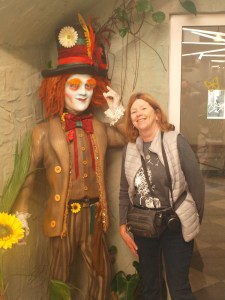
The place is named Papilonia and it is a tropical oasis for butterflies. It took us by surprise that such a place existed in a capital’s historic city. The theme is Alice in Wonderland and large models of some of the fantasy’s characters are dotted around the setting. These include the Mad Hatter, the White Rabbit, the Caterpillar and of course Alice.
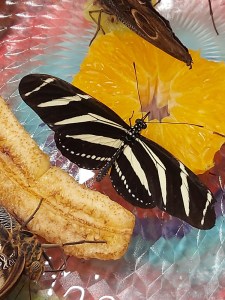
Large colourful painted imitations of ‘Wonderlands’ flowers are used to place food on, many butterflies settle on the flowers. The butterflies prefer fruit that is over ripe.
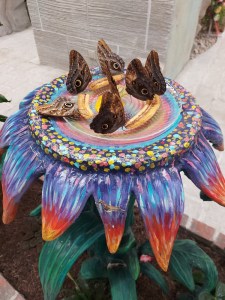
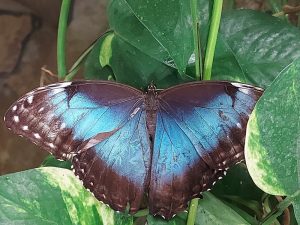
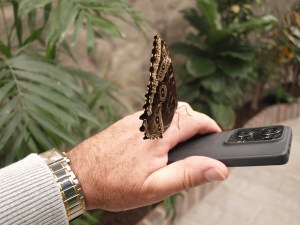
There are scores of butterflies flying around. One of them landed on Dave’s hand and we spotted a few settled on the effigies. You have to take care where you step as many are resting on the ground. There is a hatchery and posters give various information about the lives of the butterflies.
The colourful lepidopterans are from tropical forests around the world. Their life span is just 2-4 weeks. We noticed tears on some of their wings, apparently this is a sign of aging; flying also makes the wings tear.
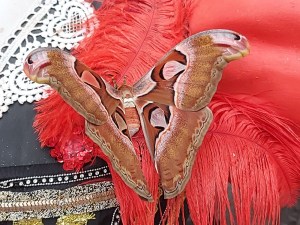
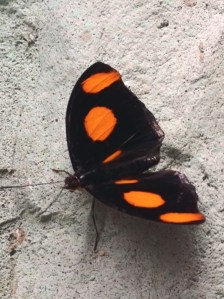
We spotted a large ‘butterfly’ on one of the whimsical ‘Wonderland Models’. However, later I learnt that it is actually a moth.
It is one of the largest in the world with a wingspan measuring up to 24cm.
The moth is endemic to Asia, and it is cultivated for its silk.
There were one or two seating areas where you could order a drink and just enjoy the butterflies fluttering around. Piped soothing birdsong played in the background. It was indeed a relaxing experience.
Next, we walked the short distance to the Primate Palace which is the residence of the city’s Lord Mayor. This palace has nothing to do with apes or monkeys!
It is so called as it was constructed to be both home and workplace to the Primate of the Kingdom of Hungary in the 18th century. Primate is the title given to the highest ranking bishop or archbishop of the area.
Yesterday, we had wandered in to its courtyard which remains open all the time and is regularly used as a short cut for many commuters and tourists.
For a small fee, you can visit many of the rooms including the Hall of Mirrors which was highly recommended. Apparently various concerts take place in the hall. However, we weren’t impressed. Perhaps, when a performance takes place, it is enhanced by the mirrors.
From one of the rooms, you can look down into a private chapel but no access is permitted.
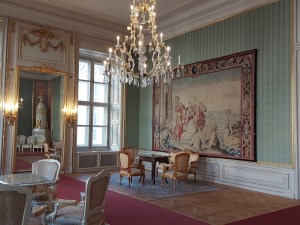
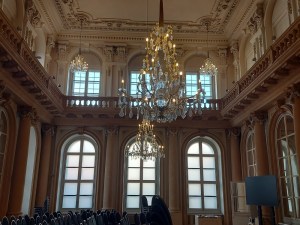
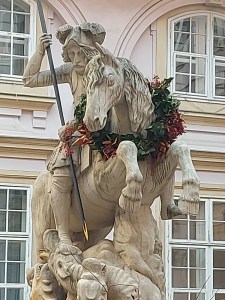
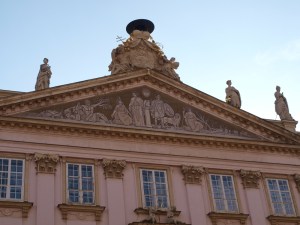
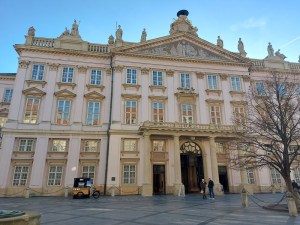
For Dave and I, the exterior of the building and the statues in the courtyard are far more spectacular than the interior.
For our lunch today, we sat in an underground bar. It was similar to a bierkeller and even though there were only a few people in, it had a good atmosphere.
I chose the Slovakian National Dish named Bryndzové Haluŝky. It is a delicious comforting and warming meal; probably full of calories too! It consists of potato dumplings with sheep’s cheese, topped with bacon and spring onions. As Dave chose a non-traditional dish, it doesn’t warrant a mention!
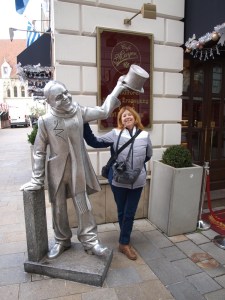
Sauntering through the streets of the old town, we came across another of the capital’s quirky statues. A life size sculpture of a local character named Schóne Náci. However, ‘Handsome Iggy’ is the name that the people in the neighbourhood gave this much loved character.
Ignác Lamár was his real name; in the German language Schóne translates to handsome and Náci is a shortened version of his Christian name. So the man who, in his spare time strolled the streets of Bratislava wearing a stylish suit and greeting people by a tip of his hat and a smile, affectionately became known as Schóne Náci. In English, the name would translate to Handsome Iggy.
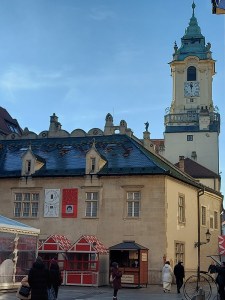
Below the town hall, preparations for the Christmas market were well under way. The small wooden huts had been erected and electricians were wheeling huge coils of cable around the square. Unfortunately, we leave the city just before the Christmas market opens.
On our way to the bus station to secure tickets for tomorrow’s day trip, we stopped at St. Elizabeth’s Church which is more often called ‘The Blue Church’ for obvious reasons.
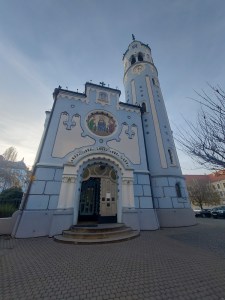
The church’s architecture is ’Hungarian Secessionist’ which is an eclectic art nouveau design.
The church is dedicated to St. Elizabeth. Apparently it has rather limited opening hours. However, it’s outer doors were open when we visited allowing us and others to peer into the interior to the blue pews.
Our evening meal was in a small restaurant decorated with paintings of some of the city’s historic architecture. The manager chatted to us about the Austro Hungarian Empire as it was. He mentioned Lviv (Ukraine), which reminded us of our visit there in December 2021. This was just a couple of months before Ukraine was invaded by Russia.
Both Bratislava and Lviv were part of the Austro Hungarian Empire until its dissolution after the end of World War I.
Dave and I shared a tasty salad of caramelized pear, goats cheese, chopped chunks of cucumber, cherry tomatoes, lettuce and walnuts, followed by a huge plate of mouth-watering Hungarian Goulash served with bread dumplings.


