Wednesday 29th March 2023
Khiva – Itchan Kala (Inner City): Kalta Minor Minaret: Kuhna Ark: Juma Mosque: Tash Khauli Palace: Allakuli Khan Madrassa: Mausoleum of Sayid Allauddin: Pahlavan Mahmoud Mausoleum:
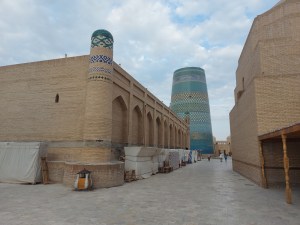
Khiva is the only fully renovated ancient city on the Silk Road. The UNESCO site is often referred to as an open air museum.
Dave and I woke early, and before breakfast, eager to see the Itchan Kala we went for a short walk. The streets were deserted.
The stalls that we would see open later, selling a variety of items, souvenirs, soft drinks etc were still covered up.
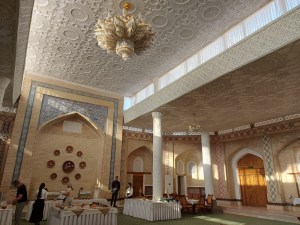
Breakfast was served in another madrassa just a few steps away from our hotel.
The restored room that now served as a restaurant has been decorated with superb ganch carvings.
The ganch decor is one of the oldest forms of Uzbekistan architectural and decorative art and can be seen in many interiors and exteriors.
There was also a large impressive chandelier that Anne said she would like to wash to make all the crystals sparkle. Well, I would leave that up to her, I was going exploring!
Dave and I went out of the inner city to purchase a day ticket to visit all the sites within the Itchan Kala. The ticket covered entrance to the majority of the buildings, there were just two or three where we had to pay a small additional fee.
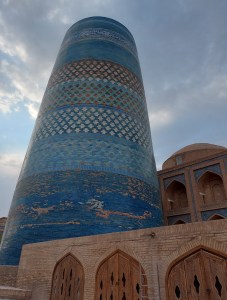
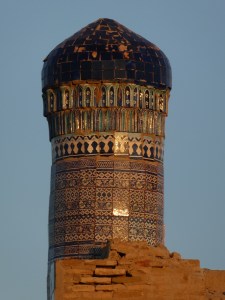
The landmark minaret named Kalta Minor is directly outside the hotel. The word kalta means short. This minaret was originally intended to be seventy metres high and would have been the tallest in Central Asia.
Sadly, its construction was brought to an abrupt halt in 1855 with the death of Mohammed Amin Khan, its patron and the ruler of Khiva.
The beautiful minaret decorated with glazed tiles and majolica tiles (tin glazed) stands at a height of just twenty metres.
Many years ago, when the ancient city was part of the silk route, the people of Khiva traded in carpets, coffee, tea and concubines.
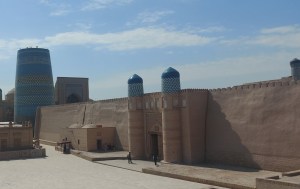
The majority of the ancient city’s mosques, minarets and madrassas have been beautifully restored. The Kuhna Ark was both fortress and palace to the rulers of Khiva. Originally built in the 12th century, it was expanded in the 17th century.
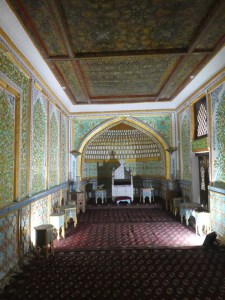
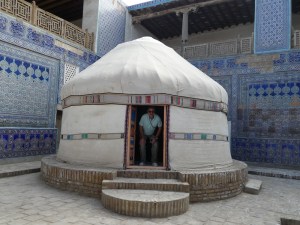
Its interior includes a summer mosque, decorated with blue and white plant motif tiles, and an interior and an exterior throne room. A royal yurt stands on a circular platform in the outdoor throne room. Although the Khans no longer lived nomadic lives, they still preferred to use a yurt in the winter months.
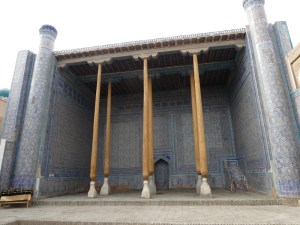
Juma Mosque (Friday Mosque) is just a short walk away from the Ark. In fact the Itchan Kala is easily walkable. Everything is just a few minutes’ walk from our hotel and there are places to get coffee or snacks as well as restaurants for a more substantial meal.
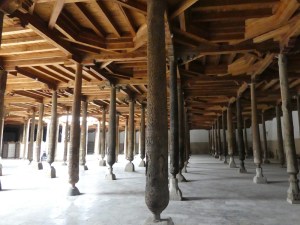
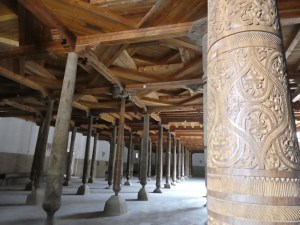
This mosque is situated in the centre of the Itchan Kala, on the road that leads from the West Gate to the East Gate. Its interior is a stark contrast to the blue and white tiled interiors. It has over two hundred individually carved wooden pillars and it is an incredible sight to see.
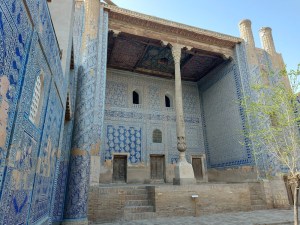
Tash Khauli Palace (this has many alternative spellings, as do many of the buildings and places in Uzbekistan ) was built in the 19th century in just eight years. Apparently the Khan had stipulated that it had to be completed in three years. When the architect stated that it would be an impossible task, he was impaled and another architect was appointed.
The palace originally had over 160 rooms and a harem. A secret corridor for the sole use of the Khan led from his quarters to the harem.
As in the Kuhna Ark, there is a circular platform where a yurt could be pitched.
The Khorezn Art Restaurant is located at the gateway to the Allakuli Khan Madrassa. Noticing the menu outside, we stopped to browse it, as we were doing so the female owner joined us and we chatted for a while.
Some years ago she had married her French husband in the now crumbling, but still beautiful madrassa. She has returned to her home city for a while to open the restaurant and to assist poorer women in Khiva to find work.

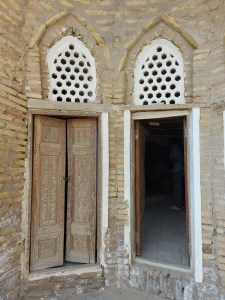
The madrassa is currently closed for renovation; however, the kind lady took her big bunch of keys and opened the huge wooden doors. After telling us to take our time, she closed the doors behind us.
How lucky were we! It was fabulous to be in the deserted madrassa alone; we walked around and looked into some of the tiny cells, once home or classroom to students. Pigeon poop was everywhere. Some of the tiles were falling off, and the wooden doors needed attention.
There was no sign of any renovation work taking place and we wondered how long it would be before the building was restored and open once more.
As we left the madrassa, a group of Uzbeks were taking selfies outside and the lady told us that tourism for locals within the country was currently being promoted. We thanked her for her kindness and booked a table for dinner.
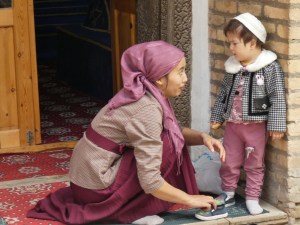
Covering my head and removing my shoes, I popped inside a small mausoleum.
Thick blue velvet fabric covered two tombs. A mother and child sat on the floor. An Imam sat reciting.
The local people were very friendly to us, acknowledging us in whatever way they could. Sometimes it was a nod of a head, a wave or a smile. Often it was the standard Islamic World greeting, “As salaam alaikum” meaning, peace be unto you. Our response “Wai alaikum as salam” meaning, and upon you be peace.
The Mausoleum of Sayid Allauddin is believed to be the oldest building in Khiva. It has a simple brick façade and its interior has plain white walls. An impressive blue and green tiled casket stands behind wooden railings.
While I was there a middle aged woman arrived with her smartly dressed son who I guessed was around the age of seven. After introductions to the Imam had been made, they then seated themselves on the floor and the Imam started to recite prayers.
The ticket lady (there was a nominal additional charge at this site) sat down too, closing her eyes and resting her palms in an open position.
A little distance away, I too sat on the floor. I was about to cross my legs when something rang a bell and after a surreptitious glance at the other folk, who were kneeling or sat with feet pointing behind, I did the same. When seated in an Islamic religious building, the feet should always be pointing away from the Mihrab.
Sayid Allauddin was a famous Sufi and thousands of pilgrims visit his mausoleum.
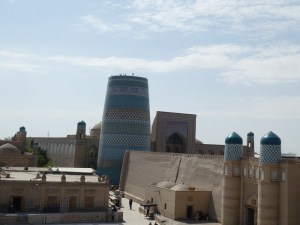
Dave and I had lunch on the balcony of the Terassa Café & Restaurant which is situated within the Itchan Kala.
The balcony overlooked our hotel, the Kalta Minor and the Kuhna Ark. Wow, what a magnificent view!
Our lunch was tasty; we ordered a green salad with beef, and a dish of plov.

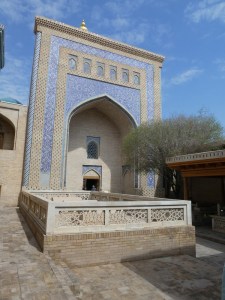
As we walked through the gravestones at the rear of the Pahlavan Mahmoud Mausoleum, we stopped to gaze at its imposing dome.
Pahlavan Mahmoud became the patron saint of Khiva and this architectural gem of a mausoleum holds his tomb. He died early in the 14th century.
Centuries later, the mausoleum dedicated to him was constructed. The generous and compassionate man was a famous wrestler, a philosopher and a poet.
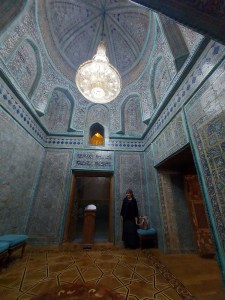
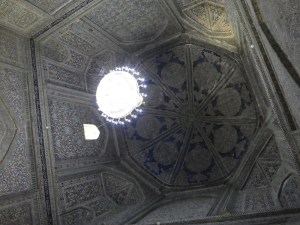
The interior of this magnificent mausoleum is breathtaking – so much skill, so much patience!
Photographs are not allowed of the actual tomb. A list of rules that must be adhered to were at the entrance to the building.
Before we travelled to this wonderful country, eager to learn more, I read the book ‘A Carpet Ride to Khiva”. The author, Chris Alexander spent seven years in Khiva.
He founded a silk carpet and suzani (embroidery) workshop with the support of UNESCO and Operation Mercy (a Swedish humanitarian organisation). His book tells of natural dyes being used, 15th century patterns and traditional skills.
So, of course we had to visit the workshop. It was fascinating to see the samples of some of the products that are used for dyeing the carpets. They include onion skins, indigo, pomegranate, alum, madder root and zok.
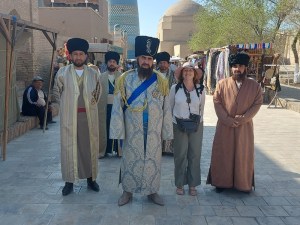
As we were walking back to the hotel, we saw some guys dressed up. They looked extremely serious but I approached one of them and asked if they worked in Khiva. He attempted to repeat what I said, mimicking me.
I saw one of the friendly tourist police that we had chatted to earlier and he informed us that they were actors dressed up as ancient leaders and ministers.
I asked if we could take a photograph, “Of course” was his reply and here it is…
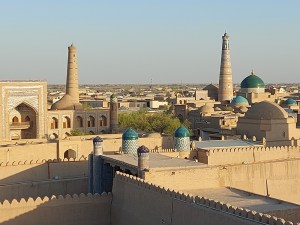
The watchtower at the Kuhna Ark was apparently the place to be for sunset. So the four of us went early to enjoy the spectacular views of Khiva. It was lucky that we did go early as quite a while before sunset; we were informed that the building was closing and we therefore had to vacate the premises.
The four of us swapped tales of our day while eating a lovely meal at the Khorezn Art Restaurant, our dishes this evening included beetroot and apple salad and green noodles (infused with dill) served with meat and vegetables.

 lindaruddstravels.com