Thursday 2nd December 2021
Krakow – Kazimierz District : Father Bernatek’s Bridge : Ghetto Heroes Square : Wieliczka Salt Mine : Rynek Glówny : Christmas Market : The Cloth Hall
After a pleasant breakfast in the adjacent posh hotel and just before setting off, we had a quick nosey at each other’s rooms. Whilst our room was more than adequate, Anne & Pete’s had traditional antique wooden carved furniture and was considerably larger than ours. I think they got the wrong key!
The temperature was 8 degree Celsius; we had been expecting minus figures. “Quite balmy” Dave commented, “A little fresh” I thought, tucking my scarf more snugly around my neck.
Chatting away on one of the city’s many trams, we missed our stop. “Lost already”, we laughed and walked back a few hundred metres to the first instruction on the walk that Pete had created. Soon we were in the Jewish Quarter known as Kazimierz; once upon a time this was a small city where Jews and Poles lived together happily for centuries.
Starting our visit at the aptly named ‘Once Upon a Time in Kazimierz’ (Dawno Temu Na Kazimierzu) restaurant, we stood and gazed at the fake building facades. The owner of the restaurant had recreated the frontages of the general store, the tailor’s, carpenter’s workshop and the grocery as they were pre world war II.
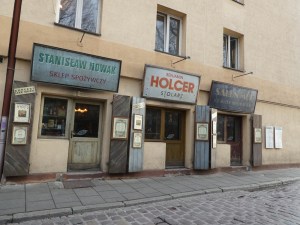
Its interior has no walls separating the faux shops.
There is simply one large room which holds a mish mash of items that would have been found in the original buildings.
These items include a Singer sewing machine table with treadle and the carpenter’s tools.

After peeking through the windows and noticing a ‘Star of David’ symbol on the old wood stove, Anne & I tentatively opened the door of the closed restaurant.
I asked the lady working there if we could take a photograph. She nodded in agreement.
A few steps from the restaurant is a bench dedicated to Jan Karski. This Polish soldier was a member of the resistance.
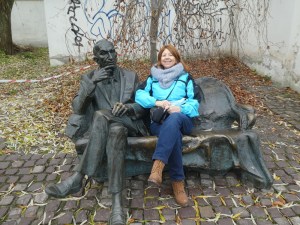
After a spell in a Russian camp, he was later detained in a German prisoner of war camp from which he escaped.
Jan bravely risked his life to take firsthand accounts of the Shah (holocaust) to the Polish government in exile and to allied leaders.
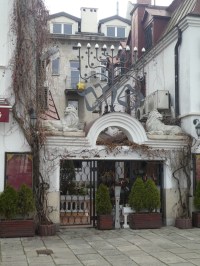
It was still too early to visit the Ramah Synagogue, so we continued wandering around the area known as the Jewish Square with its many edifices. One restaurant had a huge menorah above its entrance; some of the buildings had Star of David emblems carved into their stonework. Impressive art work adorns some of the buildings in the area, many of them symbolising a poignant event.
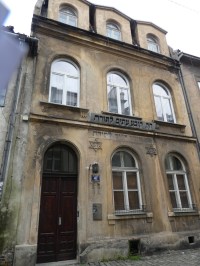
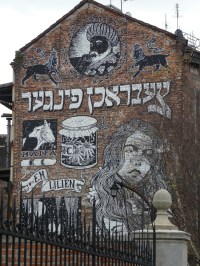
The Old Synagogue situated in the Jewish Square was erected in the 15th century and is the oldest synagogue in Poland. It now serves as a museum.
All of us found it interesting. I read about the small black cubes that some Jewish men wear during prayer. Known as ‘Tefillins’, they contain tiny scrolls with verses from the Torah. They are worn either on the forehead or the arm.
I also learnt about the ritual at the end of the Sabbath Day. It is believed that a second soul enters the body at the beginning of the Sabbath. Therefore, there is a ritual to strengthen the body as the Sabbath comes to an end and the second soul departs the body.
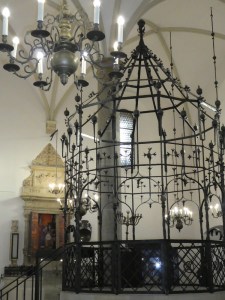
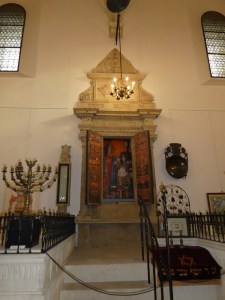
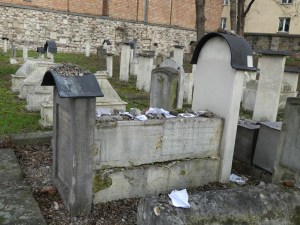
Returning to the Remuh Synagogue, we paid the small entrance charge and firstly walked around its graveyard. Some of the graves had pebbles on top of them and this reminded us of the final scene in the film ‘Schindler’s List’ where mourners left pebbles on the grave.
There appears to be a various theories as to why this is done. One such theory is that a pebble is more permanent than a flower (we did not see any flowers in the cemetery). Another is that a leaving a pebble represents a prayer being said, asking God to care for the departed’s soul.
A few of the graves also had handwritten and typed notes and letters on them.

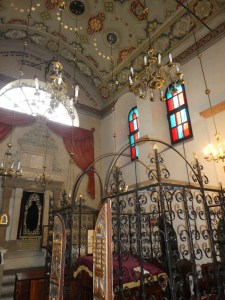
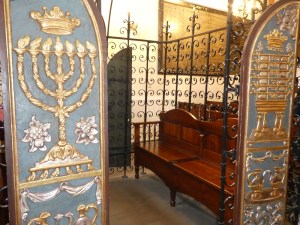
The synagogue is referred to as the ‘New Synagogue’. Its interior is beautiful.
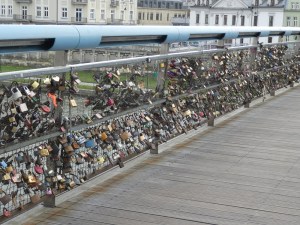
After a warming coffee at one of the many interesting looking cafes in the area we continued to Father Bernatek’s Bridge.
The footbridge connects the two districts of Kazmierz and Podgórze above the River Vistula.
The bridge has thousands of padlocks attached to its railings. Couples fasten a padlock and then throw the key into the river below to signify their undying love.
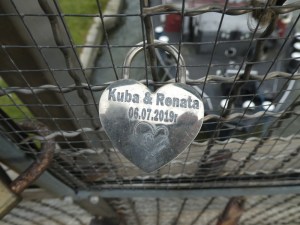
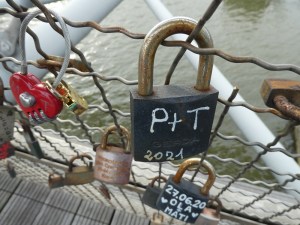
The padlocks range from bespoke, heart shaped and beautifully engraved to basic locks with initials scribbled in marker pen or even crudely scratched on.

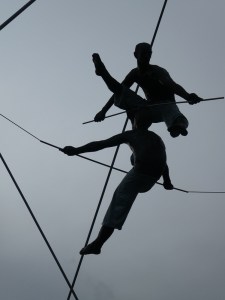
Since 2016 sculptures of acrobats by a contemporary Polish sculptor have been balancing precariously and swaying in the breeze above Father Bernatek’s Bridge. The display was planned to be temporary but due to a public campaign to keep them, all but three remain. I’m glad they do!
Our next stop was the Ghetto Heroes Square. This poignant and thought provoking square is in the district named Podgórze. The area was used as the ghetto; all the Jews from the neighbouring area of Kazmierz were forced to move into the ghetto. This square formerly known as Zgody Square was where the Nazi’s assembled the Jews for deportation to either Auschwitz or Plaszow.
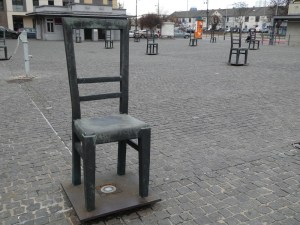
Today, seventy empty chairs stand in the square to commemorate the people that set off from here on their final journeys. The place sent a shiver through all of us.
It is just a few minutes walk from here to Oskar Schindler’s Enamel Factory, the final stop on Pete’s walk.
However, due to a ticket reservation we had made at the Wieliczka Salt mine, it was time to grab a quick lunch before heading there.
Our lunch was warming bowls of soup. ‘Sour soup with sausage and potato’, it was tasty enough but unfortunately bread was not available.
After lunch we took a tram and then a bus travelling with many commuters to the small town of Wieliczka. The small town is the home to the 13th century salt mine that was a ‘must see’ on our list.
When doing our research we had learned that the mine could be extremely busy so we had booked our tour.
The rather stern looking female guide introduced herself and after giving us some health and safety instructions proceeded briskly, leading us into the mine.
As you can imagine there were hundreds of steps to climb down. Our guide was very informative, advising us how the salt preserved the wood and pointing out a wooden cross from the 17th century in one of the small chapels.
She also had a rather dry sense of humour warning us to mind our heads, then adding that they didn’t really care about our heads but they did care about their salt mine.
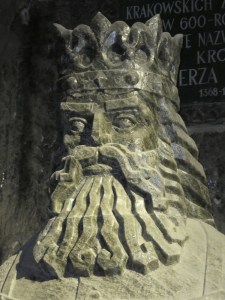
One of the first underground chambers we entered had a sculpture of King Kasimir III the Great. Kasimir was the only Polish king to be honoured with the title ‘the Great’. The mine’s amazing sculptures are hand chiselled from rock salt.
Rock salt was produced in the mine from 13th century to the 20th century. The UNESCO World Heritage Site is now a huge tourist attraction. There are 250 kilometres of tunnels in the mines on nine different levels. Our visit included just 1% of the chambers and tunnels and took us to a depth of 135 metres.
The guide said that we were permitted to lick the salt walls “It’s safe, salt is an antiseptic” she added. The whole group declined her invitation, not really surprising being in the middle of the corona virus pandemic! However, one chap did take her up on her invitation to taste some brine from a small well.
The wow factor without a shadow of a doubt was the incredible St. Kinga’s Chapel, which we first viewed from the balcony situated at the top of a flight of stairs made from rock salt.
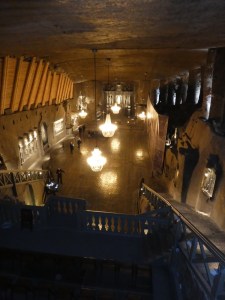
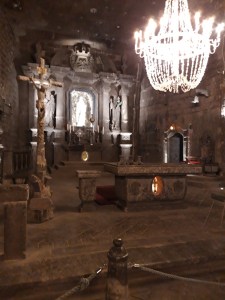


Saint Kinga was the daughter of a Hungarian king and became the patron saint of miners.
It is difficult to comprehend that every single item in this chapel is painstakingly carved out of rock salt – the ‘crystal’ chandeliers, the depiction of the ‘Lord’s Supper’, the cross, the altar…everything!
Within the salt iconostasis, huge salt crystals surround a salt sculpture of Mary. At the other end of the Saint Kinga’s Chapel is a carved effigy of Pope John Paul II. It is the only salt sculpture of the Polish pope in the world.
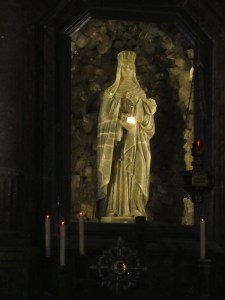

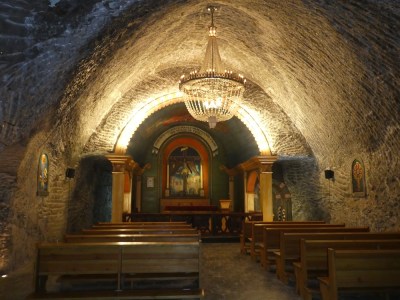
Our guide informed us that it was quite a walk to where we would then take a lift back up to the surface. It was amazing to see and to touch the salt surfaces, the various textures and different shades of colours in the strata. As we were walking back through the many tunnels and chambers, I stopped to take a quick photo of another beautiful chapel carved into the salt mine.
Exiting the mine onto a different street, it took us quite a while to get our bearings. Of course, it didn’t help as it was now dark.
The town of Wieliczka looked pretty with its various Christmas decorations. It would have been interesting to explore a little more but time was moving on and it had been a long day. It was time to make the 14 km journey back to Krakow.
Eventually, we found the railway station but after learning that the next train to Krakow wasn’t for an hour, we decided to go for the bus.
It was a long and slow journey as the bus came to a halt at every possible stop. Rush hour traffic was, as it is in most places, extremely slow.
During the journey, we agreed to continue to the Christmas market, have a wander and to perhaps eat at some of the food stalls. So, after making a quick 5 minute stop at the hotel (for Pete to change into more comfortable shoes) we continued to the Barbican, through St. Florian’s Gate and into the old town.
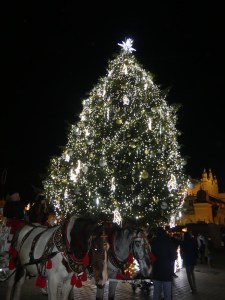
Rynek Glówny is the name of the square in the centre of the city’s old town. It is the largest medieval square in Europe.
The Christmas market was situated below the imposing St Mary’s Church and looked very colourful and festive.
There was a beautiful and brightly illuminated Christmas tree. We knew that restrictions had been placed on the number of vendors at the popular annual event due to the pandemic. Therefore, we were a little surprised to see the wooden stalls altogether at one end of the square.
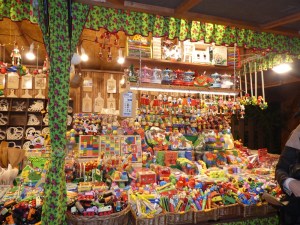
There was a big variety of products for sale, many of which were hand crafted.
One stall was full of children’s wooden toys, another with glittering and shiny Christmas trinkets.
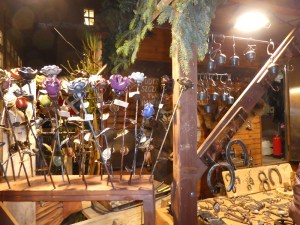
One stall that particularly caught my eye was a blacksmiths.
Two craftsmen were working at their anvils with hammers and tongs.
They were producing various items of metal work including ornamental horseshoes and intricate metal roses which were then dipped in different dyes.
It wasn’t a stall that I would have expected to see but it was fascinating watching the blacksmiths work. Having said that, I didn’t linger too long, our stomachs were all rumbling and we needed sustenance.
Dave got himself a big cardboard beaker of soup (he had a choice of 12 flavours) to warm him as we wandered around the food stalls. The rest of us were warming our hands (and insides) on beakers full of seasonal mulled wine. The enticing smells led us to one food stall, another tantalising aroma to another.
There was a huge choice – freshly cooked dumplings with various tasty fillings, meat stalls with kebabs, sausages, black pudding, chicken, pork knuckles.
Hot potatoes, (cooked in various different ways) and vegetables were on display. I spotted a big queue forming for huge sandwiches in great chunks of bread dripping with sauce. The list was endless.
There were also lots of chocolate delights and other sugary products for the sweet toothed too.
All of us wandered through the ‘Cloth Hall’ nibbling away at our purchases. The historical hall sold mainly souvenirs and amber jewellery, the stalls seemingly repeating their wares all the way through the long building.
The ‘Cloth Hall’ was once the world’s largest shopping centre. Originally built in the 13th century it has been renovated and upgraded many times.
Eating more food, we stood watching the comings and goings for a while before deciding to return to the hotel for the remainder of the evening.
As often happens, when the four of us are together, the guys ended up walking a little ahead of us with Anne and I chatting a few steps behind. A young woman approached the guys and started talking to them.
I heard Dave say “No thanks” and Pete said “I don’t think our wives would be too pleased.” “Hello”, I said to the long dark haired heavily made up woman. “Oh hello” she replied as she quickly tottered away in her high heeled boots.
Apparently, she had been asking our guys if they would like to visit a bar named ‘Kandyland’ where they would find lots of pretty girls!
Breakfast had been at 8am and we returned to our hotel a little after 8pm after a fabulous day. We have seen so much and it is only our first day of sightseeing!
Previous Next

 lindaruddstravels.com