Friday 3rd January 2025
Swayambhunath Stupa : Durbar Square : Thamel District : Pashupatinath Temple : Bodhnath Stupa
This morning was another early start; it was just 8am when we departed from the hotel. Our guides are trying their best to fit everything in for us. Our first stop today is the Swayambhunath Stupa, which we should have visited on our first day.
People from both the Buddhist and Hindu faith worship at this religious site. In Hinduism, Buddha is an incarnation of Vishnu.
The Tibetan Temple is more often referred to as ‘The Monkey Temple’, due to the many monkeys that live on the holy site.
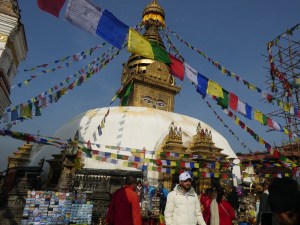


I walked the kora, (circumambulation) twice, spinning the brass prayer wheels, and then I explored the rest of the revered site.
A Tibetan monk, dressed in burgundy robes, sat on the floor, playing a tape with Buddhist Sutras. A donation box stood close by. I videoed him and also took a photograph. As I bent to put a donation in the box, he placed a black cord around my neck and said that it would protect me.
I entered a stone temple that had a row of stone carved Buddha figures. A lady entered and asked if I wanted a tikka, I nodded and she quickly applied the red mark to my forehead.
Our next stop was Kathmandu’s famous Durbar Square. The area is full of temples, royal architecture and ancient monuments. Some of the buildings were damaged during the 2015 earthquake. Therefore, a few have been reconstructed or are in the midst of some degree of renovation.
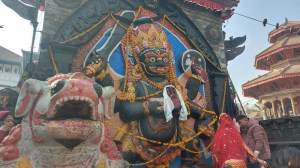
A colourful shrine of Kala (or Kaal) Bhairab drew many devotees, including a young couple soon to be married paying their respects.
The god is Shiva in his most fearsome manifestation.
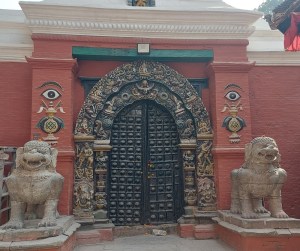
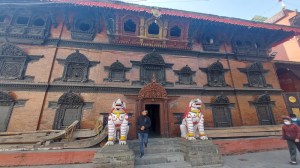
The richly embellished portal guarded by two white stone lions is the entrance to the Taleju Temple.
It is considered to be one of the oldest temples in Durbar Square and it is open just one day annually for a specific festival.
The square had vendors wandering around attempting to sell their wares, together with small shops and a large open area with locals selling everything from teas to statues of gods and goddesses and jewellery.

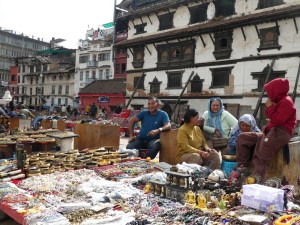
Sudan walked us through courtyards and palaces, pointed out carved stone erotic scenes on temples and answered our many queries.
Suddenly he said “Ok, it is time to go” and we followed him to see the most revered resident of Kathmandu’s Durbar Square –the Kumari.
The Kumari is a living goddess who lives in a palace named the Kumari Ghar. She appears at one of the palace’s windows for one or two minutes several times between the hours of 11am and 12pm most days.
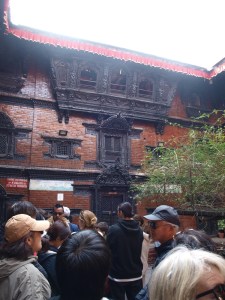
Sudan led us to a square courtyard within the palace and showed us from which window the Kumari would appear. It is strictly prohibited to take a photograph of the living goddess. A man walks around a platform checking the crowd, if anyone has a camera or a phone in their hands, he instructs them to put it away.
A lady then appears at one of the windows and searches the crowd again for anyone with a camera or phone. The man instructs everyone to put their hands together in the ‘Namaste’ pose to show respect. The Kumari appeared, everyone said “Namaste”, and after a minute or so she moved away from the window.
The young girl is not allowed to smile or respond to us. Postcards of the Kumari were for sale outside the palace.
Trishna Shakya became the current Kumari in 2017 when she was just three years old. The Kumari is chosen by a process of elimination involving various tasks including spending a night alone with the heads of slaughted goats. The young girl must also have 32 perfections including ‘eyelashes like a cow’.
She leaves the palace just 13 times a year for various festivals. Her family are permitted to visit her at the palace and she has tutors to educate her.
The Kumari is believed to be the living embodiment of the Hindu deity Taleju. The word ‘Kumari’ is Sanskrit and translates as ‘Princess’. The Kumari ceases to be the living goddess when she starts to menstruate, she then returns to her family and another Kumari is selected.
After a quick coffee, we all climbed into rickshaws for the 20 minute ride to the Thamel District which is the biggest tourist area in the bustling city.


The rickshaw ride was great fun, we had ourselves a convoy! In the Thamel District we had some free time to wander around.
Pashupatinath Temple and cremation site was our next stop. The site is greatly revered by Hindus. However, anyone can be cremated here.
The temple is dedicated to Shiva in his most peaceful form as Pashupati. Pashu means ‘living beings’ and Pati translates as ‘Lord or Shepherd’ so it could be translated as lord or shepherd of the beasts.
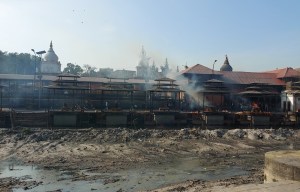
The pyres for the deceased can be seen across the sacred Bagmati River. This river flows into the Ganges.
We saw a body arrive swaddled in an orange wrap, which was removed and shredded. Underneath the wrap is a white shroud, the family circumnavigates the body before the pyre is lit.
It was a sad and an emotional experience. Unfortunately, while we were there, the level of the river was very low and there was only a trickle of water flowing.
Ashes were piled high in the centre of the river along with garbage and pigeons.
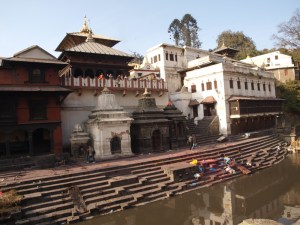
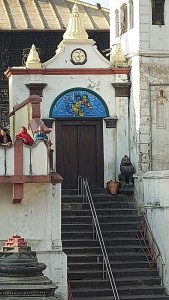
Only royalty can be cremated in front of the temple. Nine members of the Nepalese Royal Family were cremated here in June 2001 after they were massacred.
Sudan told us that we would probably see some sadhus at the religious site. He said that we could take photographs with them but we would have to pay them. That seems fair enough!
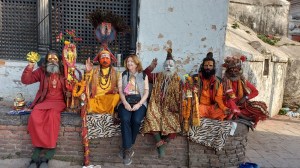
The holy ascetics have renounced their daily lives and endeavour to liberate themselves from the constant cycle of death and rebirth by adhering to a strict spiritual path.
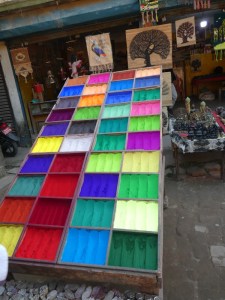
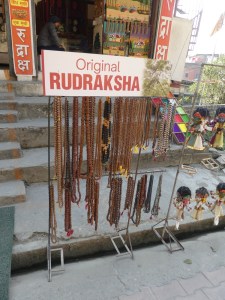
As at many of the larger temples, there are shops and stalls selling souvenirs, religious items and other products at its entrance/exit.
The colourful dyes and the Rudraksha beads caught my eye.
Rudraksha beads are the dried fruit of a tree; they can be used as prayer beads for both Buddhists and Hindus. However, many people of all religions and indeed atheists wear them as they are believed to remove negative energy, improve sleep and cure various ailments.
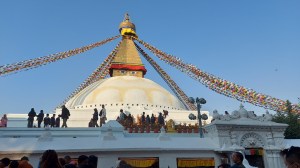
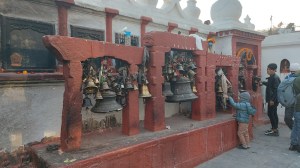
Our final stop of the day is the Bodhnath Stupa, considered to be one of the largest stupas in the world. The area surrounding the stupa is where the majority of the Tibetan refugees have made their home.
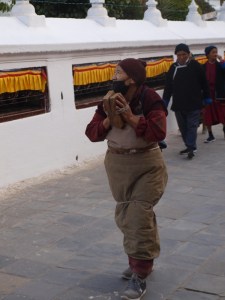
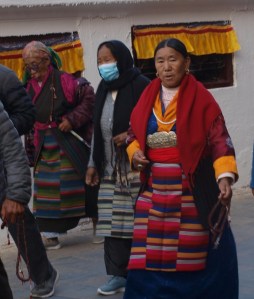
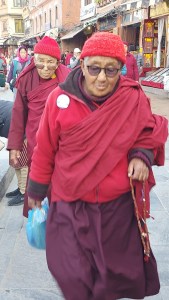
For the second time today I became rather emotional, the faith of these exiles has no bounds. I watched the faithful walking the kora, some were spinning the prayer wheels, and many were carrying prayer beads.
A tall elderly female wearing a protective apron and holding wooden blocks was prostrating around the stupa. A much younger woman was doing the same.
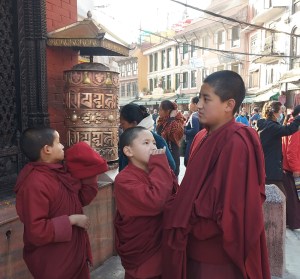
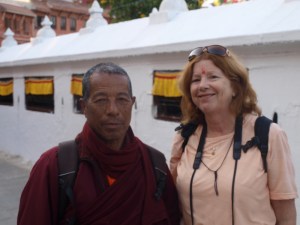
There were many monks circumambulating the huge stupa, a couple of them resembled the Dalai Lama. Young trainee monks were gathered together.
When someone of the Buddhist faith passes away, a monk decides what type of funeral the person will have. It may be a cremation or a burial. It is only in Mustang, in the foothills of the Himalayas that sky burials take place in Nepal.
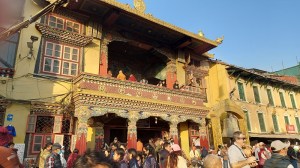
The above monastery also known as the Tamang Gumba faces the grand stupa. Unfortunately, we didn’t have time to visit it.
Originally, Melina had told us we had a certain amount of free time, she suggested that we explore the stupa etc and then perhaps go upstairs in one of the cafes and admire the view. However, one or two of the group requested that the time be shorter.
Obviously, this is one of the pitfalls if one chooses to travel with a group. With hindsight, Dave and I should have stayed and enjoyed seeing more of the site and returned to the hotel by taxi.
On the bus back to the hotel, Melina announced that tomorrow, the programme would start at 9am. Cheers went up; everyone could have a lie in!
It was 6pm when we arrived back at the hotel and it has been another fully packed wonderful day!

 lindaruddstravels.com