
Monday 30th December 2024
Budhi Rapti River : Elephant Breeding Centre : Tharu village: River Rapti : Jungle Jeep Safari : Crocodile Breeding Centre : Tharu Dancing Performance
After a good night’s rest, we were all ready to finally start our itinerary and to do some sightseeing.
At breakfast when I saw the restaurant manager, I pointed at the cereals and asked if they were spicy. “Why, no Ma’am” he answered with a rather serious facial expression until I laughed, he then of course realised that I was joking and he laughed too.
The transport today was a minibus and an open backed jeep. The younger ones happily jumped into the jeep and we were on our way just after 8.30am.
The four of us have already worked out that we are the oldest in the group. There are a few families with their young adult offspring, a couple with their son, Marko, who at 12 years old is the youngest in our group (and great company!). A trio of young ladies are travelling together. It seems a good group and we are slowly getting to know each other.
It was just a short drive to the national park, where we walked down to the Budhi Rapti River. This river flows into the Ganges in India. Dugout canoes were waiting for us. Each canoe had around ten tiny wooden chairs at one side.
So, the first person had to walk down the middle of the canoe, take a chair, place it in the middle (facing the front of the boat) and sit on it and so on and so forth until the vessel was full. One obviously had to keep their balance and proceed slowly, we had a few wobbles and lots of laughs!
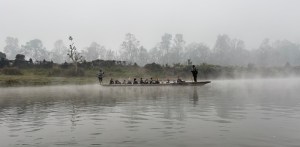
It was a misty morning and the mist seemed to cling to the river which gave an eerie atmosphere, especially when we were warned to keep our hands (and other body parts!) inside the boat.
Then we saw the first pair of crocodile eyes peering at us. There are two types of crocodile in Nepal, the gharial which has a long narrow snout. This reptile eats only fish and is in danger of extinction. There are around 200 in Nepal.
The other more well known crocodile (the mugger or marsh crocodile) has a much broader snout and eats more or less anything. Its diet includes fish, monkeys, rodents, turtles, dogs and the occasional human, so my hands are going nowhere near the river!

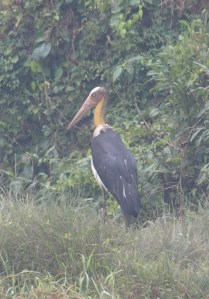
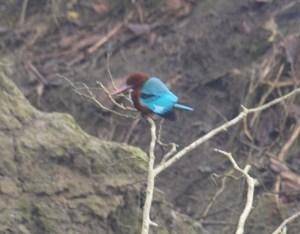
Dave spotted a few kingfishers perched in the trees, other bird life were also seen including Siberian ducks, peacocks and a marabou stork. Deer were seen hiding in the greenery and I’m quite sure there was more wildlife watching us!
There were as many laughs and wobbles getting out of the dugout canoes as there were getting in them!
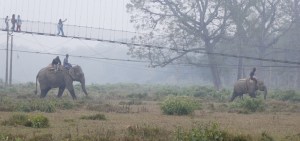
Walking to a nearby Elephant Breeding Centre, we saw a couple of large elephants with their mahouts. They were moving quite quickly.
As there are only around 250 elephants in Nepal, the Breeding Centre is an important place. Two female elephants were nursing their six month old babies. The mothers were between 30 and 40 years old and will continue to nurse their babies until they are 3 years old.

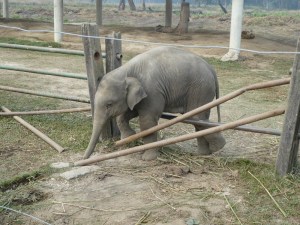
To the delight of Anne and I, a naughty 6 month old baby managed to remove the pen’s wooden poles and get out. We stroked him for a couple of minutes before a mahout came running and put him back in. Anne and I agreed that it wouldn’t be long he was out again.
The elephants start their training at 3 years old, after which they go to one of the 37 army camps in Chitwan’s jungle to do various work.
Many of the elephants are released into the jungle each day to graze. So there were only a few at the centre but it was wonderful to see them!
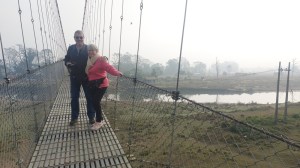
We had to walk across the long swinging suspension bridge. It was fun for some of us and quite scary for others.
The vehicles were waiting for us and the young lads shouted for one of the older chaps to join them in the back of the truck which he happily did.
Our next stop was at a tribal village. The ethnic group are mainly farmers and once farmed small pieces of land individually. A few years ago this group of Tharu people decided to join forces and the Tharu village in Chitwan was established.
There are approximately 1.8 million Tharu people in Nepal, who mainly live in the Terai region of the country and 170, 000 live in neighbouring India.
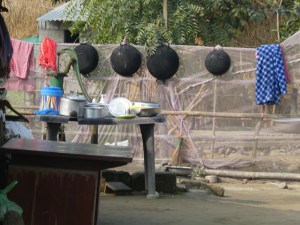
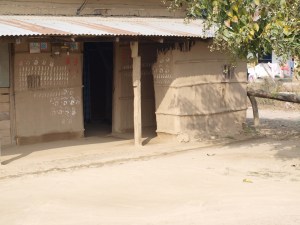
The interiors of the small homes are finished with a mix of cow dung and mud, this apparently works as an antibacterial covering for the properties. I think I will give this application a miss! Traditional artwork decorates the exteriors. One larger house had ornately decorated pillars
One of the Nepalese guides that was with us asked me not to go inside the houses. “I wouldn’t dream of it!” was my response. The friendly guy apologised and told me that the Chinese tourists open the doors and wander in. He said that it upsets the villagers. I replied “It would upset me too!
A few folk were sat on their haunches, carving wooden handles for tools. One lady was feeding her ducks. The village had two tiny shops.
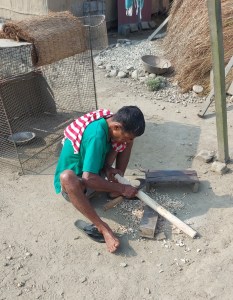
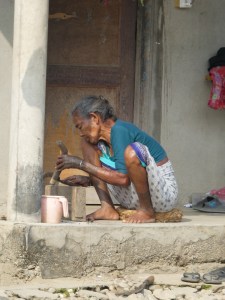
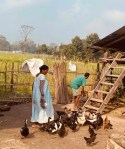
Sudan informed us that it was a day’s holiday for the ethnic group. Therefore, the children weren’t at school and preparations for a large festival were in place just a short distance away.
A lot of children ran out of their houses when they heard us arriving, no doubt hoping for sweets. They were in luck, Melina had some and the happy and smiling children gathered around her.
Our transport returned us to the hotel for lunch. Our lunch today was delicious and non spicy. Gloria and Nadia agreed that it was much more to their taste too. The attentive restaurant manager asked us how our meal was, and smiled broadly when we all told him that it was delicious.
The cost we paid to the travel company was itemised into two parts. The first part covered all flights and transfers, 4* and 5* hotels with half board, apart from here in the national park where full board was included.
The second part of the cost covered airport taxes, transport throughout the duration of our stay in Nepal, excursions, entrance fees, travel insurance and all gratuities.
After lunch, it was time for a jeep safari. Our transport took us to the River Rapti and Sudan walked with us to a platform viewing sight. From this point we could see some crocodiles and now easily distinguish between the two types.


Sandbags were slung on the riverbank like steps and this made it easier to make our way down to the river.
It was another test of balance for us all getting into the small boats. This time, two people sat on each wooden bench.
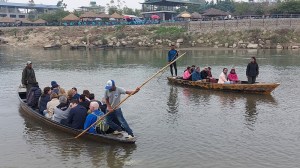
The boats took us to the other side of the river where the jeeps were waiting for us.
One spotter was with each of the vehicles, they remained standing scouring the area for wildlife. The rest of us all kept our eyes peeled too.
The national park was established in 1973, there are almost 100,000 square kilometres of jungle and it is home to quite a few endangered species.
Thirty seven army points protect the park from animal trafficking and poaching. The horns of the endangered one horned rhino command a high price and they are therefore highly sought.
In the 1960’s there were just 100 of the one horned rhino remaining in the park. Today there are 694. There are also 128 Bengal tigers, another endangered animal.
We set off in convoy and after about 15 minutes, we stopped at an army check point. One of the guides had to complete paperwork; there is strict control as to who goes into the park and how many vehicles.
A tree had fallen; it lay across the rough track in front of us. The driver just did a detour around it. The spotter explained that the tree would be left where it fell. He added that, it would be good for the ecosystem; it would become home and food to various insects and small creatures.
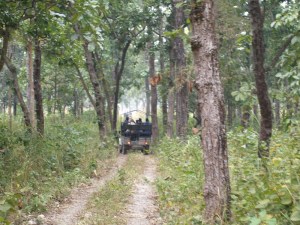
The weather was still misty, cold and damp, not the best weather conditions to see the animals but of course, we remained hopeful.
Apart from the endangered species already mentioned, there are also 4 types of deer – spotted, sambar, barking and hog.
Boars, two types of monkey – rhesus and macaque also live in the park.
Apparently the sloth bears are currently hibernating. There is also an abundance of birdlife. We saw many beautiful birds including wild peacocks, parakeets, eagles and a colourful racket-tailed drongo.
The guide spotted a huge tiger pawprint but unfortunately we didn’t see a tiger.
They are of course nocturnal animals. Our guide Sudan joked that occasionally one or two of the animals will migrate across the border into India, “without passport or visa” he added smiling.
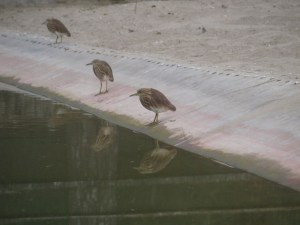
Stopping at the crocodile breeding centre which is within the park, we saw 12 inch baby gharials in the nursery. There are both types of crocodiles, at all different ages of their lives.
Numerous Indian Pond Herons sat in the crocodile compounds or on the fences.
There are many termite mounds. They have the appearance of interesting shaped rocks but are a combination of termite dung and saliva mixed with soil.
We saw wild boars, spotted deer and macaque monkeys. It was dusk when the jeeps swung off the track and drove quickly across an open area. A watering hole was in front of us but many deer ran off as we approached.
As we stopped at the army check point to do the necessary exit paperwork I think we had all resigned ourselves that we wouldn’t see the elusive one horned rhinoceros.
Anne put her red jumper back on. When we got in the jeep, she had been advised to remove it due to the possibility of it attracting an animal.
A few minutes later, the jeep in front of us came into view, it was at a standstill. This had happened a few times throughout the afternoon, when there was a movement in the bushes or when someone spotted an animal or bird.
But, this time it was different, I knew it was something big as the jeep had its indicator flashing. The driver had not done this previously, the spotters had just communicated with hand signals. Our spotter indicated for us all to be quiet and Anne bobbed down in the jeep, not wishing to be eaten alive!
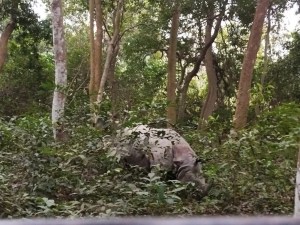
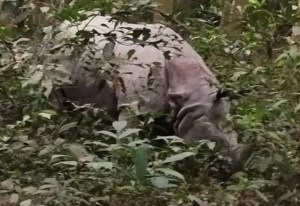
It was indeed, something big, an enormous ’greater one horned rhino’ just a couple of metres away from us. It was brilliant to see. The magnificent beast has skin folds which give the impression that it is wearing armour. Its single black horn can grow to 25 inches.
After watching it for a few minutes, we moved on quietly so the 3rd jeep in our convoy could also see the huge herbivore.
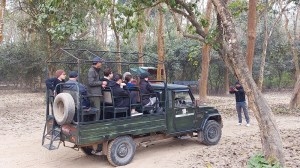
As we manoeuvred around a bend on the track, directly in front of us was a large sambar deer.
It stood startled and looked at us for a fraction of a second, then bolted into the undergrowth
The sambar deer are apparently a favourite meal for the tigers.
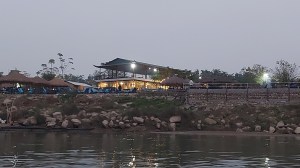
I think we were all on a high as we left the jeeps and got back into the boats to cross the Rapti River.
The cafes and eateries were illuminated with lamps and candles and there was a good atmosphere
Indeed, if we hadn’t been part of a group we would have stayed a while for a drink and to soak up some of the atmosphere. But we are tied to a schedule, which, so far has been amazing.
While waiting for the third boat to arrive, Dave, Pete and Anne chatted to some Aussies about our day and I chatted with the lovely Maria and George, practising my Greek.
Suddenly I heard an Aussie guy say rather loudly “Well, that’s a load of bullshit”.
Apparently he had told Dave and co. that they had seen two rhinos so Anne told him we had only seen one but added that we had seen three tigers ha ha! She might have got away with saying one but not three!
While we were all chatting, we hadn’t realised that the last of the boats carrying our fellow travellers had grounded in the middle of the shallow river, try as they might they could not get free!
So, another boat with a couple of guys had to go and help, another adventure for them.
With hindsight we could have stayed for that drink and then we could have returned to the hotel with a taxi. We had already mentioned to Melina (in Istanbul I think) not to worry about us, that we were seasoned travellers and were accustomed to travelling on our own.

It was 6pm when we arrived back at the hotel. Melina advised us that there would be ‘snakes in the garden’ at 6.30pm, followed by the Tharu traditional dancing show at 7pm and dinner at 8pm.
As neither of us were particularly bothered about seeing a show with snakes, we decided to opt for a cold beer and then a freshen up before the dancing show.
A local beer aptly named Ghurka was recommended to us.
Its label had a photo of a Ghurkha soldier and also the famous symbol of the ‘cross kukri’.
The kukri is the curved bladed weapon of the Ghurkha Army; it has also been used in Nepal as a tool for centuries. The famous insignia represents the renowned Ghurkhas, their courage and valour.
As we were taking our seats in the garden for the dance show, we noticed that there were some snacks available. Not wishing to spoil our appetite for dinner, we just chose a small selection.
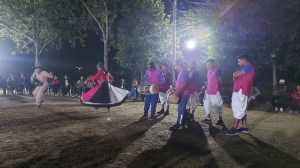
The dance show was interesting; men holding wooden sticks were dancing in a circle hitting each other’s stick.
One or two of them were playing drums as they danced. Pete commented that it reminded him of Morris Dancing without the bells.
The dance is known as the Sakhiya or Tharu Stick Dance.

Many years ago, it was only performed at certain celebrations throughout the year.
Nowadays, the entertainment is also for the tourists. Just one young woman danced, dressed in a colourful full skirt. Her male partner was dressed as a leopard or perhaps a snake, he was clearly a predator.
The female never smiled and appeared sullen throughout the dance. Perhaps, this was part of the story that she was portraying or perhaps she just didn’t want to be there.
Another dance was a fire dance with men swirling sticks and other props that were alight with fire.
After the dance show, the four of us went for dinner. We were surprised that we were the only ones there from our group.
It was a few days later that we realised that ‘snakes in the garden’ were actually ‘snacks in the garden’. The hotel had written the information incorrectly and passed it onto Melina. Oh well, that’s life!
It has been a fabulous day!

 lindaruddstravels.com