Saturday 30th March 2013
Church on the Spilled Blood : Petrogradskaya
During breakfast we check our emails and we are delighted to discover an email from the ballet ticket agency informing us that they are crediting us with 29% of the price we paid. They obviously agreed with some of the comments that I made.
Today is our last full day in this beautiful city and we plan to visit The Church on Spilled Blood and the Petrogradskaya area.
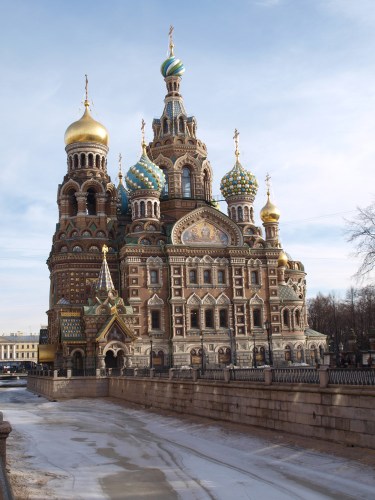
‘The Church of the Resurrection of Jesus Christ’ is one of a number of names that this beautiful church is given but the one most often used is ‘The Church on the Spilled Blood’. The church was built in memory and honour of Tsar Alexander the Second, on the site where he was assassinated. An ornate jasper canopy covers the actual spot where the tsar fell and died. Like numerous Russian churches, it was ransacked during the revolution. The result left the building seriously damaged and again like other churches in Russia it was closed in the 1930’s. It was not until 1970 that it was decided to renovate this church, and more than 25 years later it finally reopened its doors.
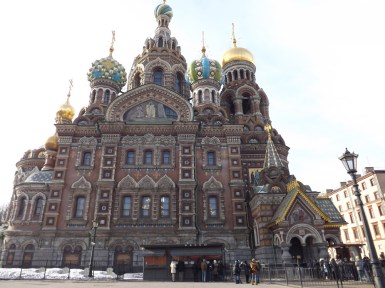
We spent a long time walking around the ornate exterior, slowly absorbing the details and of course, taking many photographs. The way we felt about this building was in complete contrast to how we felt about St. Basil’s. In our opinion this is an amazing work of architecture, not at all fairytale or ice cream cone like.
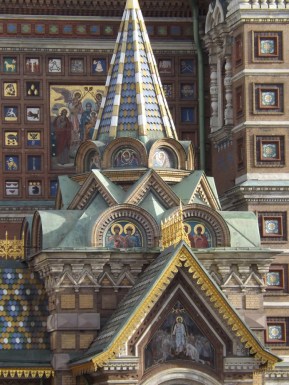
There are many coats of arms and badges that apparently portray the grief of the Russian people at the loss of their much-loved tsar.
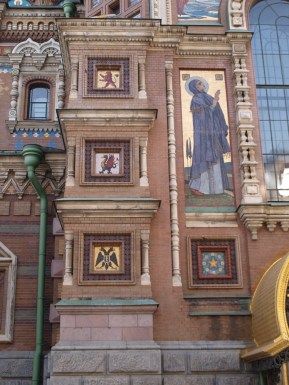
We wondered for a while if we should go inside or not – would it be similar to St. Basil’s, which we found greatly disappointing with its museum like glass cases. However, we decided to go inside and thank goodness that we did!
The interior is breathtaking. There are numerous beautiful mosaics, depicting biblical scenes.

Some records state that this church has more mosaics than any other church in the world. The walls and the high ceilings are all covered in either colourful paintings or mosaics. Some of the icons are framed with beautiful carved jasper, rhodonite and other semi precious stones.

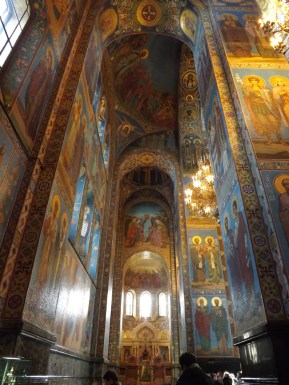
We were pleased to find information in English as well as in Russian regarding the iconostasis and some of the other artefacts. We have seen very little English information anywhere during our entire visit. A small area near the entrance displayed photographs from before the restoration began; one can easily comprehend how it took more than twenty-five years to restore. It is gratifying that work like this can still be achieved today.
We caught a metro to Gorkovskaya station, which is in the area known as Petrogradskaya and after a stop for a coffee, we followed a signpost towards the Peter and Paul Fortress.
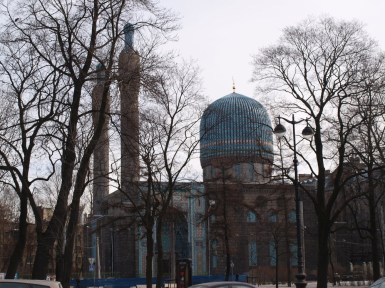
We passed a magnificent turquoise ceramic domed mosque; its two stone minarets are also topped with turquoise ceramics. Apparently this was once the largest mosque in Europe.
We continued across one of the bridges and into the fortress where the famous Cathedral of Saints Peter and Paul is situated.
Huge glittering chandeliers illuminate the lavish interior, with its elaborate 30 metre high iconostasis.
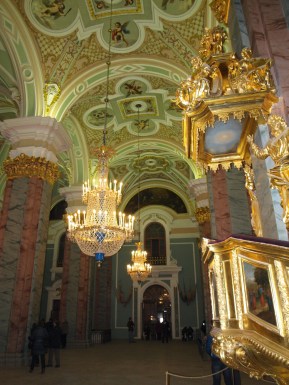
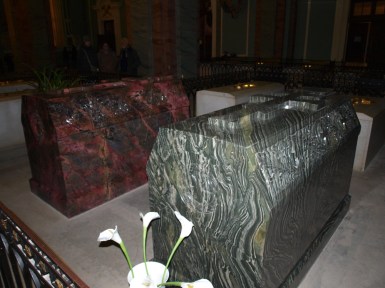
The majority of Russian rulers are buried in this church, their ornate tombs made of semi precious stones – rhodonite, jasper, and also of marble.
Eighty years after their murder, the remains of the last Romanov Tsar, his wife, their children and their faithful servants were moved to a chapel in the cathedral.
Unfortunately scaffolding covered some of the cathedral’s exterior including the bell tower. The soaring gilded spire topped with an angel holding a cross made this the tallest building in St. Petersburg until the 1960’s, when the taller television tower was constructed. Peter the Great instructed that the cathedral was not to be a typical Russian design. The church’s architecture was therefore based on European protestant churches. In particular it was influenced by Dutch architecture and the landmark needle spire was indeed built by a Dutchman. The cathedral is the oldest church in the city.
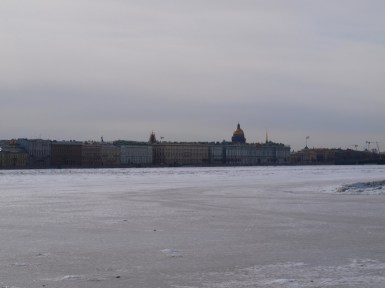
Leaving the fortress we crossed over the bridge above the frozen Neva river, we could see the Hermitage and the dome of St. Isaac’s in the distance. One or two brave folk were walking across the ice; in places it appeared as if the peaks and troughs of the waves had frozen instantly. Nearing the end of the bridge some of the ice had melted and a few ducks were stood drinking.
We passed the Field of Mars, which, appropriately named after the Roman god of war, was once an area for parades and military exercises. It is now a memorial to the victims of the revolution and the civil war.
We again admired the Church on the Spilled Blood (perhaps my favourite building of the whole trip) as we wandered past it and into a small traditional eatery for lunch. For lunch we had a warming soup of meat and vegetables that had a hint of lemon, it was called Solyanka soup. We then shared savoury ham and cheese pancakes and finished our delicious meal with a jam pancake.
On the way back to our hotel we stopped to purchase a jigsaw of the Church on the Spilled Blood. We relaxed for a while in our hotel and then packed our cases.
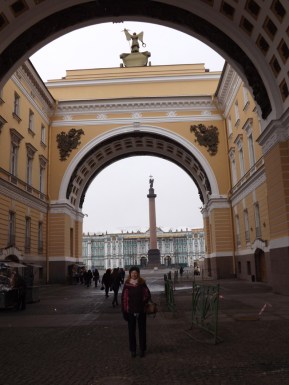
It was snowing when we went out for dinner; we walked along the river and into the Palace Square. There were four horse drawn carriages with their drivers dressed in period costume waiting hopefully for tourists to take a ride into the past… This square is where the massacre known as ‘Bloody Sunday’ took place in 1905. Nowadays large events and concerts are occasionally held here.
We walked through the double ornate arch which is part of the ‘General Staff Building’ and made our way onto Nevskiy Prospekt.
When we arrived at Dachniki, it was only just after 7pm so we were surprised to see that it was full, many Russian families were enjoying a meal. We decided to wait a while and after 15 minutes or so we were seated at a table and once more we enjoyed a lovely meal at what had become our favourite traditional Russian restaurant.
A thin layer of snow had settled by the time we left Dachniki and made our way back to the hotel.
Our alarm is set for 4.10 am and we have a taxi booked to take us to the airport at 5 am – a little early we feel for a 6 am check in but the hotel has recommended this.

 lindaruddstravels.com