Wednesday 27th March 2013
Alex Nevsky Cathedral : Church of Lady of Kazan :
Hermitage : Winter Palace
Our first day in St. Petersburg – Wow! The hotel is in a quiet location and we enjoyed a good night’s sleep. Looking out of the window, we expected to see thick snow and we were surprised to see that there was only a thin layer.
During breakfast, we decided on our itinerary for the day – Alex Nevsky Cathedral, Church of Lady of Kazan, Nevskiy Prospekt and the Hermitage for the Winter Palace. All of these are in the ‘Top Ten Sights’ in our guidebook.
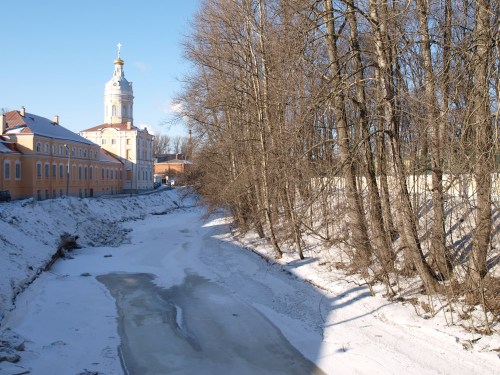
Nevskiy Prospect is approximately 4.5 kilometres long. The road was first constructed to be the starting point for the journey to Novgorod and Moscow. Originally it was forestland and for many years, wolves were said to roam. This major thoroughfare now cuts through the historical centre of the city. Alex Nevsky Cathedral is situated at the end of the wide road so we decided to get the trolley bus. The number 22 trolley bus which would take us the length of Nevskiy Prospect stopped just five minutes from our hotel. Unfortunately, two minutes after we had got off the bus and due to the freezing temperatures, Dave realised he had left his gloves on it! We walked to the cathedral, Dave with his hands pushed firmly into his pockets. Just before we reached the main entrance to the cathedral complex, there was a very pretty wintry scene.
Two cemeteries are close to the entrance, some of Russia’s famous composers are buried here and apparently their tombstones are marked with musical designs. Dostoevsky is also buried here, in the city’s oldest cemetery. We paid the entrance fee and entered the grounds. The cathedral’s main dome unfortunately had scaffolding erected and when we entered the building we discovered that most of the interior did too.
It was obvious that major renovation works were in progress. We were very disappointed but obviously appreciated that these impressive religious buildings have to be maintained. We noticed a number of people queuing to speak to a priest who was dressed in his ornate regalia. They knelt before him, kissed his hand and spoke to him in hushed tones. For these devout people, it is a blessing that this revered cathedral remains open despite the restoration work.
We caught the no. 22 bus again (unfortunately not the one with Dave’s gloves on) and travelled past the Moskovskiy railway station where we arrived in the city, back along Nevskiy Prospekt.
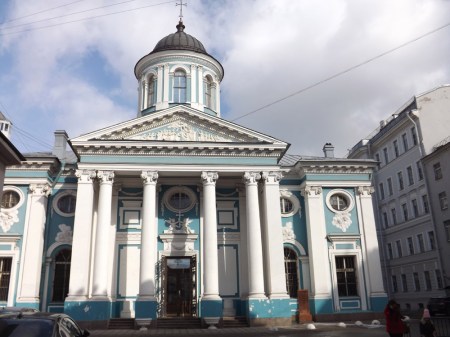
We visited the beautiful blue and white Armenian Church of St. Catherine. Then we went to the oldest Catholic Church in Russia which is also dedicated to St. Catherine. Its interior was plain compared with the ornate orthodox churches. Its crucifixes and icons were covered with purple cloth, as is the custom during Holy Week. This reminded us of when we visited the Pantheon in Rome some years ago, also during Holy Week.
After searching in a couple of shops we eventually found Dave some new gloves at one of the tiny retailers at a metro station.
We crossed the narrow frozen canal where the Church on the Spilled Blood is situated. This church is another ‘top ten sight’, and it is on our list for another day. However, we could not resist standing and admiring the impressive architecture for a few moments.

We crossed the road to the Cathedral of Our Lady of Kazan. The inspiration for this building was St. Peter’s in Rome. The 96 columns in a semi circle, which grandly face Nevskiy Prospekt, are in fact the rear of the church. This is because the altar in an orthodox church must face east. The interior is vast and again there are no seats. There is a huge dome and stunning pink granite pillars. Sadly this religious sanctuary was occupied throughout the communism era and used as a Museum of Atheism. After the fall of communism, religious services were once again resumed.
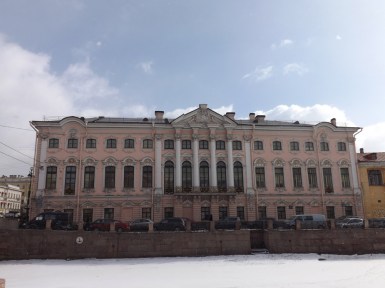
We continued walking along St.Petersburg’s longest and busiest avenue. We passed the Singer Building, which has a glass globe on top of a glass dome. As the name suggests this was built for the Singer sewing machine company in 1902. Close by is the Baroque style Stroganov Palace with its pink and white façade which overlooks both the Nevskiy Prospekt and the Moyka River.
We stopped for lunch and had bowls of warming soup served with delicious dumplings.
Next on our list is the Hermitage for the Winter Palace and its Malachite Room, which I have been so looking forward to. The Hermitage is situated in Palace Square, and is a beautiful blue-green and white building. It is one of the largest and oldest museums in the world.
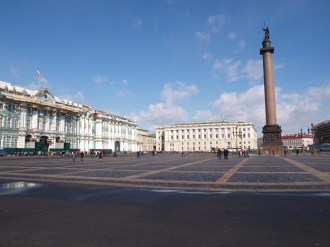

Once again, the building has scaffolding erected, but as it is such a huge building it is fairly easy to photograph without showing the scaffolding. We joined the queue and when our turn came, we requested two tickets for the Winter Palace. The cashier replied ‘well, you must go to the Winter Palace for the tickets’, we were taken aback by the comment as we believed that we were in the correct place. We asked someone else and they gave us directions and a little map to the Winter Palace.
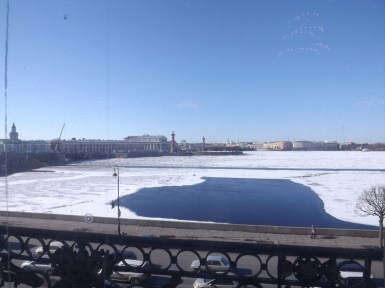
We left the building and walked along its perimeter as instructed, passing the original public entrance, which has ten 5-metre high granite statues of Atlas. We walked along a narrow canal that led us to the banks of the Neva and a beautiful view of the ice-laden river. We spotted a couple of people walking on the ice and wondered how safe they were.

We found the building from the directions, paid our entrance fee and started to look around. We wandered through six small rooms; we walked past an ornate brass sledge carved in the shape of a dragon. Each step I took, I was getting more and more disappointed, where was the Malachite Room, had I made a mistake – did it no longer exist? Realising we had seen all that there was to see in this very small palace, we asked an attendant. She smiled and advised us that we were, indeed, in the Winter Palace of Peter the First, but the room we so wanted to visit was in the Winter Palace of Catherine the Great. She informed us that we must return to the Hermitage where we had just come from.
We retraced our steps and joined the queue once more. This really is an immense building; I think one could easily spend several days in here. There are apparently 365 rooms. However, we went directly to the Winter Palace of Catherine the Great and located the Malachite Room. ‘Wow, it is amazing’ was my response to its splendour, how our dear friend Joan would love to see this …

This marvellous room was the official drawing room for the wife of Nicholas the First. It has a table, a fireplace, urns and pilaster all made from malachite – it is all stunning.
We spent some considerable time wandering around the stately rooms of the palace. The vast sweeping staircase is made from white marble, decorated with gilded stucco and many mirrors; above, the ornate ceiling depicts the gods at Olympus.


Eventually we decided that we had seen all that we wished to in this part of the Hermitage. We scanned the remainder of the exhibition list and decided to visit: ‘Art of the Far East’ and the ‘Antiquities of Siberia and Near East’. As one exhibit was on the top floor and one on the ground floor, we again took the opportunity to admire the spectacular staircase. The Far East exhibits were interesting and included a Tibetan mandala from the 17th century and also Indian, Mongolian and Japanese art.
We attempted to find the Siberian exhibition on the ground floor. We were sent through an area that was being renovated, complete with a plasterer balancing high on his ladders, and we were then directed to go back the way we came and down a different stairway. We did as instructed and were then told (by yet another member of staff) to go back up two flights of stairs, along the corridor and back down again. It seems that even the staff struggle to find their way around this vast building. But we decided that we had had enough, we had been wandering around the Hermitage for four hours, we were tired, and it had been a very long day. It was 7.30pm so we made the decision to return to the hotel to change some cash before heading back out for a meal. At least we knew we could change cash at the hotel.
However, when we tried to exchange our cash, we were informed that the sign at reception was only for information. The sign advised on the current exchange rate but the hotel did not actually exchange currencies.
Olga was not at work and there was no message for me from the ballet ticket agency.
We showered and changed and left the hotel shortly before 9pm, we caught yet another no.22 bus to Nevskiy Prospekt as it was the place that we knew we could change our euros into rubles. We soon found an exchange and then we decided to return to the restaurant where we ate the previous evening.
One of the dishes offered on the menu was ‘Fried Bream – delicious if bony’, another, ‘Snack a la Dacha’ – potatoes & canned meat for two. I ordered beef stroganoff, which originated here in St Petersburg. It was Count Stroganov’s chef who originally cooked this famous dish; the dish took the name of the Count rather than the name of the chef who had created it. Dave ordered pike cutlets, but the waitress misunderstood and he was served pork, as it was 10.20pm, Dave accepted the pork, once he confirmed it wasn’t intended for a different table. We also ordered green beans and cabbage patties. The cabbage patties were similar to Cornish pasties but with cabbage as their only ingredient.
While eating our meal we overheard a conversation between some Russians and Europeans. One of the Russians commented that it should have been spring and it was still winter…
We sent a ‘From Russia with Love’ birthday greeting to a friend, using the small restaurant’s Wi-Fi, which seems to be readily available wherever you are these days.
It was after midnight when we arrived back at our hotel. It had been a long day and we had very much enjoyed our first day in this incredible city.

 lindaruddstravels.com