Friday 6th March 2020
Meknes: Bou Inania Medersa : Imperial City :
Bassin de l’ Agdal :
Today we have the whole day to further explore Meknes. Unfortunately, we have learnt that two of the city’s main sights are closed for renovation.
The Palais Dar Jamai is a museum these days, but it apparently still retains many of its original palatial features as well as displaying various pieces of Moroccan art. Nobody seems to know when it is scheduled to reopen.
However, the closure of the Mausoleum of Moulay Ismaïl is our biggest disappointment.
Putting our disappointments aside we set off through the souk to the Bou Inania Medersa. It was eerily quiet in the souks at 9.30am; almost all of the tiny units were still closed.
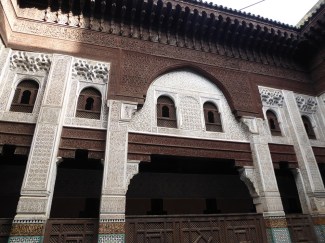
The medersa, or madrassa as it is also referred to, (indeed the word medersa is above the entrance and ‘madrassa’ is on a plaque at the side of the entrance)was constructed in the 14th century. It is similar to its namesake in Fez but sadly there are many signs of disrepair. The admission fee is three times the cost as the one in Fez and we hope that the extra revenue goes towards renovating and maintaining the former Koranic school.
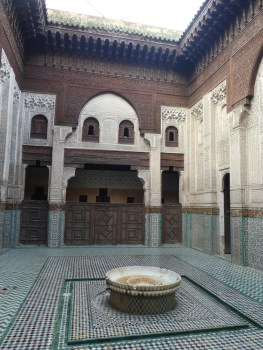
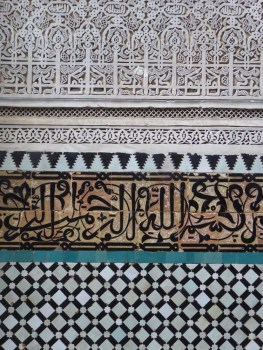
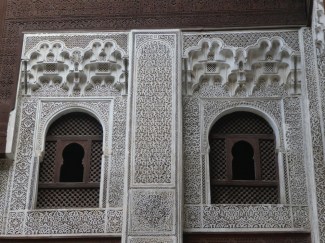
The architecture however is absolutely stunning, the decorative stucco work, the carved cedarwood, the beautiful calligraphy in colourful zellij tiles. We consider ourselves extremely lucky to be here!
From the roof where we are now stood, we can see some of the city’s impressive minarets.
There is a makeshift platform dangling precariously from the top of one of them with some sort of pulley system. Some type of work is going on. No workers today though, as it is Friday, Islam’s holy day.
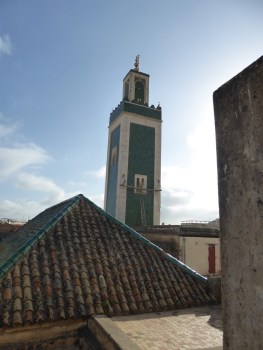
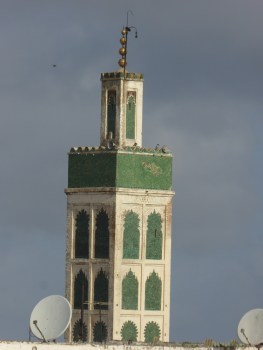
Dave counted eight minarets rising above the numerous weed covered roofs. Many of the roofs were home to huge satellite dishes.
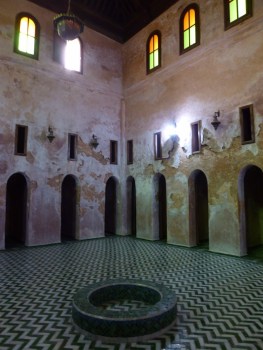
As we were about to leave the medersa, one of the staff pointed to another room. Although it is in the process of being renovated we are so pleased not to have missed it!
Plaster is flaking off the walls. The circular pool has some large industrial sized rusty staples in it attempting to hold it together.
The eye-catching zellji tiles on the floor show skilled workmanship.
Peering upwards, we were rewarded with a fabulously crafted cedarwood ceiling.
As we left the beautiful medersa, we asked one of the staff for information relating to the Grand Mosque. It was also closed, again for renovation.
It is difficult to work out which minaret belongs to which mosque when you are on a roof terrace. And from the souk with all the alleys being so narrow it is impossible too. And unfortunately, due to the language barrier when we asked the chap about it, we could not make ourselves understood.
The chap did tell us however, that three of the mosques doorways can be seen from within the souk. The souks and the medina have built up around the Grand Mosque; the holy building is of course the central point of the medina.
Leaving the souk, we walked to the ‘Imperial City’. Ashraf had said that we should ask the guard at the gate if we could enter the royal gardens.
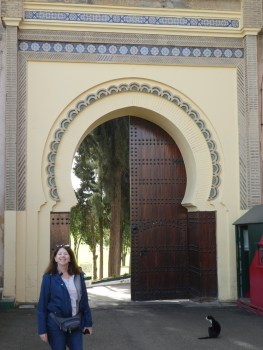
Telling us that we were welcome, he waved us through the huge gateway. Part of the royal garden is actually a 9 hole golf course.
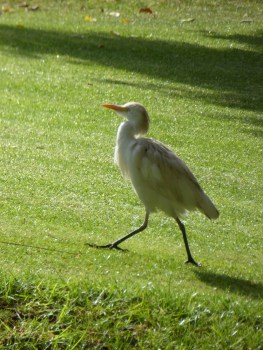
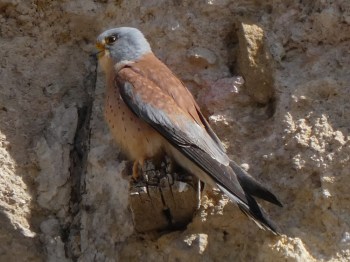
It is all extremely well kept. Various birdlife wandered around, including herons and storks.
A guy in a white coat who we guessed was something to do with the golf club suddenly appeared. Without acknowledging us he moved a sign which read ‘Restricted access to the Public’ to a few feet in front of us.
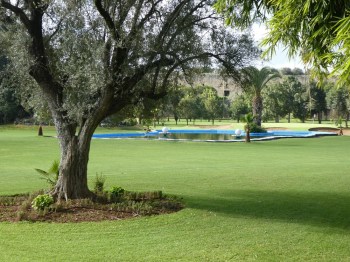
Suddenly feeling not quite so welcome and assuming we could not continue through the gardens to the Bassin de l’ Agdal, we turned to leave. A couple of gardeners near the gateway however, were extremely helpful and told us to follow the perimeter of the high crenellated walls to reach the lake.
There was a group of around fifteen teenagers having fun, laughing and a few playing kickabout with a football in front of us. This must have disturbed the birdlife in the trees and on the high walls as suddenly many egrets and storks flew above us. Looking back up at the wall a minute later, Dave counted twenty storks.
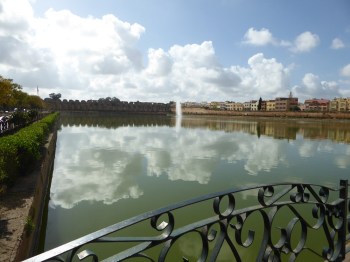
Expecting to see more birdlife at the reservoir, we were surprised to see only a few ducks.
The manmade lake was built during the time of Moulay Ismail in the 18th century to supply water to the palace and its grounds. It was apparently also used for leisure and the sailing of small boats
Today, it is a popular place for people strolling on an evening. During the summer months, one may spot a few folk swimming.
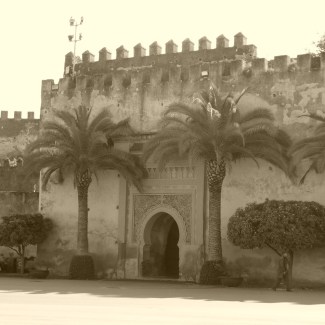
Continuing to follow the perimeter of the palace walls, we watched the birdlife and admired the horseshoe gateways. Dave took a photograph of one of the gates and one of the guards walked towards him and asked to see the photo. He then told Dave to delete the photograph as it had a guard on it and therefore it was not permitted. Ashraf had informed us that the guards that we had seen dressed in red uniforms were the King’s guards and were only in the area when the King was nearby.

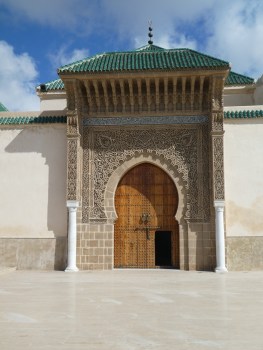
Outside the mausoleum of Moulay Ismaïl, we stopped to take a photograph. A man approached us asking if we would like a guide, although we declined he started chatting with us.
I asked him if I could see the building’s other facade from the other side. “There is no other side, this is it” he replied. I mentioned that it was different to the photograph in our guide book and he asked to see it. He informed us that the photograph was of the old facade. He added that in his opinion the new one was much better as it was more traditional.
The really frustrating thing is that the restoration of the building is actually complete and the city of Meknes is waiting for the King to inaugurate it. The door to the mausoleum was open, (which frustrated me even more!) but the gate on the fence surrounding it was locked and would remain so until the official opening.
The mausoleum has been closed for three years; it is apparently a superb example of Islamic architecture. Non Muslims were previously permitted to certain areas of the mausoleum. However, later in the day we heard that when the place does reopen, it may not admit non Muslims.
Having now walked a full circle we decided it was time for coffee and we sat on a terrace of a rather posh restaurant. While we were there, a minibus arrived and a guide accompanied a small group of tourists inside, they proceeded to take photos of the beautiful interior. They then continued up to the roof terrace. Looking at a menu, it was, as expected more expensive than the places we had been eating in but it wasn’t over the top and we agreed that we would come for our evening meal.
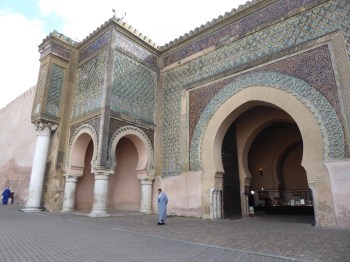
Heading over to the Bab Mansour, the city’s impressive gate, we took some more daylight shots and once again marvelled at the intricate decoration of the massive gateway.
The Place el-Hedim was getting busy. The man carrying the snakes was strolling about, as was a man with a monkey.
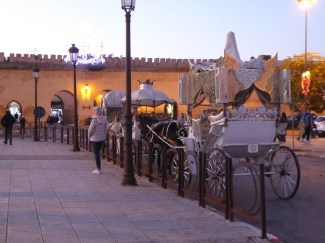
A small pony was pulling a small decorated carriage and a few children were queuing for a ride. Lots of older kids were on the way home from school, we wondered if their lessons had finished for the weekend…
Walking in a different direction we passed through yet another market, selling just about everything again, hair products, emery boards, clothes, bedding and onions! Bab El Khemis, one of the city’s gates, was our destination.
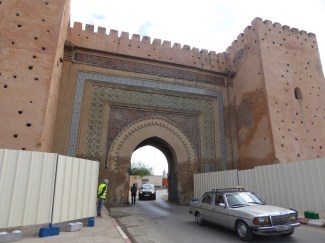
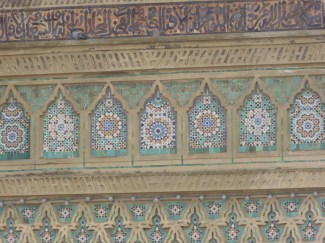
The gate’s restoration is still in progress but it didn’t stop us admiring its splendour. Like Bab Mansour, the twin towered gate has beautiful intricately detailed patterns and Islamic calligraphy.
Apparently, Bab El Khemis translates as the ‘Thursday Gate’, as a weekly souk was easily reachable from the gate.
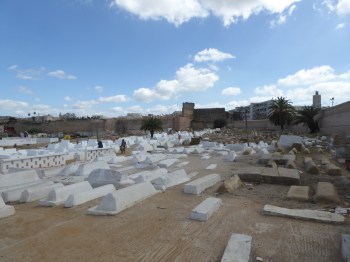
Passing through the ancient mellah (Jewish) district, we saw that the cemetery was also in the process of being restored.
The older tombs are being cleaned and pathways are being made to them.
Back at the main square, we had a bite to eat and chatted with the owner of the eatery. He is the proud owner of a couple of places in the square and also a riad. The 55 year old said to us “Today is our holy day, tomorrow it is for the Jewish and the next day it is for the Christians” As an afterthought he then added “I have been to London, you know!”
The square was now extremely quiet, the kids had all gone and there were just a few vendors still hanging on hoping for a little more business. The monkeys dressed in matching clothes were still there, as were the horse and pony. I watched the snake charmer pop his snakes into a sack bag, then into another bag before wandering away.
Perhaps, it was time for the main Friday prayer. As we made our way back to the riad everywhere was shuttered up including the small kiosk where we usually bought our water from.
As we left the riad later, there was freshly laid concrete directly outside the door. There were already a couple of footprints and a paw print embedded in it. Unfortunately, it was a little wide for me and as I attempted to jump across it I didn’t quite make it, so there will be a permanent partial footprint of mine in Meknes!
Aimlessly wandering through the labyrinth of alleyways, we noticed quite a lot of them were being excavated. Paving blocks were piled up and there were heaps of rubble next to deep trenches. There were quite a few unpleasant aromas too! So we guessed there was a problem or two with the drains.
Later, we headed over to the ‘imperial city’, where its large modern square is in complete contrast to the medina. Young folk and couples were sat on stone benches, some were chatting but most were tapping away on their smart phones or taking selfies. Children were playing in a small park, on the swings and roundabouts, their mothers, all wearing head scarves were busy chatting while catching the last rays of the sun.
Sadly, we were the only diners in the lovely restaurant with its big round tables, purple and gold cushioned sofas and stucco decorated walls and ceilings. A young lad came in at one point and laid on one of the sofas and switched on a large TV mounted on the wall. He was, we assumed, one of the staff’s relatives.
Dave ordered lamb chops and I decided on the kefta skewers. Just as we finished and placed our cutlery on the plate, the waiter was at our side. “Finished?” he enquired. “Oh, eh, yes thank you” we responded, a little surprised. “Check” he asked, using the American word. A few seconds later, he returned with the bill, placed it in front of us and said “tip not included”.
While the food was acceptable and the surroundings were lovely, there was unfortunately no atmosphere, probably due to the fact we were the only ones there at that time.
Dave and I commented on how quick our evening meals tend to be, but we usually only order one course and we aren’t lingering over a bottle of wine.
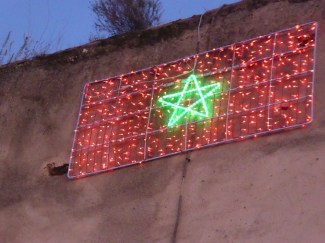
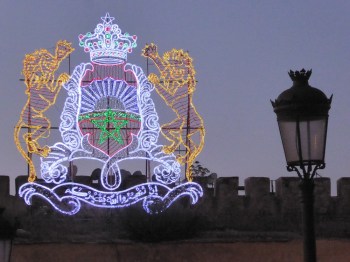
Back in the large square, which was now illuminated with a few decorative lights, people were still mingling and chatting. Small decorated carriages resembling crowns or Cinderella’s coach were offering rides around the imperial city’s sights. After a few minutes stroll, we returned to the riad.
Previous Next

 lindaruddstravels.com