Sunday 1st March 2020
Fez: Bou Inania Medersa : Zaouia of Moulay Idriss II : El-Attarine Medersa
Place el-Seffarine : Chouara Tannery
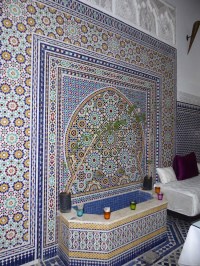
Breakfast was a treat in this stunning courtyard setting and we lingered a while. The French manager conversed a little with us using Google translate on his smart phone.

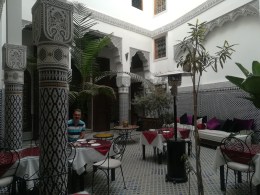
After breakfast we climbed the stairs to the roof of the riad and marvelled at the view of Fez over the rooftops.
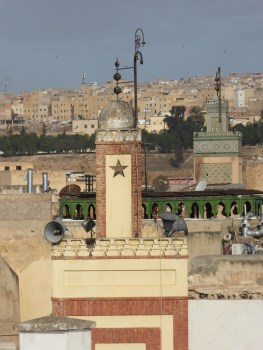
Leaving the riad we set off to the ancient medina. First on our list this morning was a visit to the Bou Inania Medersa. The medersa was once a residential religious teaching institute which was built in the 14th century. Today for a small cost one can admire its incredible architecture.
Bou Inania Medersa was also a mosque and is the only medersa in Morrocco with a minaret. The hydraulic clock that we saw yesterday was built in conjunction with the medersa and the clock was apparently overseen by the mosque’s muwaqqit (timekeeper and astrologer).
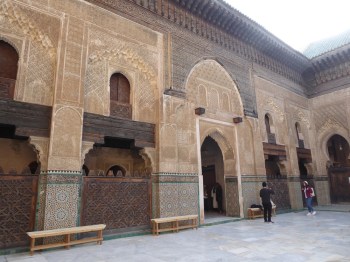
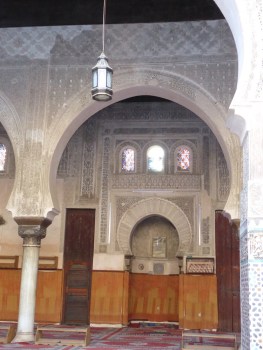
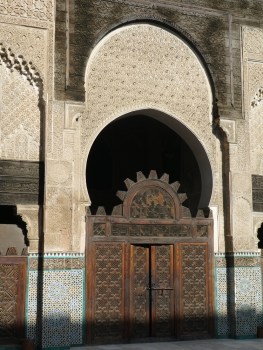
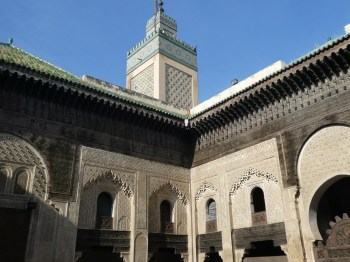
The architecture is truly stunning. Unfortunately, while we were there a young man was taking hundreds of photos of a young woman in a floaty dress. She was posing and they were generally being disrespectful of the holy place. I noticed a couple of people asking them to stop.
Another lady who was part of a tourist group was walking backwards admiring part of the courtyard and unfortunately she fell backwards landing in the courtyard’s fountain. Many people rushed to assist her; while she appeared to be okay she was of course dripping wet!
Tala’a Kebira is the name of one of the main streets in the medina and it roughly translates as Great Climb or Great Slope. It is indeed a slope and we walked slowly upwards constantly taking in the sights around us.

Both sides of the street have small shops with products ranging from jewellery and pottery to musical instruments and food.
One or two beggars were sat at the side of the street with their hands held out hopefully and we saw a blind man slowly walking with his palm open and his arm stretched out.
Our next stop was at the mausoleum containing the tomb of the ruler who is believed to be the founder of Fez, Moulay Idriss II.
At first I wasn’t sure if non Muslims were permitted. But, then I saw a young woman with long dark hair entering and I followed her. First, I removed my shoes as she had done and then I proceeded up the few steps behind her.
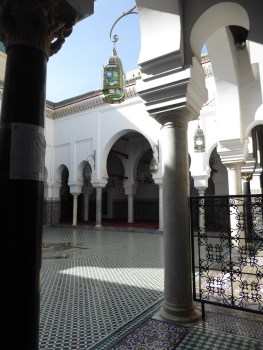
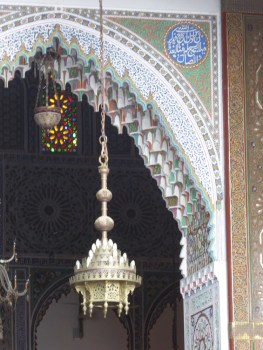
As I took a step forward, a man put his hand up towards me indicating for me to stop and another started quickly walking towards me. I retreated down the steps. The pretty young woman who I had followed turned to me and enquired if I was Muslim. “No, no, I’m not. Are you? I followed you, I am so sorry” I answered. She shrugged my apology away, smiled and told me not to worry.
However, I felt bad! Already I had forgotten what Linda had said yesterday, all female Muslims do not wear head coverings.
Outside the mausoleum there were a few artisans’ shops and we got chatting to one of the owners. His textile products were manufactured from cactus silk.
He asked us where we were from in England and he said that he had friends in Doncaster. The shop’s proprietor went on to tell us that he had visited them once or twice and although he didn’t drink alcohol at home in Morocco, he had tried it in Doncaster. He continued, saying that, although he only drank two pints of beer he woke the following day with a hangover.
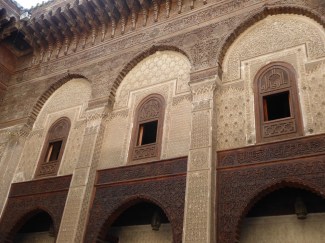
El-Attarine Medersa was the next place on our self made itinerary. It is another example of breathtaking Islamic architecture.
Also built during the 14th century; the tiny rooms, which were once occupied by the scholars, overlooked the decorated courtyard.

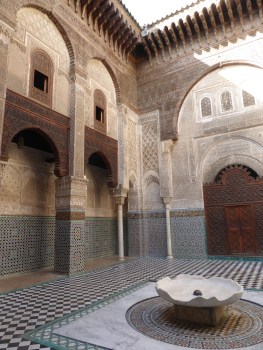
We sat for a while admiring the beauty of the architecture as well as listening to a local guide address the tourist group he was accompanying. He was explaining the meaning of the Moroccan Flag.
He said that the star on the flag was the colour of Islam-green and that its five points symbolised the five pillars of Islam – 1. One God 2. Pray five times daily 3. 2½% of earnings must be given to the poor (not to someone you know) 4. Observe Ramadan and fast 5. Go to Mecca if you can afford it and are healthy.

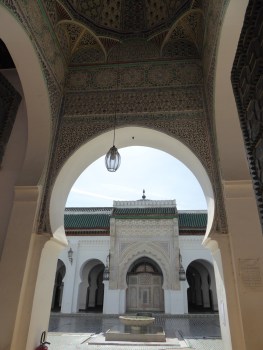
The Karaouiyn Mosque and University which still operates today is in the middle of the medina surrounded by alleyways.
While non Muslims are not permitted, guidebooks tell of glimpses being possible from some of its many doorways.
A small group of people were gathered outside the horseshoe entrance to the courtyard as we passed.
The security guide on duty allowed peeks and photographs of the magnificent courtyard from the doorway.
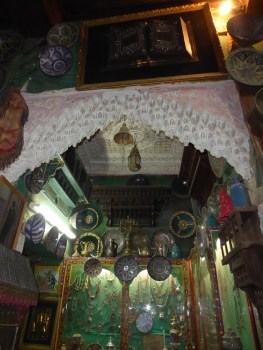
Wandering through the medina’s labyrinthine alleyways we came across what at first glance looked like an Aladdin’s Cave.
The Jewish owner was stood outside and asked if we would please step inside to see his private synagogue, which his mother, a Sephardic Jew, had built.
He introduced himself and then rubbed and kissed a sacred relic before entering. After showing us the beautiful ceiling and other sacred items he insisted that we let him make us some tea.
However, when I mentioned that we would not be purchasing anything, his attitude changed and he became pushy suggesting that we buy this or that. When we declined he turned on his heel and returned to his spot outside his shop, looking away when I thanked him as we left.
A small alley opened into a leather works. One man was removing the fur from a skin. Another man told us that it was a camel skin and added that they also dealt with fish, goat and cow skins. Theses skins were for drums and tambourines. There were also leather pouffes in every imaginable colour and shade. Some men were operating sewing machines, others were sewing by hand.
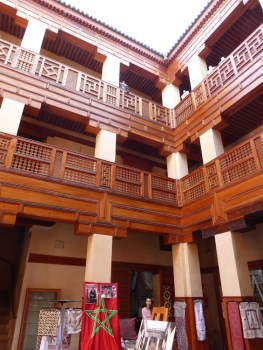
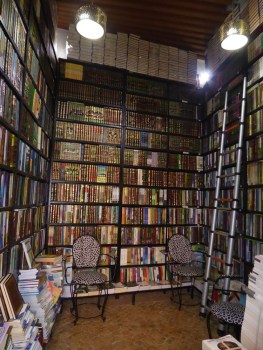
In the middle of the medina is a restored foundouk, also referred to as a caravanserai. Many years ago this would have been a hostel for weary travelling merchants.
This painstakingly restored foundouk now has various outlets including a couple of small book shops. Beautifully bound books line the shelves, some sets have Arabic words or letters on each spine and when the set is placed together, it creates a saying or phrase. The owner appeared to be pleased that I was interested and indicated that I could take a photo.
Wandering across to where Dave was browsing I saw another bookshop with similar sets of books. While showing Dave, the man working there who spoke a little English explained that the sets were volumes of the Koran. Sat in the small area was a man wearing a long flowing yellow djellaba. On his head was a pale yellow turban, the centre of which appeared to be silver coloured metal. The long bearded man was engrossed in a large heavy book.
I thought the whole scene was beautiful and I sneaked a photograph. I was mortified however, when the shutter clicked loudly and the man shifted and raised the book to cover his face.
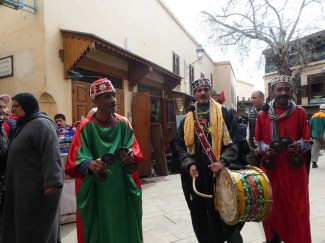
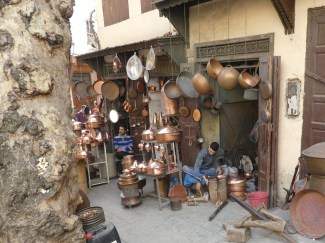
We stopped for mint tea in a busy and noisy square. Place el-Seffarine has been the home of copper, brass and silverware makers for hundreds of years.
Adding to the noise of the copper beaters was a band of musicians slowly walking around the square as they played.
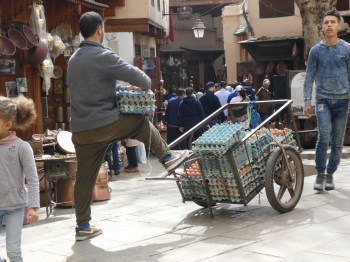
Dave added to the cacophony when he saw a guy delivering eggs and started to sing “I am the eggman, they are the eggmen, goo goo g’joob”.
The Seffarine Medersa in the square is still in operation today and it is not open for visitors. It has had major renovations in recent years and belongs to the Karaouiyn University.
It took us a while to find the ‘Tanners Quarter’, also known as the ‘Chouara Tannery’. Leather is exported all over the world from this, the biggest of three tanneries in Fez.
As we got closer to the tannery, a man from one of the leather shops offered us some spearmint leaves. Having read about the miasma from the works, I took them gratefully, holding the mint to my nose. Although, to be truthful the stench wasn’t so strong on the day we were there.
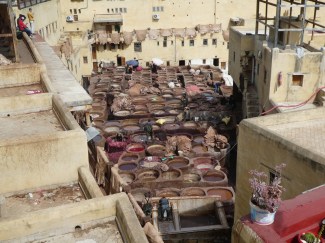
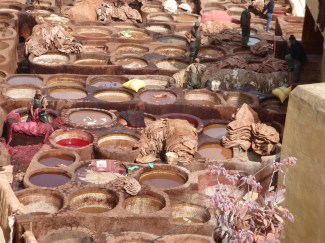
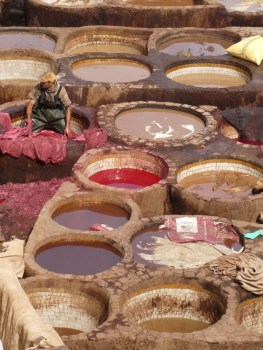
Natural ammonia from pigeon poop mixed with lime is apparently used to clean the skins.
The colours in the huge vats are changed every ten days.
While the work is physically demanding, the pay is high. A tannery worker will earn around 400 MAD per day compared to 200 MAD for a labourer working on road works. The trade is often passed on from father to son.
Stopping for a rather late lunch on the top terrace of an eatery close to the Bab Boujloud (Blue Gate), we had a wonderful view of the gate itself and also of a couple of minarets. It is quite difficult to see the impressively decorated minarets as the alleys of the medina are so narrow.
Pastilla is a sweet and savoury pie. It is often on the menu under the Moroccan specialities although some say that the recipe was brought from Andalusia by Moorish Muslims as early as the 16th century. Pigeon or chicken is the meat that is traditionally used but more often or not these days it is chicken. This is mixed together with eggs and almonds, placed in a pastry similar to filo, baked, and dusted with icing sugar and cinnamon. So, having learnt about it, we decided to order one together with a couple of bowls of the soup of the day which was chick pea soup.
A small complimentary dish of harira soup, tomato based with pulses and herbs and spices was brought to our table first with a couple of big flat bread cakes.
All the dishes were tasty although Dave wasn’t keen on the icing sugar and cinnamon on his chicken pie!
After lunch we headed down another small alley, at the bottom of it, an opened metal door led into a large square workshop.
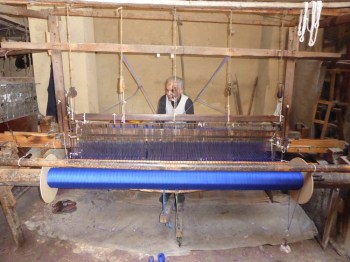
A man was sat at a wooden loom. He was pushing the two wooden treadles in turn with his feet and pulling down the wooden mechanism simultaneously, turning the royal blue thread into reams of material.
Another man was weaving a stripy material and we watched him change his long wooden spool. Like their looms the two male weavers appeared to be of considerable age. A couple of young guys were operating smaller machines transferring the thread onto spools, perhaps they were apprentices learning the trade.
Leaving the medina, we set off to the CTM bus station to book tickets to Chefchaouen for Tuesday. The area in front of the station had grand taxis waiting. These taxis take up to six passengers and travel between towns. They usually wait until they are full before they leave. They are larger than the taxis that do smaller trips within a city.
After entering the busy bus station we soon located the CTM office where a notice boasted “Tickets available for all over Morocco”. A young man speaking fluent English issued the tickets and gave us all the necessary information.
The bus would leave at 7.30am and take four hours. He advised us to be at his office at 7am. There would be two comfort breaks, one for five minutes and another for ten minutes. The return buses would depart at 3.35pm or 6.10pm. We booked for the later return bus to give us as much time as possible in Chefchaouen. The driver told us that if we wanted to return on the earlier bus we could do so providing seats were available; he said we would be charged 50 MAD per person to change the tickets. The total price for the return journey for us both was the equivalent of 31 Euro.
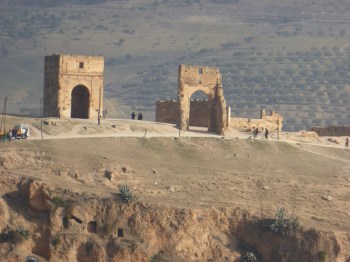
Walking the short distance back to the medina we had a good view of a small section of the crennelated rampart walls.
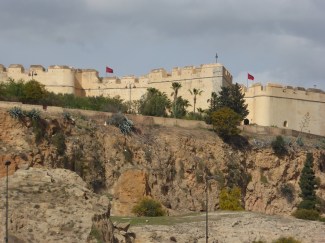
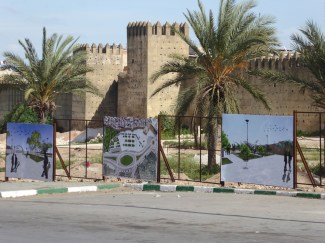
Billboards with artists’ impressions showed gardens, grassed areas and children’s playgrounds adjacent to the ramparts. The planned works had just begun.
Back at the riad, we relaxed for an hour or so. Later we ticked off the places that we had visited from our list of must sees, got ready and went out again.
Many children were playing outside as we headed back to the medina, their mothers were sat chatting. The cafes a few steps away were bursting at the seams. The clientele was predominantly male, the majority were watching football on a small screen. A few others were sat outside in the warm evening.
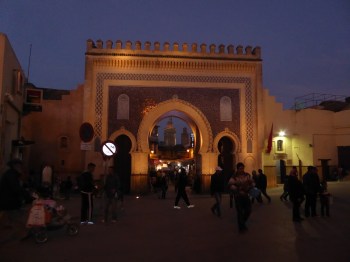
It was 7.30pm and almost dark as we strolled through the Blue Gate into the medina.
Once again we admired both the gate and the minarets its horseshoe arch framed.
There was a jolly atmosphere in the medina. Locals and tourists mingled together as they sauntered up one of the main arteries. Families with small children were buying drinks from stalls.
Stopping to look outside a spice shop, I pointed at something named ‘Berber Tea’. A young lady seemed to fly out the shop. “Can I help, can I help?” she enquired. “Oh we were just wondering what is in the Berber tea…” “It’s lavender, hibiscus, mint etc, we call it Moroccan whisky” she explained. “Alcohol free!” she added beaming.
Further along, at a small shop selling gravestones, we stood watching a man carefully inscribing words into the white marble. One man was applying paint to the words with his hand; another with a brush. After leaving the paint to dry slightly, the surplus was removed.
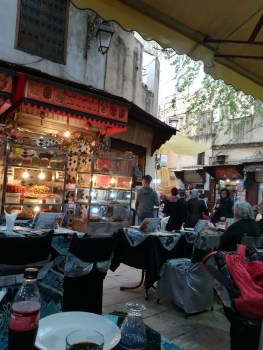
For our evening meal we decided to eat in the covered area in the souk where there are a few eateries together. Opposite there was a double fronted shop selling sweet pastries. The window display was full of plates piled high with different sized and shaped delicacies. Many would be filled with honey, nuts and dates or as Dave says “sticky sweet stuff.”
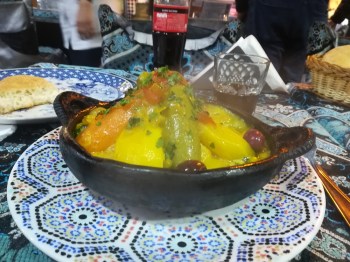
Dave ordered harira soup to begin with followed by a chicken and vegetable tagine and I chose a beef and vegetable tagine. Both were delicious and they were brought to the table steaming. The vegetables included carrots, peas, turnips, potatoes and courgettes.
Dave had a coke and I ordered a G. & T. which here in Morocco means a ‘glass of tonic’! The bill was even cheaper than the snack places in the Jemaa-el-Fna Square in Marrakech and the tagines much larger!
Previous Next

 lindaruddstravels.com