Friday 28th February 2020
Marrakech – Atlas Mountains : Aït Benhaddou : Ouarzazate –Taourirt Kasbah
The travel alarm rang at 6am. Jamal had promised to have a small breakfast ready for us at 6.30am.
Just before 7am we heard the knock on the riad’s door, a young man had arrived to take us to the waiting minibus.
It was still dark and as we walked swiftly through the alleyways we saw for the first time bags of rubbish. There were also freshly swept piles of debris and we wondered if someone would be along soon to collect it all.
Handcarts are used as a mode of transport here, to ferry goods to shops from the delivery wagons, to take tourist’s luggage from taxis to the riads and back again. So, perhaps the handcarts are also used for collecting the waste.
It was a modern minibus and there were a total of eight passengers and a driver who would also act as a guide. Luckily we managed to get the front seats next to the driver; actually it was only one and a half seats really so it was a little cramped for Dave and I but worth it for the first class view.
It would take us about four hours to cross the Atlas Mountains. As we left the medina we joined the modern dual carriageways again. Decorative red and green lights were attached to the lamp posts depicting Moroccan flags .
The road has miles and miles of large scale road works. In places it is being widened, and they are cutting through the mountains in other places, no doubt to improve the current crazy curvy route!
In addition to this a draining system is being installed, hundreds of workers and scores of wagons and rock shifting plant are working throughout the daylight hours.
Also sharing the road but thankfully driving in the opposite direction are numerous rally cars as it is the annual Renault 4L Trophy.
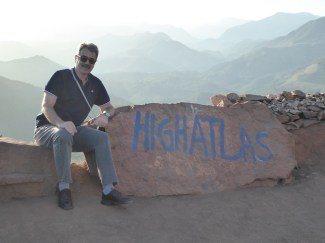
Our first stop was at a view point, ‘High Atlas’ had been painted roughly on a large rock and the panoramic view of the rolling mountains behind is just incredible.
Minerals and crystals were displayed on a makeshift table, most of which had been artificially coloured to give a more intense colour. For me this ruined their natural beauty, other samples that we saw later in the day had clearly been manufactured.

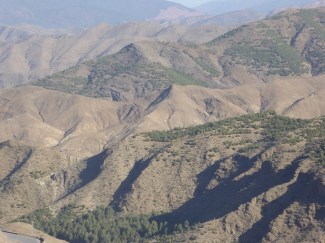
The mountains continually changed colour and shapes, there were numerous shades of green from the trees, shrubs and rocks. There were scenes with shades of red, beige and sandy hues mixed with black slate and tints of purple, all of this was occasionally topped with snow covered peaks.
At one point we saw a snow plough at the side of the road and speculated as to when it had been last used.
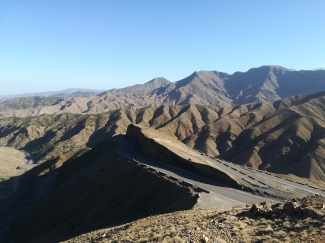
The mountain pass known as the Tizi-N-Tichka Pass has dizzying heights and breathtaking switchbacks. It is the country’s highest road and its elevation reaches 2260 metres.
Finally, we reached Aït Benhaddou. The fortified village referred to as a kasbah or ksar is situated on the old caravan route between Marrakech and the Sahara
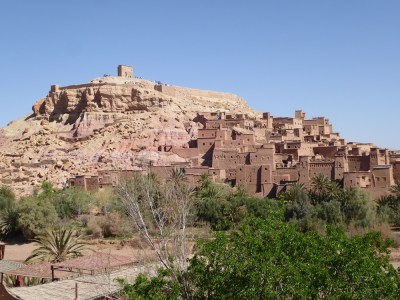
Our driver recommended that we had a local guide, and he arranged that for a small cost per person the guide would accompany the eight of us.
The ksar was built in the 11th century. It continually has to be repaired due to both the heavy rains and also the materials that were used in its construction. Mud, manure and straw were the original ingredients that were used to manufacture the bricks.
Since the ksar has become a UNESCO heritage site, wood and other materials have been used in its repair and restoration.
Many years ago seventy three families inhabited the ksar, a mixture of Muslim and Jewish households. Due mainly to the lack of utilities and the lure of modern homes just a short walk away, the majority of the inhabitants deserted the village during the sixties. Today, only eight families remain.
UNESCO paid for electricity and water to be installed in the ksar and also for a primary school to be built in the new village.
The biblical setting has been used in many films-Lawrence of Arabia, Gladiator, Queen of the Desert, The Bible, and Jesus of Nazareth to name just a few.

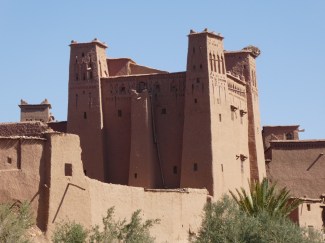
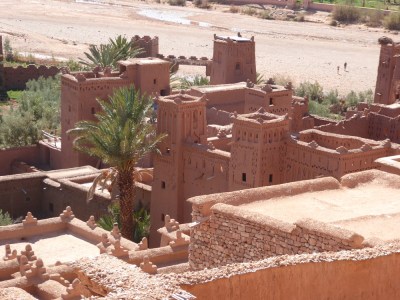
The guide pointed out a disused stork’s nest on one of the patterned turrets and I commented on how I would love to see one with a stork in it.
Whilst the guide was informative, he was also repetitive. I was aware of the time ticking away on our ridiculously low allocation of time, we had just one hour for this site. After a while Dave and I paid the guide and agreed to meet our driver and the rest of the group at the scheduled time, one couple had wandered off earlier.
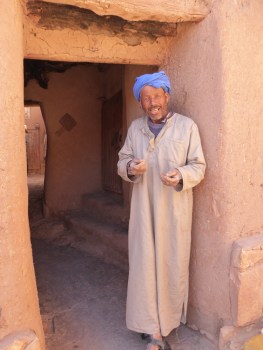
A man standing in his doorway beckoned to us and gestured that we could go into his house. This was too good an opportunity to miss!
The house contained a small kitchen with a bottle of calor gas and a two burner portable hob. Another long room was carpeted and had lots of rugs piled up so perhaps this was a room used for all manner of things including sleeping.
Behind another door, where at first we thought we may find a bedroom, we found three sheep lying on a bed of straw.
A few of the houses had goods displayed outside the properties which were for sale. A quick glance confirmed that they were typical Moroccan souvenirs. However, we were not at all interested in shopping and there was no time anyway!
Looking at our watches and snapping a few more shots, we regretfully started retracing our steps. This is why we don’t like doing organised tours – not enough time at the place that you really wish to see and too much time at other places!
Walking back to the minibus, Dave spotted a stork’s nest on top of a mosque’s square shaped minaret with not one but two storks! How lucky are we!
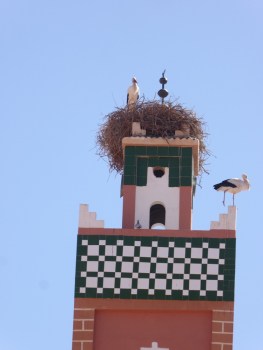
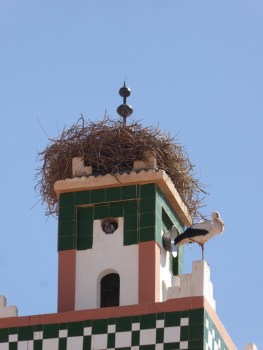
While waiting for the other people to return to the transport we stood and photographed and watched the long legged birds. Wow! Brilliant! It was just what I had hoped to see!
All the minarets that we have seen so far in Morocco have been square, unlike the numerous round ones that we have seen in many other countries.
In Marrakech we noticed that the minarets had three or four orbs on the top which is apparently the traditional style here in Morocco. The Mosque’s minaret in this tiny village has the crescent with a star in its centre atop three metal orbs.
After a short ten minute drive, we stopped and the driver announced that it was time for lunch. Dave and I would have much preferred to have the allotted time at Aït Benhaddou; the couple that we shared a table with said the same too.
I ordered a vegetable omelette. A plain omelette arrived with a small mound of pieces of potatoes and a few sliced courgettes on the side. “Mmmm, a deconstructed vegetable omelette” I commented.
Back in the minibus we drove to Ouarzazate. En route we passed a large dusty field with many of the Renault rally cars; this was obviously some sort of check point area.
On the outskirts of the town, the driver pulled up at the aptly named Atlas Studios and enquired if any of us wished to visit. As no one was interested he continued to Ouarzazate. The town appears to be quite modern, no doubt this is due to the amount of visitors it has for the film studios. A roundabout on the road leading to the town has a clapper board at its centre.
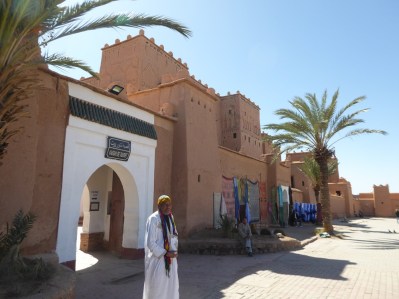
A few minutes later the driver pulled into a car park next to a cinema museum; on the opposite side of the road was a Kasbah. The driver suggested half an hour at each place and six of us immediately headed across the road.
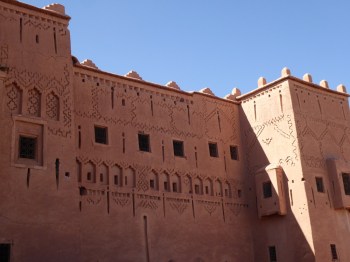
The Taourirt Kasbah is the small town’s only historic building.
It was built in the 19th century and belonged to the El Glaoui family who ruled the south and dictated who ventured over the Atlas Mountains.
The Kasbah’s exterior was impressive and in good condition
With a payment of just 20 MAD (2Euro), we entered the courtyard where we were pressurised to take a guide for an additional 150MAD.
Declining the offer we explored the interior. It contained a maze of rooms, some of which were extremely small; one of the rooms had a terrace where more of the exterior of the building could be seen.
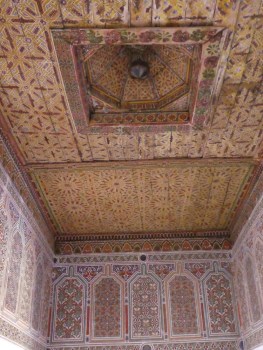
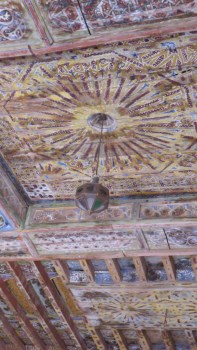
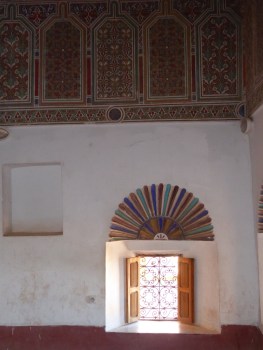
One or two of the rooms had impressively decorated ceilings and stucco work.
There were many small flights of stairs. Sometimes we had to retrace our steps up some stairs and through a warren of tiny rooms in order to find a flight of stairs that led us downwards.
It was quite confusing and easy to get lost!
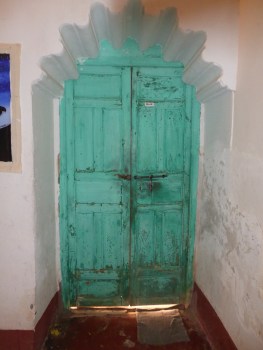

Just before we set off on the long return journey to Marrakech, we spotted another stork’s nest on a mosque’s minaret.


Dave and I took many photographs of the spectacular scenery as we drove once more through the Atlas Mountains.


In addition to the spectacular scenery, we saw many more rally cars and this time we were all travelling in the same direction, towards Marrakech. Throughout the day we must have seen 500. Unfortunately, we passed around 20 that were broken down. Their bonnets were up and young people were bent over them frowning and tinkering with their engines.
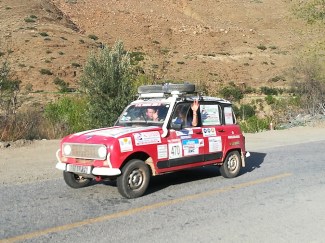

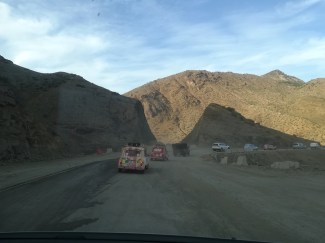
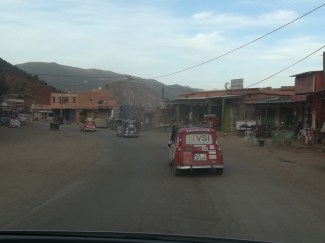
The rally is an annual event and mainly supports Moroccan schools and children. A huge amount of school equipment is donated to the schools.
The criteria to enter the rally is that you must be a student and you must own a Renault 4L. The ten day rally covers 6,000 kilometers.
As we stopped to stretch our legs at the final stop of the day, we waved and cheered on the rally drivers. They responded by waving back and tooting their horns, many of which played various melodies.
Engineers and labourers were still working on the road works after 7pm.
Eventually we reached Marrakech at 8.15pm and we all agreed to be dropped off in the ’big square’. I think that all of us had the same thing in mind, food somewhere before heading back to our accommodation.
At a small roadside eatery, Dave ordered a traditional tagine which was called kefta bil matisha wa bayd –meatballs in a rich tomato sauce topped with an egg.
My evening meal was turkey skewers and chips. Once again our meals were accompanied with a couple of soft drinks. Places serving alcohol are extremely rare inside the medina.
Today has been incredible. Travelling through the Atlas Mountains on the rugged terrain alongside the rally cars on their epic journey added to the unforgettable experience.
Back at the riad around 9.30pm, we showered, packed and fell into bed. Our alarm is set for 5.

 lindaruddstravels.com