Wednesday 26th February 2020
Chania, Crete to Marrakech – Souks : Jemaa-el- Fna Square
Both of us were awake when our alarms went off at 3.40am. As always, we set two alarms as we have a plane to catch!
The aircraft for our flight had been changed so therefore as we were boarding the plane at Chania we were notified that our seats had been altered.
Around 45 minutes later we landed in Greece’s capital city, Athens. The time was 7.20am so we had enough time for breakfast before our 9.15am flight to Marrakech.
Dave’s shaving foam was confiscated at security due to it being 110ml therefore not within the 100ml limit. A little baffling as we have purchased this small ‘travel size’ many times, so has the packaging changed or has no one noticed before (including ourselves!).
The 4 hour 20 minute flight covers 2990 kilometres to the Moroccan city of Marrakech. At boarding we were asked if we had changed our seats online. “No”, we chorused, the member of staff made a call and then proceeded to print new boarding cards. She apologised for the hold up as she handed them to us and informed us that she had given us a row of three seats with extra legroom. Thank you Aegean! My 6ft long legged husband was extremely happy.
As usual we have planned our Moroccan adventure ourselves (with a little help from our friends who have visited the African country a few times) and we will be staying in four different places-Marrakech, Fez, Meknes and Essaouira. Our chosen accommodation throughout the trip is the traditional guesthouses or hotels known as riads. Apart from staying in the aforementioned places we are hoping for a day in Chefchaouen and possibly a day trip across the High Atlas Mountains to Aït Benhaddou. I only read about this UNESCO site a couple of days ago but wow I want to go!!
Marrakech’s medina has around two hundred riads, the majority of which promise a peaceful retreat from the hustle and bustle of the busy medina.
As usual I reread information and flicked through the guide books again during the flight. I read that contrary to some reports ‘eating out at Jemaa-el-Fna Square is possibly safer than eating at some of the restaurants’, this is due to the high turnover of fresh produce. The produce is apparently on display so the quality of both the vegetables and the meat can be easily inspected.
However warnings were given to use bread to eat the food rather than the quickly rinsed plastic cutlery that is provided. Being resourceful we quickly retained our plastic cutlery provided with the in flight meal.
Our first view of Marrakech as the plane circled in its descent was of low red sandy coloured buildings, this scene was dotted periodically with minarets. Apparently no construction is permitted to be taller than the mosques’ minarets.
The airport has a surprisingly futuristic appearance. A form was handed to us to be completed before we were permitted to continue through the airport. The questionnaire was relating to the coronavirus.
As we left the airport, the unexpected heat hit us, the forecast had told of temperatures ranging between 18 degrees Celsius and 20, with a possible plummet to a much colder 6 degrees at night. However it was high 20’s and we were dressed in jeans and boots!
Our prearranged transport was waiting for us and the young man drove us to the city’s medina. A man from our riad met the taxi and led us through the dusty alleyways and pointed us in the direction of our accommodation. I wondered if we would find our way back out again!
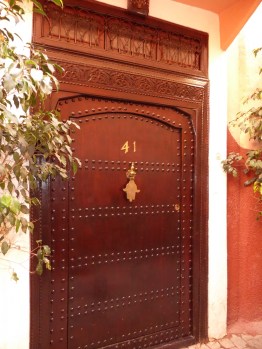
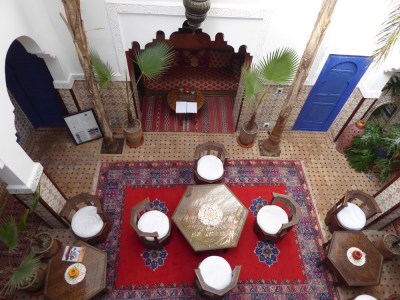
The riad had a large brown painted wooden door, and we used the brass ‘Hand of Fatima’ door knocker to announce our arrival. A lady welcomed us and led the way to a blue and white inner courtyard. These interior courtyards are typical of the architecture of the riads.
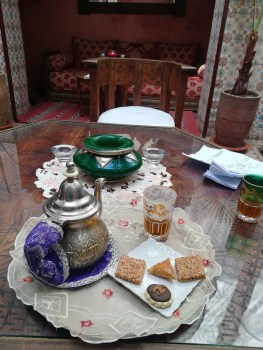
The lady brought us traditional mint tea served from a silver teapot. The tea should apparently be poured from as high as possible into the cup without splashing. The first cup is often poured immediately back into the teapot to cool it a little.
Another lady arrived after a couple of minutes and enquired “Parlez vous français”? I looked pointedly at Dave who had agreed to learn some French and brush up on the little he already knew.
Somehow between the three of us we managed to converse. Words like regardez, excusez-moi, combien etc somehow came to the front of my mind, albeit mixed with a little Greek and English! While drinking the soothing mint tea I had flicked through a ring binder advertising possible tours and we even managed to book a day trip to Aït Benhaddou!
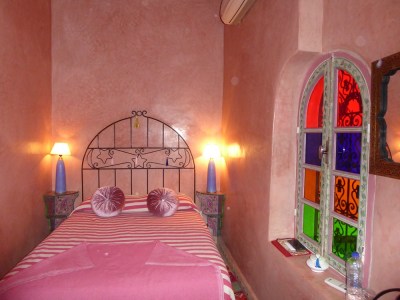
Our room had a wooden door with a padlock on it. The padlock, we would learn was often the norm.
It was colourful, small and very narrow but perfectly adequate for our needs.
A few minutes later we were retracing our steps through the busy alleys to the place where we were dropped off.
Our original plan was to get on ‘the big red bus tour’, so we would get our bearings. However we agreed to start wandering and see what happened.
There were a few tiny lock up shops, more like cubby holes really. One had beautiful handcrafted wooden items. Small wooden boxes, domino sets and a whole range of wooden products lined the shelves of the doors of the tiny business. The friendly chap invited us to watch, crouched on his haunches with his foot on a small lathe and using a chisel he proceeded to create a small wooden pendulum/pendant. Incredibly it had a moveable ring at its centre.

Within seconds the happy workman had drilled a tiny hole into it, cut a length of thread, popped the pendant on it, tied a knot to secure it and offered it to me. “How much?” I enquired. “Whatever you wish” was his reply. Dave paid him and I took a couple of photographs. I showed a couple the pendant, they had been tentatively watching the scene. They moved a little closer; hopefully he would get another sale from them.
There were quite a few brightly coloured lamp shops and mirror shops. Heading into the souks we intended to cut through to the Ben Youssef Medersa but ended up just wandering for quite some time. It was now late afternoon and the souks were fairly quiet and none of the sellers were pushy.
When we came across the medersa, we learnt that it was closed for renovation. Conflicting information on the internet had led us to believe that it had just reopened. This former Islamic School (also known as a madrassa) has intricate zellij tile work in its courtyard. It is promoted as one of the top places to visit in Marrakech so it is a disappointment that its doors are firmly closed.
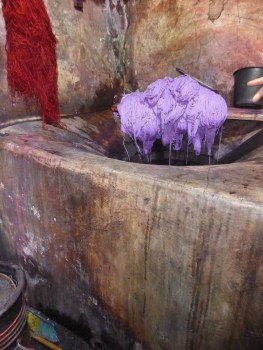
Continuing we wandered into the dyers’ souk, hanks of wool in all the colours of the rainbow were hanging to dry. A guy showed us a huge stone sink where the dyeing was done. The jars of the dye powder were lined up on shelves, indigo, ochre and saffron were amongst the numerous shades available.
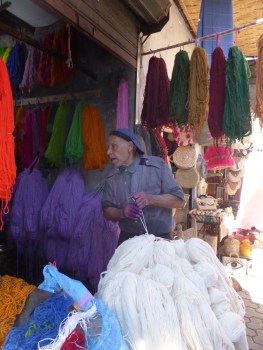
There was a silver souk, dazzling silver teapots and trays dominated most of the stalls with some equally shiny brass tableware competing on others.
Warnings of scams were in all the guidebooks and reviews on the internet. We were obviously aware but enjoyed a little banter with the people.
A guy stopped us and said that we had to visit the tannery. He said it was the final day of a three day event where the Berbers come down from the High Atlas Mountains to process their skins and that it was a fabulous sight to see.
He pointed us in the right direction, a few seconds later, he shouted after us “Wait there is a Berber”! Then, he yelled “Hey Berber, show these the way”. “It’s okay, we are just wandering” we said. “No money, no honey” was his reply. The ‘Berber’ continued to walk a couple of steps ahead of us, politely but firmly we told him that we didn’t need his help and we turned around and walked the other way.
This occurred a further three times, each repeating their phrase ‘No, money, no honey’, and with a ‘Berber’ tagging alongside us. One chap trailed behind us for quite a while insisting he was going that way. We stood still for a short while and I smiled at him and said “Bye”. He looked puzzled and continued walking in the same direction but we smiled to ourselves when a couple of minutes later we spotted him doubling back and retracing his footsteps (off to find more tourists, no doubt).
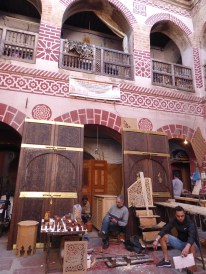

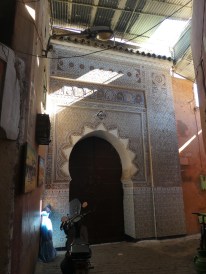
Apart from the stalls and workshops amongst the narrow lanes and souks there is also the amazing architecture to enjoy. The structures include ornately decorated fountains and arched shaped doorways which are the entrances to a mosque or madrassa.
Hearing the muezzin call the faithful to prayer, we saw from our map that we were close to the Ben Saleh mosque. Its tall minaret had a green leaf decoration.
Unfortunately, non Muslims are not permitted inside mosques in Morocco.
School kids in their early teens were pouring out of a large school. All were wearing short white jackets similar to dentist or doctors’ coats.
One young lad saw us looking at our map and asked where we were looking for. “Oh, we are just wandering” we answered him with our now well used phrase. He told us that we could go to the big square; he added that he lived close to it and that he would show us the way.
So many folk have offered to take us somewhere and there are so many scams that unfortunately you do start doubting everyone. He was a nice lad, just 14 years old, he spoke excellent English and he beamed at us when I told him so.
He pointed to the nearby building where some kids were still dwindling out through the gates. “That is my school” he said proudly. “I am learning English, French and of course Arabic. Later I will go to college and learn Spanish and Italian” he continued. After chatting a little longer we wished him well and continued on our way.
A younger lad around ten or eleven ran up to us laughing “Come, come” he said in a singsong voice as he beckoned to us “to the square, to the square” he sang and started to run around us. An older girl, perhaps his sister suddenly grabbed him and slapped him lightly on his head, which immediately put an end to his skylarking.
So, we headed to the Jemaa-el-Fna Square, the city’s most well known destination.
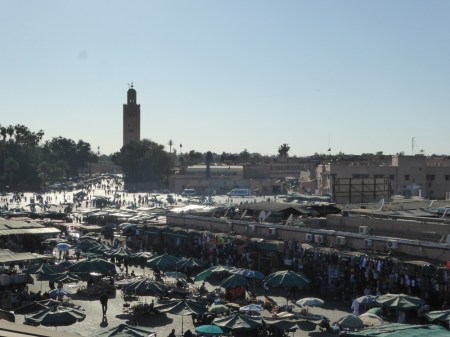
Locals and tourists mingle together in the city’s largest square. Some people are just using the square to cut through on their way home and are walking purposefully.
The majority of folk, however, are dawdling slowly, taking in the sights and the smells. The square has a market as well as places to eat and it is also the setting for various entertainments.
A small crowd of people were gathered around a band playing music accompanied by a female dancing. Another larger colourfully dressed band is walking around the square. More music led us to snake charmers congregated together under half a dozen parasols.
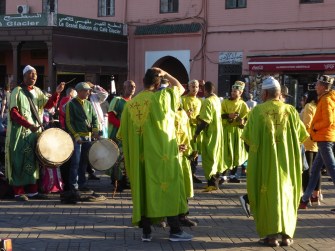
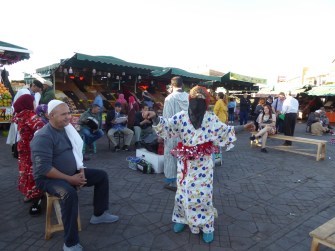
Deciding we needed a cold drink we headed to one of the upstairs terraces of one of the many cafes and restaurants that are situated around the perimeter of the square. From here we had an excellent view of the activities below.
A couple of ladies were offering henna tattoos. They wore Moroccan traditional djellabas; the long flowing robes have a pointed hood and are worn by both men and women. They are often paired with a litham, a type of veil that covers the lower part of the face leaving only the eyes visible. Originally, lithams were worn by nomadic tribes, the thin strip of cloth was often wound around the head and then across the face.
Another female was selling a variety of the hats commonly known as a fez. The correct name for the hat is a tarboosh. Fez refers to the Moroccan city where the original dye for the red fezs was produced. Crimson berries were used to make the red colouring.
From our elevated position above the square we spotted four minarets. One of them was the minaret from the imposing Koutoubia mosque, Marrakech’s most famous landmark.
There were around forty small eateries, all with long benches, small tables and plastic tablecloths. Fish, seafood, skewers of meat, chops and koftes were all neatly displayed alongside fresh vegetables and salad.

A young man on a nearby fruit stall attempted to entice us over to his stall as we passed by offering us a taste of his apricots. But it was time for our main meal of the day so we continued trying to decide which eatery to choose.
Eventually deciding on one of the stalls, we joined a couple of young chaps on one of the benches and ordered our food.
We ordered traditional Moroccan dishes, a vegetable tagine for me and a meat one for Dave and we added a dish of vegetable couscous for us to share. As expected, wine and beer were not available so we ordered coke and a bottle of water
Tagine is the name of the vessel that the dishes are cooked in. They have a cone shaped lid that keeps the steam in the pot ensuring the dishes are juicy and moist.
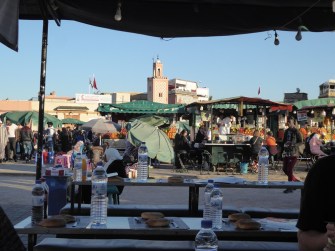
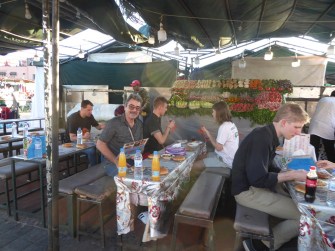
Our evening meal came to the grand total of 110 Dhiram which is the equivalent of 11Euro. Unfortunately the young chaps seated next to us and a couple on another table all had a problem with being overcharged. I spoke to the man regarding the young guys’ bill confirming what dishes they had, after which he reduced their bill by 120 Dhiram, quite a difference!
These popular eateries are dismantled at the end of each evening and reassembled the following day in the late afternoon.
More people were arriving in the square and the place was livening up. There were folk forming circles around musicians and other performers. A couple of guys had a peacock, guinea pigs and pigeons and they were charging for folk to take photographs. Barbary macaques secured on heavy chains were being led around the square. Their owners were also hoping for cash in exchange for a photo of an ape on one’s shoulder.
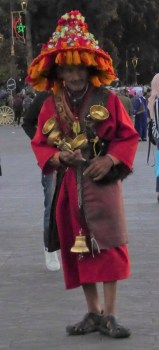
Another photo opportunity which is much more to our taste is of a guerrab, otherwise known as a water carrier.
In days gone by the brightly dressed man would wander the souks selling water to the thirst quenched stall keepers and customers alike.
He would announce his arrival by ringing a bell; the water was carried in a goatskin. Copper and tin cups that were tied around his body would be used to serve the water. The once popular profession declined when running water became available and more recently with the easy obtainable plastic bottles of water. These days the Guerrab’s income is derived from posing for photographs.

It was around 8pm and the sun had gone down leaving a light orange glow behind the Koutoubia Mosque.
After a walk around the interesting square once more we decided to head back to our riad and unpack. Luckily, Dave found the way back easily.
It has been an interesting first day in Morocco and we are pleased that we have managed to see so much today.
Previous Next

 lindaruddstravels.com