
Saturday 29th February 2020
Marrakech to Fez – Bab Boujloud: Medina
Today we leave the modern city of Marrakech with its 19 kilometres of rampart walls protecting its ancient medina and travel to Fez.
Our early alarm woke us at 5.45am, two early mornings on the trot. As we switched off the alarm clock we promised ourselves a lay in until at least 7.30am tomorrow!
The taxi arrived promptly at 7am and whisked us out of the medina and to the impressive glass fronted railway station in the modern part of the city.
Our train carriage had six seats with an overhead luggage rack. A lady arrived seconds before the train departed. In perfect English she remarked loudly “Phew, I didn’t think I was going to make it, I have a rendezvous with a doctor”.
She then proceeded to rearrange everybody’s luggage in order to make space for her rather large case. I did wonder why she needed such a large case for a doctor’s appointment!
I voiced my concern as to the seemingly precarious way that she had placed my much smaller case, “Is that ok, I don’t want it to fall on someone’s head?”
“It will be fine, because the centre of gravity is here” she retorted confidently pointing at a specific point on my small suitcase. However, after I had helped her heave her huge case up onto the rack, she did turn my case around again.
The train departed promptly at 7.50am. It is expected to arrive in Fez at 3.50pm. A uniformed guard complete with cap duly arrived with a digital machine to check the tickets.
It was a foggy morning as we left the city behind, passing large luxury properties on the outskirts followed by clusters of palm trees similar to an oasis.
As the fog lifted, it revealed a grey sky in contrast to the piercing blue skies of the last couple of days.
The journey took us through flat agricultural scenes with growing crops. Further along, a shepherdess was tending her flocks. Nearby a chap stood close to his two cows, there were no fences or walls surrounding the fields and the animals were perilously close to the tracks.
A pinky-red hilly landscape had the occasional hamlet, its abodes constructed from mud and manure bricks. The only stone building was the area’s mosque.
One or two rivers meandered through miles of scrubland and disappeared into the distance.
The train passed through Casablanca and also the country’s capital Rabat.
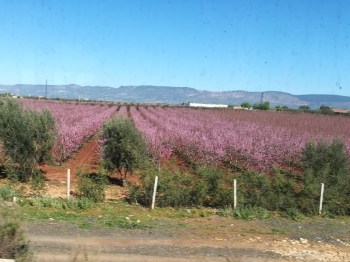
Nearing Meknes which is well known for its agriculture, there were a couple of fields of small fruit trees with vivid pink blossom.
A chap who had just joined the train struck up a conversation with us, offering information of places to see and where to eat in Fez. He then enquired where we would be staying. I quickly nudged Dave and said “Oh, I can’t remember”, a short while later he left the carriage.
The lady next to me warned “You must be careful what you say to some people, he probably hoped to be your guide and maybe pester you.” We started to chat generally; after a while I asked if she was a Muslim. “Yes” she replied. “You choose not to cover your head…due to you being a modern woman” I asked.
“No, it is not to do with being modern, it is because that nowhere in the Koran, in the sutras, does it say that I must cover my hair” the lady, also named Linda explained. “It is just how some people read and understand things” she added.
The three of us continued chatting until another man entered the train carriage and started asking where we were going, where we were staying etc. When our responses became less forthcoming, he too left the carriage.
Linda had informed us that a taxi should cost 25 Dh/MAD maximum to Batha Square from the railway station. The first couple of drivers who approached us demanded many times this amount. They laughed and walked away when we told them the figure we expected to pay. Another driver a few steps away from the station quoted 30 Dh/MAD which we happily agreed to.
As we were getting out of the taxi, a few men gathered around us, all speaking at once “Where are you going? Do you need a place to stay? A guide?” After being up for hours and having spent quite a while attempting to bargain with taxi drivers we were both feeling a little frazzled. It took us a few minutes to remove ourselves from the unwanted offers of help.
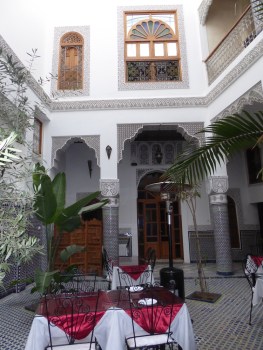
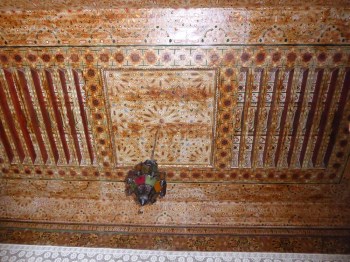
It took us about thirty minutes to find the Riad Sheryne, instead of the five minutes that the information with the address etc led us to believe. However as we entered the riad I just said “Wow!” The interior courtyard is amazing. Zellji style tiles cover the floors, walls and pillars. In an alcove off the courtyard there is a seating area, its beautifully decorated ceiling of cedar wood is reminiscent of one that we saw in the Bahia Palace.
The manager of the riad was a Frenchman so we had a bit of a language problem again. He gave us a ridiculously small map that had been badly photocopied and he marked a cross on where the riad was situated.
He insisted that Batha Place was just two minutes away and the famous gateway Bab Boujloud was just five minutes. Our other enquiries led him to speak louder and faster, we were getting nowhere… So we asked for the key to our room, dumped our bags and headed out in the direction he had said.
Two minutes later we reached Batha Square, well it’s easy when you know how isn’t it!
As we passed a large hotel, we popped in to ask if they had a map. The male receptionist told us that maps were not available and we needed a guide and said that he could arrange one. He continued to tell us about excursions and trips he could organise, no doubt to supplement his wages. One of the hotel’s residents dressed in a pale yellow djellaba arrived and asked for his room key and we managed at this point to thank the receptionist and make a hasty retreat.
Heading to the hotel’s restaurant, we checked the menu and bar list. Only a few places are permitted to sell alcohol, usually these are located outside the medina.
As we left the hotel we were approached by the hotel’s guest in the pale yellow djellaba, he asked us if we needed a guide, we just laughed and continued on our way.
A couple of minutes later we arrived at the Bab Boujloud, the Blue Gate.
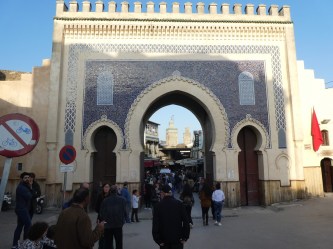
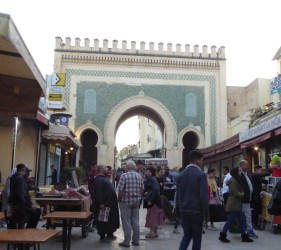
The monumental structure has three horseshoe arches and is one of the main entrances to the city’s ancient medina.
The exterior of the huge gate is blue, the colour of the pottery that has been manufactured in the city for centuries. These glazed ceramics can be seen at many stalls and tiny shops within the medina.
On the medina’s side of the gate, it is green, the colour of Islam.
Eateries including restaurants and snack bars are situated at either side of the gate as you walk into the medina. A chap approached us and asked if we would like to eat and perhaps have a glass of wine or beer; we looked inside but the place was very tatty so we made our excuses and left.
A short while later we enjoyed a Chinese meal and a couple of ‘Casablanca’ beers.
Afterwards, we decided to grab a taxi to a large supermarket where we would be able to purchase a bottle of wine. Dave asked the driver the price and he pointed to his meter. The drive was a little less than the one we had taken earlier and cost an unbelievable 6.8 MAD, just 68 cents (Euros).
After purchasing our goodies at the huge supermarket, we returned to Batha Square, paying a similar small amount.
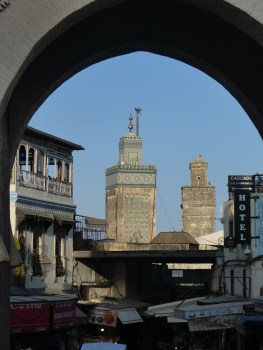
After dropping our shopping at our riad we returned to the Medina. As we walked through the Bab Boujloud this time we stopped to take photos of the gate and the impressive minarets that we could see in the background.
I had asked Linda yesterday why the minarets had spheres on the top as opposed to the crescent we had seen in other countries. She told us that it had no significance and that it was just a different style of architecture.
Walking past the eateries we entered a covered area where there were more restaurants, the only way you could tell where one eatery stopped and another started was by the different table cloths. A hammam was situated in the corner of this covered area.
Wandering through the souks and small streets and alleyways, we spotted some fabulous architecture including doors and fountains.

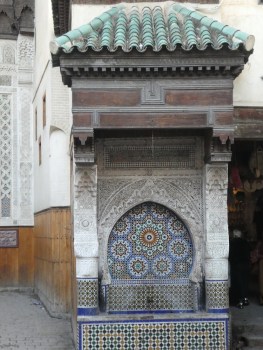
As we were gazing at the water clock a young guy came out of the nearby butchers and started to tell us about it. It was constructed in the 14th century to ensure the correct time for the muezzin to declare the call to prayer. It was a complicated system that operated by water dripping into a brass bowl, when the bowl was full, it triggered a mechanism to open a window. The time device has twelve brass bowls and twelve windows.
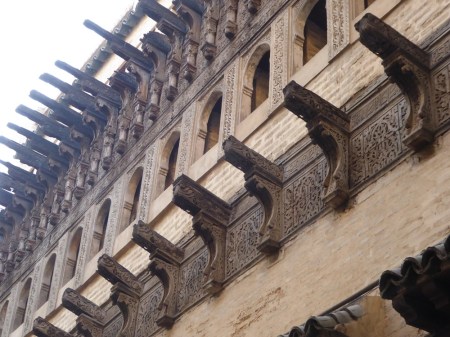
Unfortunately, despite the many attempts at repairing the water clock, many centuries have passed since it has been in operation.
The friendly young guy told us that the butcher’s shop was actually his father’s and that he had set up a pottery shop next door so he could help his parent when necessary. He asked if we would like to look around his shop but we declined explaining that we weren’t shopping. He didn’t push us; so far we have found the traders here less pushy than in Marrakech.
It had been a long day, so we headed back to the riad.

 lindaruddstravels.com