
Saturday 7th March 2020
Meknes to Essaouira
It was pitch black outside when our alarm woke us at 5.40am. Ashraf had our breakfast ready for 6.15am; goodness knows what time he got up.
He then walked with us to get a taxi, lighting the way with his phone through the darkened alleys. The temperature was just 4 degrees!
Ashraf stepped out into the road and flagged a passing taxi for us and told the driver our destination. He then explained to us that Meknes had two railway stations and we were not departing from the one that we had arrived at. Ashraf had been to the station a couple of days previous and purchased the tickets for us.

Our tickets are for the 07.17 train to Marrakech, it is a six hour journey, arriving at 13.14. The next part of our journey will be a three hour bus ride to Essaouira.
So, we are expecting to reach the Atlantic Coast by 6pm. This, we decided is better than arriving at 8pm, which would have been the case if we had risen at a reasonable time and got the train at 10am.
Somehow, we have managed to recall more French from our schooldays. Generally, the majority of people here speak Arabic and French. Some people speak good English and also some Spanish. Many of our conversations have started with a little French, had a little English in the middle and of course ended with the Arabic shokran or inshallah.
The train journey was comfortable. The journey took us through similar scenes to the ones on our way to Fez – olive groves, tiny villages, barren land, mud brick houses and a modern town or two.
At one of the train stations we saw a double decker train which had ‘cafeteria’ emblazoned across one of its carriages. The high speed train covers the 323 kilometers (210 miles) between Tangiers and Casablanca in just 2 hours and 10 minutes.
For part of the journey we chatted to a couple of young ladies who, like ourselves, love travelling. Marla, originally from Arizona, was planning to make Madrid her home and to teach English. Her friend, Melissa, a New Zealander currently lives in Barcelona. Both of them were members of a pet sitting/house sitting network so travelled without the cost of accommodation. It was an interesting chat, and we enjoyed swapping our travel tales.
After a quick lunch sat in the sunshine at Marrakech railway station’s large branch of McDonald’s, we walked the few metres to the Supratours Bus Station.
With its modern buildings and wide pavements, this part of Marrakech appears a million miles away from its ancient medina.
As ONCF (Morocco’s rail company) and Supratours are linked, we already had our tickets which were purchased with the train tickets so we just joined the queue outside the waiting bus. However, as we went to put our small suitcases in the boot of the coach, we were told that we also needed a ticket for each item of luggage. So, we had to hurry to the small kiosk and queue to purchase the required tickets, our luggage was then duly stored. The bus was full so it was a good job that we had purchased our tickets a couple of days ago.
As we were leaving the city we passed many large impressive residences which were in complete contrast to the majority of the homes in the medina. After a few kilometers, we passed through a toll booth and joined an express road.
On the journey, we spotted quite a few female cooperatives, most of these manufactured products from the argan trees. The traditional process of extracting the oil is still practised in many places today. Goats eat the fruit and their digestive juices soften the fruit’s nut. The workers then retrieve the softened product from the dung and it is processed and products such as face cream and argan oil hair products are manufactured. Mmm!
The trees are endemic to Morocco and we passed hundreds of them. Luckily we got a fleeting glimpse of one large argan tree with many goats amidst its numerous branches eating the fruit.
One of the gateways to Essaouira’s medina was just a few steps away from the bus station; the alleyways are much wider than in the previous medinas that we have visited.
As we got closer to the riad we had booked, the alleyways became narrower and were lined with tiny shops. Their goods were stored in large baskets on the dusty pavement and hanging on the building’s walls.
When we walked into the riad, the largest one that we have stayed in, we were immediately impressed with the decor in the spacious reception area.


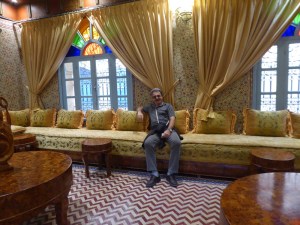
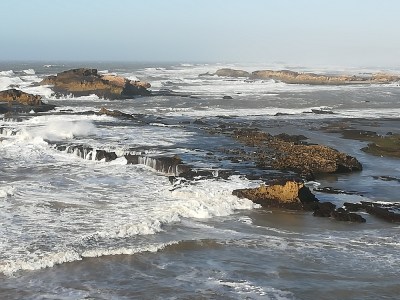
A short while later we were overawed by the magnificent views of the Atlantic Ocean from the riad’s communal areas and restaurant.
After freshening up after our long journey we popped out for a while, we wanted to retrace our steps and look at the eatery advertising ‘Live Gnawa Music’ every Saturday night. It was Saturday night of course and we agreed it would be good to see some local live music. Plus we wanted to pay a visit to one of the off licences and get a bottle of wine or two. The alcohol rules are much more relaxed here in Essaouira.
After checking the menu at the eatery we continued in the direction of the off licence. I knew we were getting close when I spotted a guy wandering along with what looked like a bottle of wine wrapped in newspaper and carried in a blue recyclable bag. Incidentally, there have been no plastic carrier bags in Morocco for four years; the fairly strong carrier bags that are readily available are produced from a recyclable material.
The shop was indeed just ahead; its windows were covered with huge advertisements for various well known brands of spirits. The shop was busy with both locals and tourists. A jellahbah clad man thrust a newspaper wrapped bottle of wine deep into his seemingly never ending pocket.
We returned to our hotel with our shopping and to get ready for dinner. Then we had a pre-dinner drink overlooking the magnificent ocean view. The waves crashed high on the rocks creating mini cataracts.
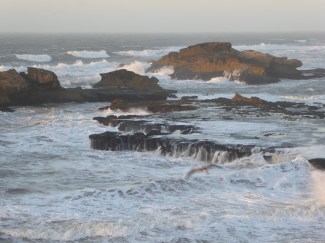
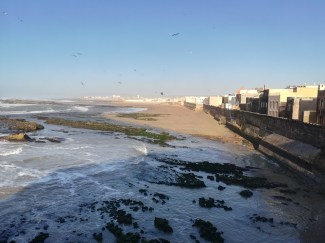
The sounds of the ocean and the views out to sea and along the coast were spectacular. Only as the sky started to darken did we set off through the alleyways to the eatery. This riad definitely has our kind of views!
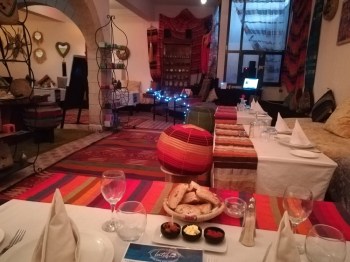
Arriving back at the eatery, we were ushered up some narrow stairs, the small landing opened out into a large restaurant.
Low traditional seating and vibrant coloured cushions and rugs decorated the room.
However, we were the only ones there.
By the time we had ordered and our food had been served, a few more diners had arrived. As if on cue, the musicians arrived, we guessed them to be in their mid to late teens.
The poster outside the building had showed older men wearing white jellahbahs, decorated with cowry shells and embroidery as is the tradition. On their heads were patterned tarbooshes. These musicians, however, played their music dressed in jeans and thick anoraks although they did don hats for a couple of tunes.
Gnawa music is apparently extremely popular in North Africa; their instruments are metal castanets and three stringed wooden lutes. The music has a long and interesting history.
Unfortunately however after just ten minutes we had heard enough and we were wishing that they would stop. At least we have now experienced the Gnawa music although we suspect not the best!
Ready for sleep after our long day, we returned to the riad.

 lindaruddstravels.com