Monday 2nd March 2020
Fez: Fez el Jdid : Danan Synagogue : Dar el-Makhzen : Bab el-Ftouh : Andalusian Quarter : Souks
After breakfast, we walked to the area known as Fez el Jdid; this district is also sometimes called White Fez or New Fez. The latter name is surprising as it was constructed in the 13th century!
The walk took us about twenty minutes and took us past a large park, its gates were firmly padlocked and a notice advised that it was closed on Mondays. Peering through the gates with our heads pressed against the metal, we could see that it appeared to be a lovely park and a peaceful oasis.
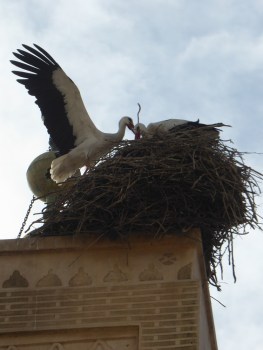
High on a wall, we spotted two storks on a nest. Unfortunately, we have no idea if one was an adult and the other a baby. Seemingly, both adults tend to the nest and feed the chicks. Anyhow, I just love them!
As we turned a corner we came upon an impressive gateway. Five men in different coloured uniforms stood in front of the gate. One of the men indicated to us that we were not permitted to take photographs. Referring to our map, we believed the gate to be one of the entrances to the royal palace.
Some of the outlets were just opening in the souks; other wooden doors were still closed. A few of the places already open had mannequins in their windows. All the dummies were modelling similar long velvet gowns with artificial gems decorating the necklines and cuffs.
Noticing a sign for a synagogue we decided to follow it and soon located the 17th century building. Seated outside were two police officers who confirmed that it was open to visitors.

A lady in a hooded long red velvet robe appeared at the door and informed us of the entrance fee. After taking the payment, she led us into the synagogue. Speaking rapidly she gave us a brief history of the place and pointed out various points of interest.
The Danan Synagogue is a Sephardic Synagogue. Although it has been restored, it is no longer in regular use, opening only for the ‘High Holy Days’.
Their Torah is made from antelope skin. It is swathed in protective material which she parted to show us the 17th century scroll.
There was an upstairs gallery where females would worship, separated from the men. Some stone steps led downwards to a stone purification pool. Known as a mikveh, this ritual bathing pool would often be used by a woman before she marries.
Another staircase led us past a living room and kitchen. Small children’s shoes were on the steps and this led us to believe that the privately owned synagogue is also a family home.
From the terrace at the top of the stairway we could view the Jewish Cemetery. Whilst we were on the terrace a man approached us “don’t go shopping on your own, you need a proper guide…” Even in a religious building there appears to be no respite from being approached by a hopeful guide. This is the third time this morning that we have been offered the services of a guide.
At the main gateway to the palace, Dar el-Makhzen, there was another set of uniformed guards. This time, however, photography was permitted. The King of Morocco and his family stay in the royal palace when they are visiting Fez.
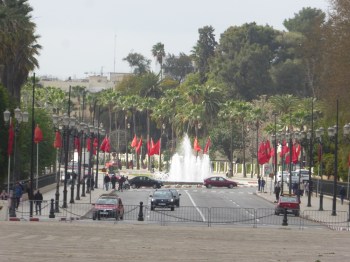
The garden leading to the palace was cordoned off. Beyond the greenery, a large fountain doubled as a roundabout and we could see the city’s red taxis circling around it.
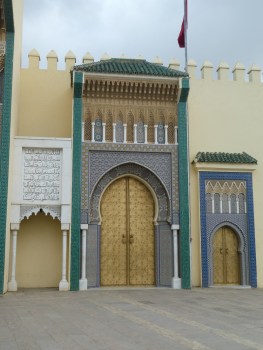

In the late sixties the main entrance was changed to where it is today.
New gates were therefore commissioned. The new facade is elaborately decorated.
Leaving the palace, which is closed to the public, we jumped in a taxi to Bab el-Ftouh.
The taxi already had one female passenger, the taxis here are often shared. It is a good idea in our opinion. The lady was dropped off at one point and an elderly man flagged the taxi a short time later.
After he had dropped him off, he stopped for a couple of minutes; we were busy looking around and we both assumed that we were stopped at traffic lights.
However, we suddenly realised that there wasn’t any traffic lights and he had just stopped the taxi. He was just sat, texting on his phone. With the meter running of course!
“Eh, excuse me, why have we stopped?” “Oh, sorry” he grinned, pulling away again. Dave and I just laughed; the fare would only be coppers anyway.
The ride was interesting and we passed a lot of the city’s fortifications.
According to our guidebook, the Bab el-Ftouh led to the Andalusian Quarter and the gate itself had three green horseshoe arches. So we were more than a little surprised when he pulled up at the curb and announced “Bab el-Ftouh”.
Had we pronounced it wrong? I thought. The gate that he was pointing at across the busy road was a plain stone gateway. Showing him the coloured photograph of the gate in our guidebook, he shook his head. “No, no this picture is not Bab el-Ftouh, maybe it is Bab Boujloud” he said looking closer at the picture. Then he corrected himself, “No, this is not the Blue Gate either, I am sorry I do not know this gate”.
The poor driver was as puzzled as we were. Deciding to get out and find exactly where we were, we paid him and thanked him for his help.
Within a couple of minutes, we managed to find a large placard with a street map; this was the first one that we had come across. The gate in front of us was, indeed Bab-el-Ftouh, clearly the photograph in the book is incorrect!
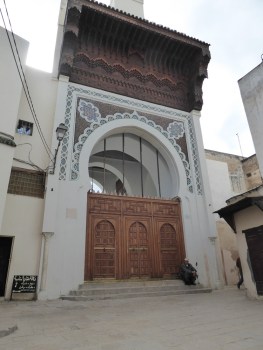
Passing the main entrance to the Mosque of the Andalusians, we stopped to admire its architecture.
Near to the mosque is the Sahrij Madrasa which I had read about in a memoir about Fez. The author had mentioned that it had a splendid courtyard. However, as we approached it, a chap told us quite firmly that it was not open to the public.
Continuing, we wandered aimlessly through the narrow alleyways and souks. After a while we decided to attempt to navigate our way through the myriad of lanes to the Karaouiyine Mosque and then back to the Blue Gate.
Well, as you can imagine, it took us quite some time and no doubt we took numerous incorrect turnings, but it was fun!
At one point we were turned back as police had cordoned off a section of the souk, we overheard someone saying “the King is coming”. Thinking that this was highly unlikely we continued. When we arrived at a main road, we were quite surprised, so we asked a chap for directions to the Karaouiyn Mosque. Speaking fluent English he gave us a few directions and instructed us to ask someone else for further directions along the way.
As we were crossing the main road, we saw many police vans and official government cars. Metal barriers were being placed along the curb and uniformed men and dignitaries were rushing around. Some of the area had been decorated in red and green, the same colours as the country’s flag. The King was coming to town!
Walking through the Place el-Seffarine, the noisy and busy coppersmiths square, we were back on familiar turf.
Passing the open door of the Karaouiyn Mosque, I joined other tourists catching a glimpse of its interior. Yesterday, we had managed to see its beautiful courtyard.
Having taken a couple of wrong turnings, we again asked for directions, this time to the Bab Boujloud. On the few occasions we needed to ask the way, we tended to ask shopkeepers or other people that couldn’t follow us. Most spoke good English and were extremely friendly and helpful.
Many people approached us wanting to be our guide, take us somewhere, or show us something. Basically, if you stop to look around or dare to get a map out, someone appears at your side. While the majority are not overly pushy or aggressive, they can be tiresome after a while.
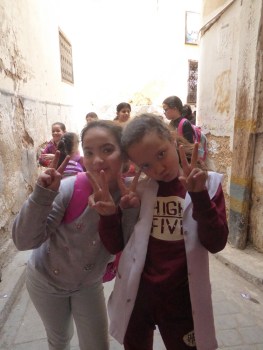
A couple of young girls, one wearing a t-shirt with the slogan ‘High Five’ and the other carrying a Disney Princess rucksack, came racing around a corner. They saw me taking a photo of something, posed for a shot and then ran off laughing!
The kids were leaving school and a couple of lads were scrapping and messing about. One young lad aged around eleven or twelve with perfect English said we could follow him to wherever we wanted to go (in exchange for cash). His shy friend not as confident with the English language hovered in the background.
Declining the offer but complimenting the young entrepreneur on his language skills we carried on.
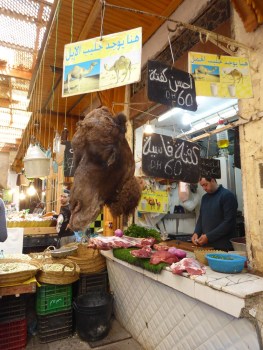
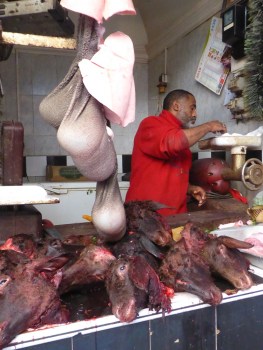
Passing butchers, we noticed the many goats’ heads or were they sheep’s? Dangling from metal hooks were bulls huge testicles. Another butcher had a camel’s head hanging up, signifying that the meat he sold was only from camels. A poster also offered camel’s milk. The camel meat looked similar to beef.
A guy stood on a corner holding a carton of ‘Winston’ cigarettes. A passer by stopped occasionally to purchase a packet or just a single cigarette from him.

A restaurant’s sunny terrace adjacent to the Bab Boujloud was where we chose for lunch.
One of the dishes we ordered was a soup, which was served in a small dish and accompanied with dates and cherbiyane. Pointing at the cherbiyane, the waiter explained “We make it like bread.” It resembled pretzels and was sticky and sweet.
After lunch, we returned to the riad for an hour or so before our appointment at the hammam.
As we passed through the Blue Gate we confirmed what we believed and what the taxi driver had also said. The photograph with the heading ‘Bab-el Ftouh’ in the guidebook is not the Blue Gate. Once again we wondered where it was…

Whilst we enjoyed our Moroccan Spa experience, it all seemed a little rushed. Seated together, we relaxed in a 3 metre by 3 metre tiled bathing room. A square trough with running water was at its centre.
A smiling young woman appeared dressed in a smart white cotton uniform similar to a doctor’s coat. She immediately removed it revealing her animal print ski pants, rolled up her sleeves and proceeded to throw small buckets of water over both of us in turn.
She then covered Dave with the traditional thick black soap that looked like sticky black toffee. After doing the same to me, using a rough glove, she exfoliated us both to within an inch of our lives. She worked briskly and firmly.
Immediately after rinsing us with more buckets of water, she applied a clay mask. Then, we were both washed and shampooed. Even Dave’s moustache was shampooed, which made me laugh!
The young lady then instructed us to relax for a while and led us to another room where there were wooden sun beds. The sun beds strangely faced a brick wall. However, gazing upwards we both commented on the spa’s interesting cupola. Less than two minutes later, two masseurs arrived and we were whisked off to separate rooms for our massages.
It was all a bit different to other hammams, but it would be, we are in Morocco!
With shining faces we decided to have an early dinner. Unusually for us, we agreed to go to the same place in the covered souk as we had the previous evening. This time we ordered ‘royal couscous’-couscous with small pieces of barbecued chicken and beef plus some red beef sausages and slices of vegetables.
After dinner we headed back to the riad.

 lindaruddstravels.com