Thursday 27th February 2020
Marrakech – Bahia Palace-Kasbah Mosque-Saadian Tombs-Marjorelle Gardens- Koutoubia Mosque
Well, as we unpacked last night we realised that we hadn’t packed any shower gel! Along with the shaving gel being confiscated we weren’t doing very well in the toiletry department.
Dave was pleased as he always is to see that there was a shower head holder! It was only usable by tall people though. I couldn’t even reach it and we laughed as we realised this. The washbasin was made from copper and it was surrounded by green and white tiles.
Living in Greece we are accustomed to notices in toilets requesting that no items are thrown in the loo. The notice in this bathroom stated “Warning: septic tank-please do not throw anything in the toilet that could trigger the alarm”.
Oohh! I wonder what the alarm sounds like!
All the walls of our small room are plastered and painted pink. An arched window has coloured glass in it which gives a good degree of privacy. The wooden double door opens onto the courtyard balcony.
This morning Dave’s trainers have suddenly decided to fall apart! Good job he has a decent pair of walking shoes with him as neither of us are willing to exchange some of our precious sightseeing time for shoe shopping.


A tasty breakfast was served to us in the Riad’s lovely breakfast room by Jamal.
Apart from serving breakfast and doing numerous other tasks, he would assist in any enquiries that guests had. Dave therefore arranged for Jamal to purchase our onward travel train tickets to Fez for us.
The riad has a roof terrace where breakfast can also be served. It has a pleasant shaded seated area but although the sun heats up later in the morning it is a little chilly early in the morning. Plus it is rather a lot of stairs for Jamal to climb!
Our first visit of the day was to the Bahia Palace. It was built in the 19th century and promises an array of Islamic and Moroccan architecture.
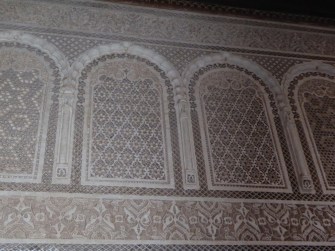
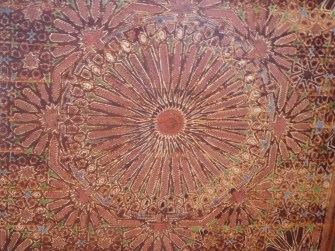
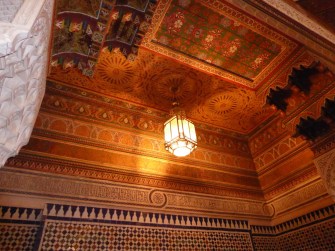
in the
Bahia Palace
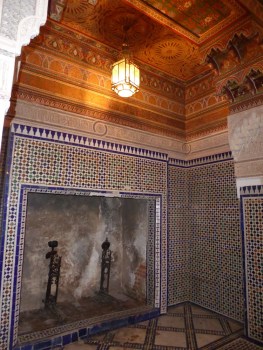
Well it definitely didn’t disappoint us.
The architecture is amazing and reminded us of some of the architectural delights that we had seen in Andalusia.
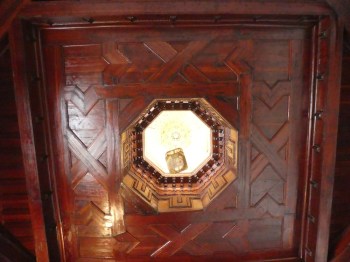
All the stucco decoration and artwork was apparently designed on the floor before being placed on the walls or ceilings. The ceilings were mostly made from cedar wood and then intricately decorated.
I spotted one wooden ceiling that was not painted and asked a guide what type of wood it was. He said that it was also cedar wood.
He continued “All houses contain cedar wood as it gives off a nice smell and creates a good ambience. Years ago and still today we are superstitious people and we believe that cedar wood wards off negative energies.”
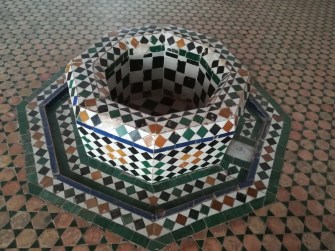
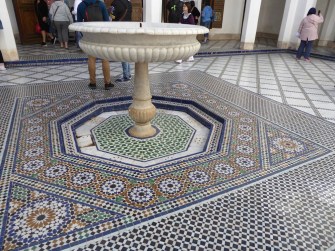
Throughout the palace there were exquisite examples of zellji tiles artwork. It is difficult to appreciate that every individual tile has been handcrafted to produce the expanse of colourful mosaic work.
After leaving the palace we walked a short way to a cafe with a terrace opposite the Kasbah Mosque. It was a lovely place to sit and enjoy some cold refreshments whilst gazing at the mosque and simultaneously people watching.
The mosque’s minaret has a green leaf like pattern on it which is similar to a fleur de lys and the decorative motif is known as a sebka pattern in Moorish architecture.
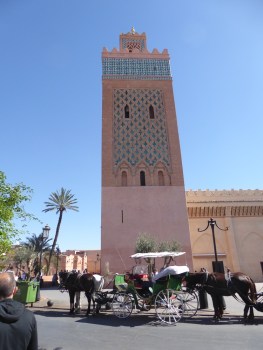
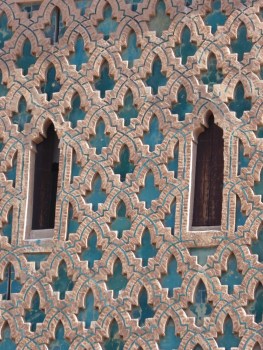
Built in the 12th century, the mosque is one of the most historically significant in the city. The mosque has two other names, the Moulay el Yazid and the Mansouria Mosque.
The religious structure was constructed to be a Jama Masjid which literally translates as Friday mosque. A Friday mosque is the main mosque in an area where the obligatory (for male Muslims) noon prayers known as jumu’ah take place.
Just around the corner a street led us to the Bab Agnaou gate, which is one of the nineteen historical gates of the city. This gate was used as the public entrance to the Royal Kasbah and it apparently has an impressive facade. Today, however, we found the huge horseshoe shaped archway under major renovation. Many stonemasons were busy in the process of returning the monumental gate to its former glory.
Continuing to explore the area known as the Royal Kasbah, the next place we visited was the Saadian Tombs.
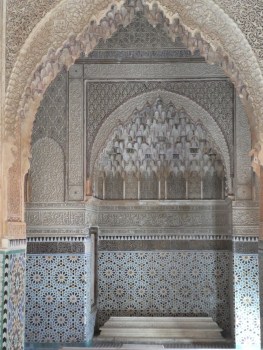
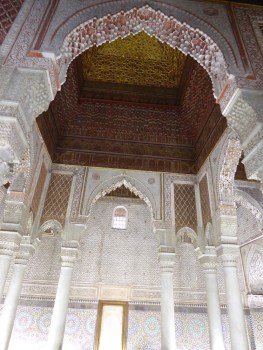
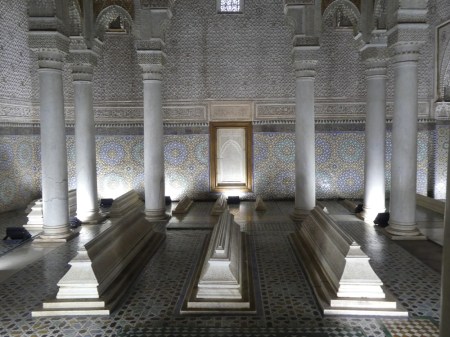
The beautiful royal necropolis is a wonderful illustration of Moorish architecture. Gold and Italian marble together with stunning stucco work and contrasting colourful zellji tiles were all used to create the mausoleums.
Both of us were in need of a snack for lunch and another drink to quench our thirst so we returned to the cafe. After placing our order for some traditional pies known as briks we continued to people watch. The briks are made from a pastry similar to filo pastry; we chose two types of filling, one with cheese and one with minced beef and both were delicious.
As we left the eatery I managed to stop a turning taxi and I told him in French our destination and asked if he would turn on the meter. He grinned at me and asked in English “How much do you normally pay”. Before I could answer he quoted an extortionate price to which I replied “No” and repeated “Will you turn the meter on please?” After grinning again he turned around and drove away!
Spotting a taxi at the side of the road, with its driver twiddling his thumbs and perhaps hoping for a fare we approached him. He too, refused to turn on his meter but we managed to bargain him down from his original high price.
The taxi ride to the Marjorelle Gardens took us out of the medina and along modern dual carriageways with eye catching plants in the central reservation
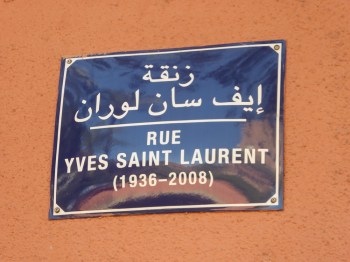
The taxi came to a stop on Yves Saint Laurent Street where the botanical gardens are located
The botanical gardens were created in the early 1920’s by the French painter Jacques Marjorelle.
The artist’s residence and many of the fountains and planting urns in the gardens are painted a striking shade of blue which he created himself. The artist patented the shade and named it Marjorelle Blue.
The gardens, which have various species of cacti, succulents and bamboo in addition to many other plants, are a peaceful and pretty oasis in the middle of a busy city.
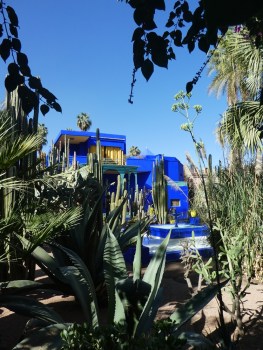
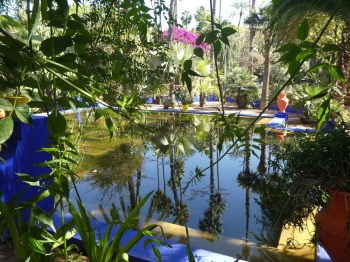
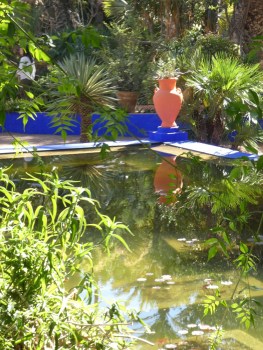
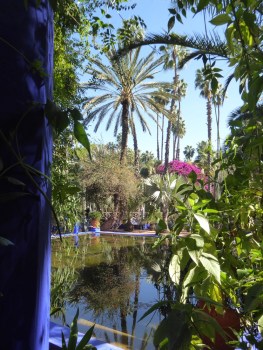
The house and gardens were purchased in 1980 by the fashion designer Yves Saint Laurent and his partner at the time Pierre Bergé. By this time the site was in disrepair and the couple completely restored it.
A taxi returned us to the medina and we strolled around the perimeter of the Koutoubia Mosque. During its construction there were often stalls surrounding the building selling books. Therefore the mosque is also referred to as the Booksellers Mosque.
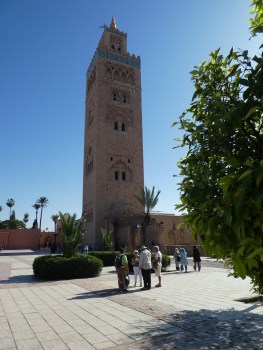
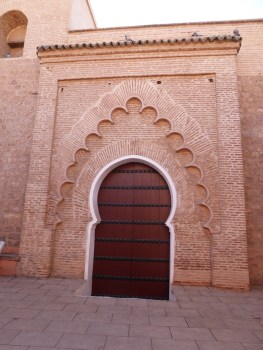
It was far too hot to walk around the mosque’s gardens so we decided to head into the shade and coolness of the souks.
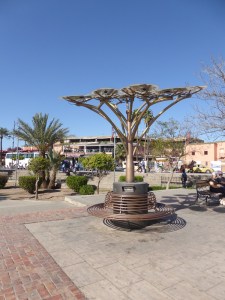
As we were leaving the area we spotted a modern sight. A circular metal seating area surrounded a mobile telephone charging station.
From a distance the solar powered device resembles a tree.
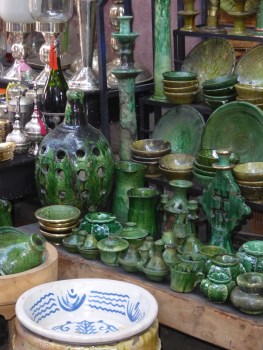
One or two of the traders in the souks had fixed prices but the majority relied on their bargaining skills. From a fixed price stall we had already purchased a ceramic cruet set that was designed like miniature tagines complete with conical shaped lids. The price we paid was just 25 MAD.
Deciding to purchase a set with three mini tagines so that we could use the additional one for perhaps oregano we continued looking.
When we spotted one we liked we asked the price and the optimistic salesman stated an inflated price of 150MAD. After a bit of friendly bartering, he sold us the set quite happily for 30MAD. He was not at all fazed or embarrassed that just a few minutes earlier he had asked for five times that amount!
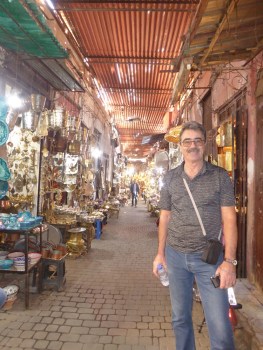

After wandering aimlessly around the interesting souks we headed to the Jemaa-el-Fna Square. It appeared to be busier than the previous evening. The same entertainment was taking place plus we noticed some acrobats.
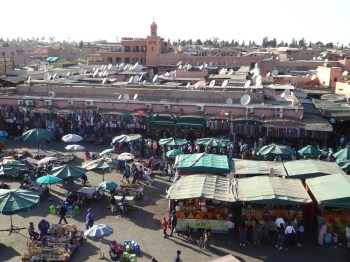
Choosing one of the eateries which advertised a panoramic view we climbed the seemingly endless flights of stairs to the terrace above. It did indeed have an excellent view, overlooking the carnival like proceedings below.
There were numerous satellite dishes on the roofs of the souks and the nearby homes.
Dinner was tasty, a beef and vegetable tagine for Dave and a vegetable one for me. The waiter ceremoniously removed the conical shaped lids of the tagines and the hot billowing steam quickly escaped.
After our early evening meal and wandering around the square again we headed back towards the riad.
Turning off the main road and entering into the smaller narrower streets of the neighbourhood we decided to make a detour and explore the area.
At the end of one of the lanes we came across the neighbourhood’s mosque with a simple but beautiful name plaque. Every district within the medina has its own mosque, grocery, bakery and a hammam. Apparently some of the locals take their tagines to the local hammam to be cooked.
One of the wider lanes had a Moroccan flag strung across between two buildings.


A few of the pink stone coloured buildings had large beautiful doors with big brass knockers in various shapes.
Hidden behind some of these doors would be magnificent restored riads. How I would love to step behind some of these doors!
Passing a sentry box we stopped and read the notice next to it, it mentioned security in the area.
Yesterday, we had noticed a large mural. Within the painting there was the following message ‘A security service started in this neighbourhood in 2016 for the added security of us all’.
There were some small kiosk type shops that mainly sold groceries. One of them had closed for the evening; just a curtain was covering the shop’s wares.
Stopping at one of the kiosks to purchase some water I noticed an elderly man leaning on the side of the wall. He was wearing very dark glasses, clutching a couple of bags in one hand and an empty carton of milk in the other.
I suddenly realised that the man was possibly hoping for someone to buy him some milk. I asked him but he appeared not to hear so I asked the smiling elderly shopkeeper (who wore an old fashioned grey shopkeeper’s coat from days gone by). “Glasses, glasses” he said frantically pointing to a young man nearby who was wearing glasses.
I spoke quickly to ‘glasses’ as the old chap put his empty carton in his bag and started shuffling away. ‘Glasses’ spoke with him and yes he did need some milk, did he need anything else we enquired. “No, just milk” was the answer.
We bought the chap some milk and we thanked the shopkeeper and ‘Glasses’, who spoke excellent English, for their help.
A couple of young lads were in the ‘education community centre’ and we wondered what they were learning. Last night there were seven or eight adults all poring over their books. The centre has an inspiring motto above its door


 lindaruddstravels.com