Wednesday 13th February 2019
Delhi – Jama Masjid : Chandri Chowk : Red Fort : Lotus Temple : ISKCON : Qutub Minar : India Gate : Parliament House : President’s House
Gottam our guide for the day introduced himself and our driver Rajesh. “We are Hindus” he informed us, adding that one can usually tell someone’s religion by their name. “Khan and Mohammed are Islamic names, the name Singh belongs to a Sikh”. Gottam continued to be informative throughout the day.
We set off on what was going to be a fairly full day according to our itinerary.

One of the first things we noticed was that the road signs are in four languages – Hindi, English, Punjabi and Urdu
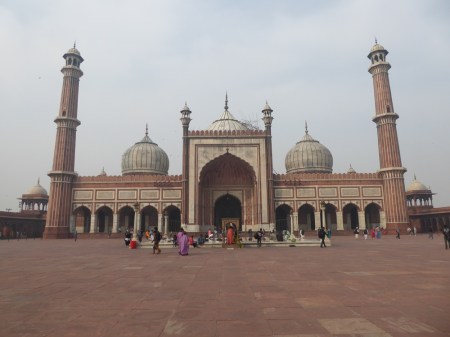
The first stop was the Jama Masjid, the largest mosque in India. The driver dropped us close by and we walked towards the Islamic holy building dodging green and yellow tuk tuks and rickshaws some of which were battery powered. The tiny narrow shops had their wares on the pavements and there was a lot of food being cooked at small roadside places.

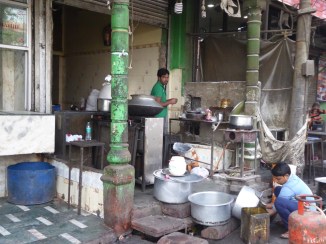
Gottam pointed out a young man who was cooking chapatis. “He is cooking them on the backside of the pan” he said. The wok like pan was turned upside down and the bread was being cooked on the base. Our guide explained that Hindus and Muslims do many things the opposite way to each other, “one cooks the chapatis on the bottom of the pan, one on the top of the pan. Our clocks go one way, theirs the opposite, when we pray one washes their hands downwards, the other upwards. The Hindu marries just one wife the Muslim can wed four”.
What an interesting guide we have, aren’t we lucky!
After removing our footwear at the entrance to the mosque, we gave Gottam some cash to cover the charges for using photographic equipment and to pay the guy who would look after our shoes. He then passed me a floor length purple silky gown and instructed me to put it on, adding that it was mandatory for women.
This huge mosque is known locally as ‘The Friday Mosque’ as every Friday 25,000 men come to worship in its courtyard. It is an impressive edifice constructed from red sandstone and white marble.
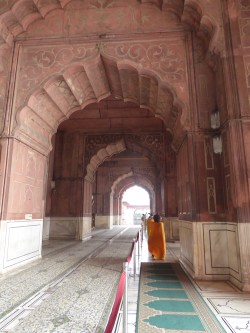
Its interior is a narrow walkway with several mihrabs, there was a red cord restricting access to devotees of the faith. We were dismayed to see a group of four couples in their sixties posing for a photograph behind the barrier; their guide was obviously permitting this to happen.
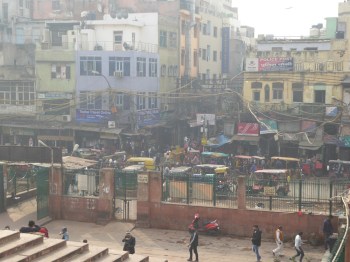
Standing on the steps of the mosque we watched the chaos below, and were deafened by the cacophony of shouting and traffic noises.
Gottam hailed a passing rickshaw and the three of us jumped on. We stopped at the spice market and were ushered into a long narrow shop where the proprietor told us about many of the numerous spices which he stocked. He thanked us (the English) for making Chicken Marsala our national dish but quipped that they made it better than us. “Of course” I replied, smiling.
Workers were sat on the road surrounded by flowers, making garlands. A young chap offered me one, “no thank you” I said, continuing to walk along the street. Gottam said “He offered you one out of respect; he didn’t want you to give him any money”.

An older flower man asked me if I wanted to buy, I replied “no, thank you” and when I indicated my camera, he smiled and posed for a shot.
We took another rickshaw ride around Chandni Chowk, which translates to the intriguing name ‘Moonlight Square’. It is one of the oldest and busiest market areas and is located in the heart of Old Delhi. Some of the area was under renovation so therefore inaccessible.
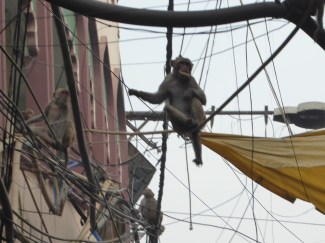
Our rickshaw ride was exhilarating, jaw dropping and scary! Narrowly missing other vehicles we looked at the passing sights in awe. We spotted monkeys above us on the tangled mass of electrical cabling which criss crossed the street and wondered what our son Paul, an electrician, would say.
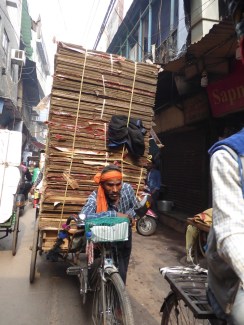
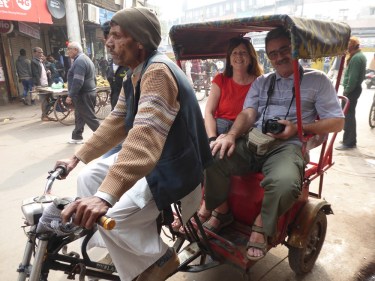
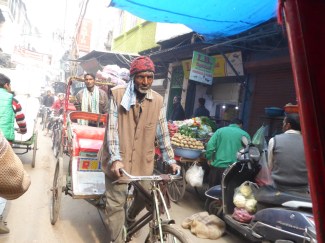
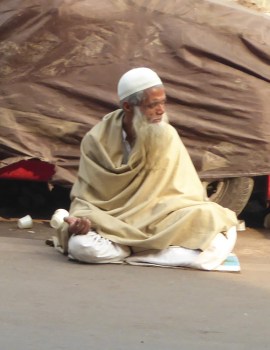
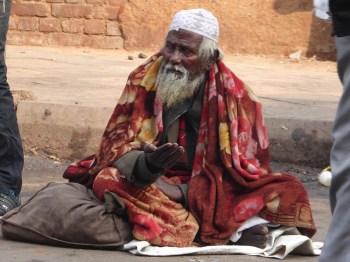
Dangerously seated on the road, beggars with their palms outstretched hoped for cash from passersby. There are apparently twenty million people in this huge sprawling city, one million of whom are homeless.
Having survived the rickshaw ride experience we now had to face the prospect of crossing a main road. With my heart beating fast and involuntary little squeals of ‘oohh’ and ‘aahh’ escaping from my mouth I tried to stay as close as possible to our guide. “Take my hand, Ma’am” Gottam instructed when he saw how worried I was and with my hand in his, he led me safely across the road as vehicles narrowly missed hitting us by inches!
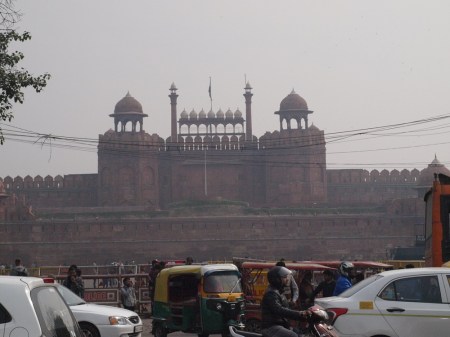
We stood opposite the famous Red Fort and took a photograph or two. Gottam advised us that we will visit the Amber Fort in Agra which is very similar. Although we will probably visit the Red Fort tomorrow when we have a day without a guide.
Directly opposite the famous fort we saw a temple dedicated to the Jainism religion. In the grounds of the temple, there is a bird hospital. Apparently, in keeping with the Jainism belief of non violence and harmlessness they will only treat birds of prey as outpatients and will not permit them to stay overnight like other species of birds are allowed.
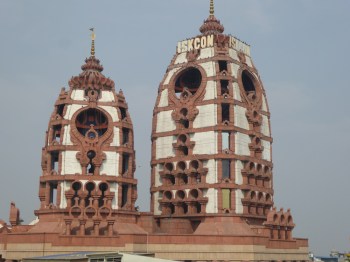
Our next stop was the ISKCON Temple. The acronym stands for International Society of Krishna Consciousness and the temple is dedicated to Lord Krishna, a revered Hindu god.
Devotees believe that repeated chanting of the Hare Krishna mantra awakens ones soul to spirituality.
Before entering the temple we had to pass through security, the female guard confiscated my tube of peppermints, promising to return them to me as I left. I was also asked to turn my camera on and off. Photography is not permitted within the temple.
We left our shoes with a man who placed them in small wooden cubby holes and issued us with plastic tokens in exchange. As instructed we then washed our hands before entering the temple. Our guide had already informed us that the men with very short hair were Hare Krishna devotees as were the members of the small musical group seated on the floor. There was a man singing and three other males each playing a different instrument. A group of females were sat amidst piles of pretty flowers making garlands.
I was walking with my hands behind my back but Gottam told us that we should keep our hands in front of us. He told us the names of some of the deities which were depicted colourfully in the temple, one of which was the monkey god, Hanuman. Gottam explained the parikrama ritual, “one greets a deity and then walks clockwise around it and greets the god again. This indicates reverence to the god and also helps oneself to connect with the spirituality of the temple”.
This particular parikrama led us around an art exhibition within the temple which included photographs of other ISKCON temples throughout the world.
It was just a short distance to our next stop, the Lotus Temple. The temple is a Bahá’í house of worship and the lotus shaped building is amidst pretty lawned gardens with striking flower beds and orange trees.
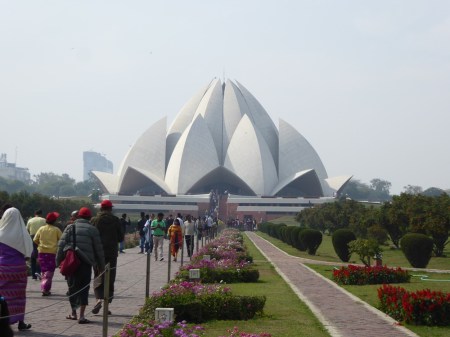
A marble plaque states the following: This House of Worship is a place for prayer and meditation for the people of all religions and races.
Many school children in their smart uniforms queued to enter the temple.
Gottam said that we had to make a decision whether to queue to visit the interior, if we decided to, all electronic equipment would have to be left with him as no photography is permitted within the temple. He added that there could be a considerable wait and that the majority of people just viewed the structure from the gardens.
As the temple is a place for all religions, there are no statues, paintings or anything else, just an empty space with chairs for people to sit on and silently pray or meditate. We therefore opted just to view the temple from the outside.
For lunch we stopped at a pleasant restaurant that catered for tourists and we asked the waiter’s advice for something that wasn’t spicy. On his recommendation we ordered buttered naan bread and buttered chicken, the creamy tomato and onion sauce was just slightly spicy and we both enjoyed it.
Before we arrived at our next stop, the Qutub Minar, Gottam told us that if we paid the entrance fee with a credit card there would be a reduction of 50 rupees. “How unusual” we said “usually a discount is given for cash”. He laughed “I know, that is why we call it incredible India!”

The Qutub Minar is a UNESCO world heritage site. The site’s highlight is a soaring red sandstone minaret that is over 70 meters tall. It is beautifully carved with inscriptions.
An iron pillar stands nearby which is believed to have been constructed in the 4th century and moved to its current home around one thousand years ago. The reason that this iron column deserves a mention is that despite its age it remains rust free.
There is also a small mosque and the remains of a gateway and tombs in the complex; most of which have intricate carvings. Unfortunately, at one point in history the carvings of Vishnu and Ganesh, both Hindu gods, were defaced during an Islamic period.
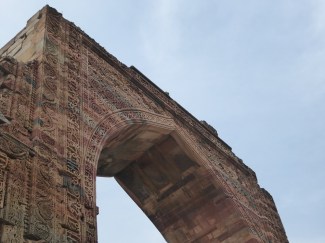
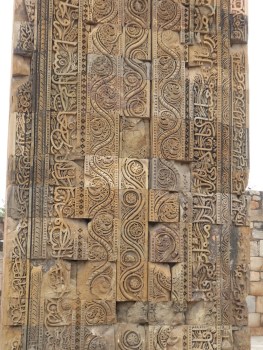
We enjoyed wandering around the historic complex and we were also entertained by the wildlife. There were numerous mynah birds, parrots and squirrels.
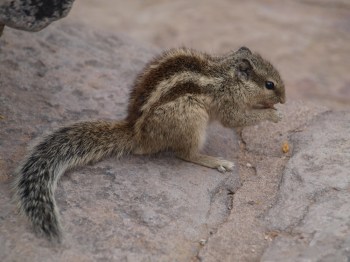
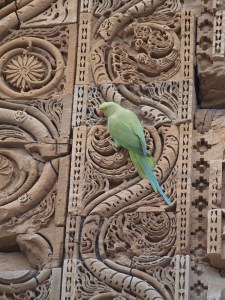
As we were leaving, a couple of young girls asked for a selfie with me, I obliged and I in turn got one of the three of us.
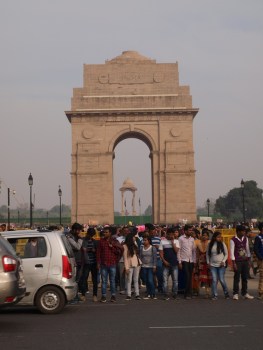
Reminiscent of the French capital’s Arc De Triomphe, the memorial is dedicated to the soldiers of India who lost their lives in World War One. The commemorative archway is simply known as the India Gate.
Continuing, we travelled along wide avenues to pass by Parliament House and then the Presidential Palace which is the official residence of the country’s president.
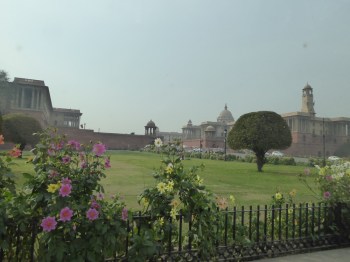
This area greatly reminded us of the Mall in London, the tree lined avenue that leads to Buckingham Palace and is in stark contrast to the scenes of Delhi that we visited this morning.
The district is generally referred to as Lutyens’ Delhi after the British architect Sir Edwin Lutyens who designed many of the capital’s buildings during the period of the British Raj.
We declined the chance of going to a ‘shopping emporium’, although there would be the opportunity to see some local handicrafts being manufactured, it really was just a glorified souvenir shop.
On returning to our hotel we sat in the bar with a nice cold beer and read through our research of other sights we wanted to visit in Delhi. Tomorrow we would be on our own; where could we visit without having to cross a major road??
Dinner this evening was a buffet and I tried the ‘Aloo Gobi’ after being assured “no spice, Ma’am”. Well, my mouth definitely felt as if it contained spices, hot ones!
Needless to say, Dave refrained from tasting it.
Previous Next

 lindaruddstravels.com