Monday 25th February 2019
Agra – Sunrise at the Taj Mahal : Agra Fort : Itimad-ud-Daulah (Baby Taj) :
Another early morning, our alarm woke us at 5.15am; we arrived at the Taj Mahal and joined a small queue a few minutes before the gates swung open at 6.15am. It was 30 minutes before sunrise and it was misty and quite chilly but oh, so beautiful!
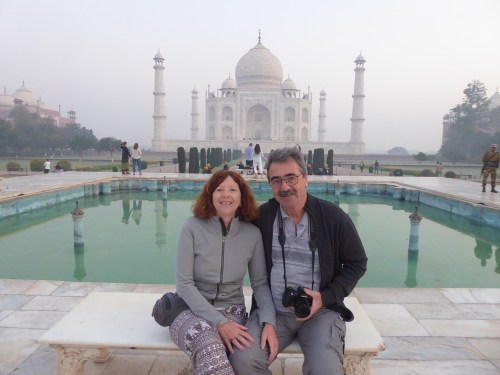
Our guide suggested that we had a photograph taken on the bench known as ‘Diana’s Bench’. The bench was made famous after the iconic photograph of Princess Diana at the Taj Mahal. Malik warned that a queue for a photograph there would soon be forming. After he took the photo, he left us agreeing to meet us later close to the exit.
This magnificent monument to love took 22 years to build, 20,000 Persians worked on the construction. Today some of the descendants of the workers still work here in the city of Agra using some of the techniques that have been passed down from father to son. Some of the methods are a closely guarded secret. The Taj Mahal was constructed from the highest grade of non porous marble making it easily cleaned with just soap and water.

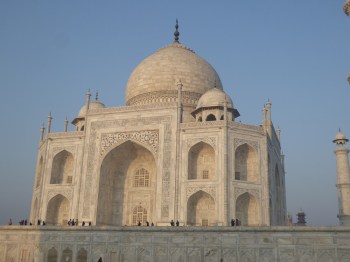
Built on a huge plinth, the edifice is perfectly symmetrical and verses from the Holy Koran are inscribed into the marble. The Taj Mahal is considered to be an exquisite example of Mughal architecture.
Photography is forbidden within the mausoleum. The two tombs that you can see are actual replicas; the original ones are directly below. A guard shines a torch at some of the gemstones inlaid in the marble, the orange gemstone carnelian is also known as the ‘stone of flame’ and it does indeed shine brightly like a flame when the light is on it. Flowers were created from gems, a jasmine flower signifying the Shah’s wife’s beauty, a poppy representing her delicacy.
Shah Jahan’s wife Mumtaz Mahal lost her life giving birth to their fourteenth child at the age of 39 and the Shah ordered the mausoleum to be built. The Meghal Bagh was intended to be the destination for a black Taj Mahal, for a mausoleum for the Shah. This would be situated directly opposite the ivory white mausoleum on the other side of the river. However, his son was angry, stating that it was a misuse of public money and he ordered his father to be imprisoned. The Shah passed away six years after his imprisonment and his tomb is next to his wife’s in the Taj Mahal.
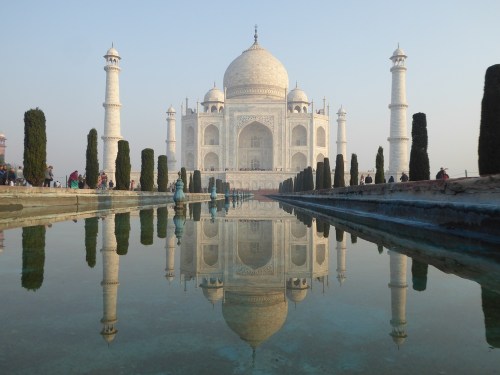
We thoroughly enjoyed our time at the Taj Mahal; once again we watched the colour of the marble change, this time as the sun rose. As you can imagine we took quite a few photographs! This is one of our favourites.
Leaving the Taj Mahal we returned to our hotel for breakfast, after which we spent a couple of hours or so relaxing in the pleasant gardens by the pool. There were many parrots flying amongst the palm trees.
Later we met Devendra and Malik again, this time to visit the Agra Fort. It was Shah Jahan’s grandfather, Emperor Akbar, who was responsible for the construction of both Fathepur Sikri and Agra Fort.
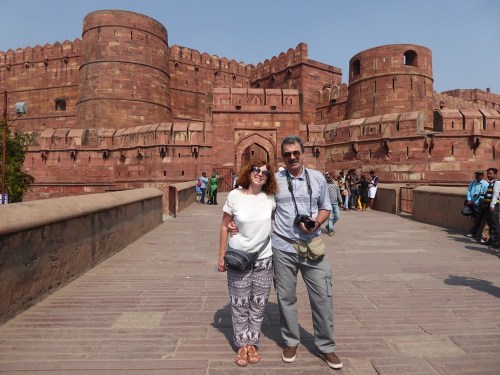
Only 25% of the enormous sandstone fort is accessible to visitors, 35% is used by the army as barracks etc and unfortunately the remainder of the fort is in disrepair and unused.
Shah Jahan apparently was responsible for the addition of the white marble structures in Agra Fort. Unfortunately one of these ornate buildings became his prison. His son allowed him to choose the building and the one he chose was inlaid with semi precious stones similar to the Taj Mahal. Most important of all, is that the building had an uninterrupted view across the Yamuna River to the Taj Mahal where his beloved wife had been laid to rest.
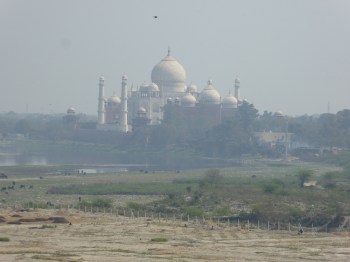
The building that the Shah spent his last years of his life can now only be viewed from outside.
Entrance to its interior was prohibited a few years ago when it was realised that many of the inlaid precious stones were missing. Apparently, visitors were taking screwdrivers or knives to prise the gemstones from the marble.
Shah Jahan passed away at the age of 74, still under house arrest; he was interred in the Taj Mahal next to his wife Mumtaz Mahal.
Mumtaz was given the name Arjumand Banu Begum at birth; she was the daughter of a Persian noble. After her marriage the Shah honoured her with her new name which translates as ‘Chosen One of the Palace’.
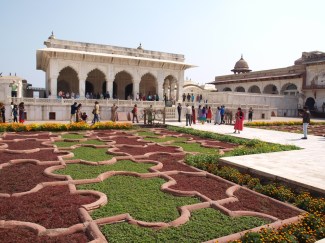
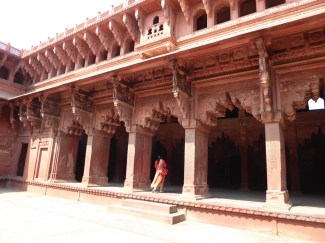
The fort contains numerous stunning structures, pretty gardens and courtyards. However, it is disappointing to see the signs of disrepair and the lack of remedial work to protect the buildings from further deterioration.
The next stop we made was at a marble emporium. Demonstrations are given throughout the day. Some of the workforce who create the amazing works of art are descendents of the Persian workers who worked on the construction of the Taj Mahal.

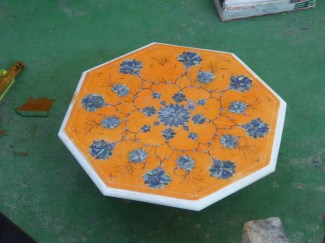
There are of course a few processes involved to create the intricate details. The first is to paint the piece of marble with a vegetable paint. The gemstones are then laid in place and adhered with temporary glue. The outline is then traced with a sharp pointed tool. The stones then must be removed and the shapes carefully carved out. A special glue (that apparently is still a closely guarded secret) is then used and the stones are secured into the marble.
The salesman led us into the next room where the items were displayed. Wow, it was filled with these amazing works of art, marble elephants from very tiny to huge, tables – round, square, oval, octagonal in various sizes. All the items were intricately inlaid with assorted shapes and sizes of gemstones. They are all available with a choice of crystals, carnelian, malachite, agate and lapis lazuli to name a few.
Transit could of course be arranged and the prices depended on the size of the object and also the quality of the crystals.
The final visit of the day was to the Itimad-ud-Daulah, more popularly known as the ‘Baby Taj’. It is another stunning structure.
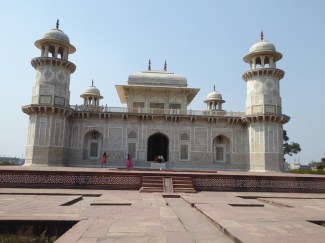
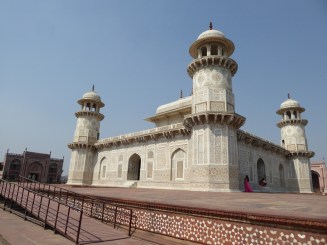
This mausoleum is the final resting place of a Persian nobleman Mirza Ghiyas and his wife. He was an advisor to Emperor Akbar and later to his son during his reign. Mirza was bestowed the honourable name of Itimad-ud-Daulah which means ‘Pillar of the State’.
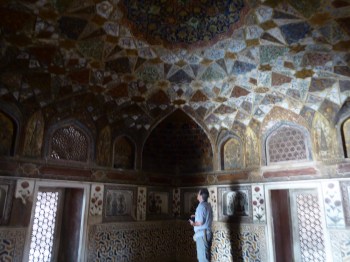
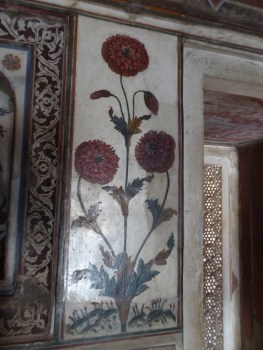
The marble mausoleum’s ceiling is magnificent and its walls are covered with geometric and floral patterns, paintings and inlaid stonework.
Both the interior and the exterior are really quite breathtaking.
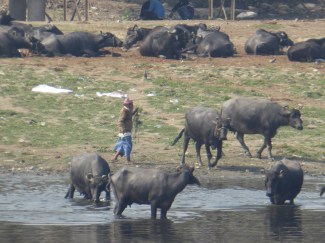
Leaving the building, we wandered through the gardens which led to the river and for a while we watched the bird life, animals and the people.

As we were walking to the car, I saw a man laid at the edge of the road and immediately told our guide. ‘He will be drunk’ he said, shrugging his shoulders. ‘Are you sure?’ I enquired, watching folk walk by the man. He said that he was sure and that there were many drunks in the area due to the fact that they drank too much!
Back at the hotel which was a pleasant oasis in the bustling noisy city, we relaxed on our balcony. I scribbled in my journal and Dave read.
Around teatime there was a storm with tremendously loud crashing thunder and a fabulous lightening show. It subsided after an hour or so.

 lindaruddstravels.com