Thursday 21st February 2019
Jaipur: Hawa Mahal : Jaigarth Fort : Amber Fort : Jal Mahal : City Palace
I asked at reception this morning about the lights and a helpful young man came to the room, the switches we had been searching for were behind the curtains. There are 18 light switches in this room!
Pushpendra and our driver who was now introduced by his full name, Devendra, were waiting for us at 9am to begin our sightseeing tour. Devendra means ‘King of the Lions’, so we will be accompanied today by two kings, one of lions and one of flowers!
Our first stop was to see the most photographed site in Jaipur, the Hawa Mahal, otherwise known as the Palace of the Winds. It was built in 1799 in the shape of the crown of the Hindu god Krishna.
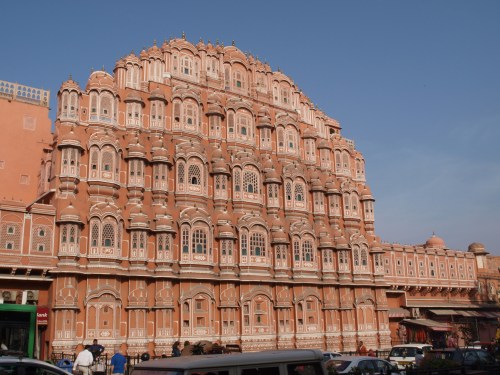
Pushpendra pointed out the screened windows of this impressive five storey building. Behind the screens, the royal ladies could watch any festivities below.
Many folk believe that the summer palace built as an extension to the city palace is just a facade; however, access to its interior is from the rear of the palace.
It is, apparently, very basic inside in comparison to its beautiful exterior. Its upper three floors are only a single room depth and have no stairs. Ramps were constructed for ease of carrying the palanquins of the royal ladies.
As we were driving away from the Hawa Mahal en route to Jaigarth Fort, we saw a body being carried on a metal stretcher. The Muslim males who were carrying the bier would apparently be joined at the cemetery by the female relatives.
Pushpendra, a Hindu, chatted away, he spoke about negative energies and how every Hindu home has a statue of Ganesh at its entrance to dispel these obstructive energies. He added that women are more susceptible to the energies than men.
He pointed out a crematorium specifically for royal ladies. “After death the royal men don’t wish to be with the women, they want peace” he joked.
A couple of minutes later we passed a place where people feed crows on specific dates. Pushpendra explained that it was to do with astrology. “Although one cannot alter what God has in store, if people’s planets are incorrectly aligned, feeding the birds may help their problems ease” he continued.
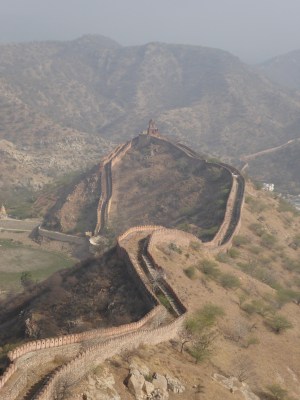 Jaigarth Fort was just a few kilometres away from the city; its perimeter wall reminded us of the Great Wall of China.
On the pretty narrow road that led us upwards towards the fort, we spotted boars. The boars are evidently not wild, but domestic and used by their owners as food.
A couple of peahens and a peacock (which is the national bird of India) foraged for insects and grubs at the roadside.
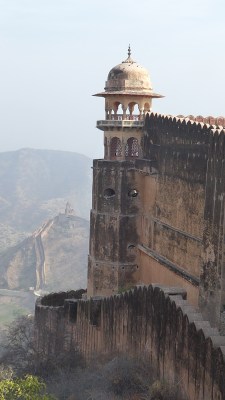
This impressive structure’s foundation stone was laid in the 12th century and it was finally completed in the early 18th century. The purpose of its construction was to protect Amer Fort and its palaces. It is situated on the ‘Cheel ka Teela Hills’ which translates as ‘Hill of the Eagles’ and the fort does indeed have a bird’s eye view of the complex of buildings that make up the Amer Fort. The two forts are connected by underground tunnels.

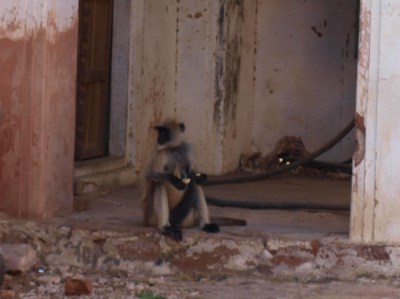
Entering the fort we immediately spotted some wild Gray Langur monkeys.
These primates are also known as ‘Hanuman Langurs’ after the Hindu god, Hanuman.
They are sacred creatures to Hindus. The capture or killing of these monkeys is prohibited by law in India. They have black faces, ears, fingers and toes.
We spotted parrots in the trees as we walked around the fort and numerous squirrels; the hair of the small creatures is used in artist’s paintbrushes. A couple of guys were decorating their camels, no doubt in preparation to offer rides to tourists.
From Jaigarth, the views of the surrounding countryside and the Aravali Hills were tremendous.
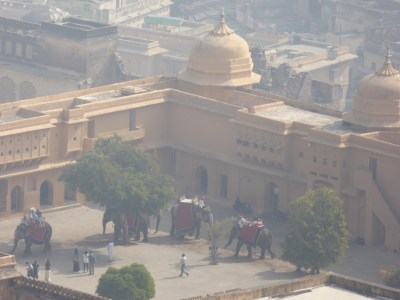
The view of Amer was directly below us and we could see the decorated elephants carrying tourists into the fort. Our tour included an elephant ride but we declined the offer.
Apparently the riding of the elephants is now government controlled. Each animal can now only do six round trips daily; however the mahouts still beat the animals.
Some black and white photographs are displayed in the fort, amongst them are photos of the British Army. Pushpendra mentioned that his Grandfather was a commanding officer in the army.
One photograph taken in 1961 shows the Maharajah and Maharani of Jaipur together with Queen Elizabeth and the Duke of Edinburgh at Ranthambore National Park.
The current Maharajah is just 19 years of age. “He is in the city now, as the quarter flag is flying. He was educated in the United Kingdom and now studies law here in India” Pushpendra informed us.
Our guide spoke a little about the schools as we drove to Amer Fort. His daughter who is 12 years old goes to private school. “Government schools are for poor kids” he said. “They receive a free bag, a free meal each day and a free uniform but the principal of the school probably doesn’t speak English” he added. I recalled seeing many school kids dressed smartly in their uniforms leaving the slum dwellings as we travelled on the train from Delhi.
En route to the fort, we stopped to visit a step well.


Step wells were once the only source of water for drinking, bathing, washing clothes etc. People would walk down the steps to reach the water level. These have gradually been replaced by stand pipes in the streets. Our guide told us that when it was in use, it would be scrupulously clean. It was an ingenious idea.
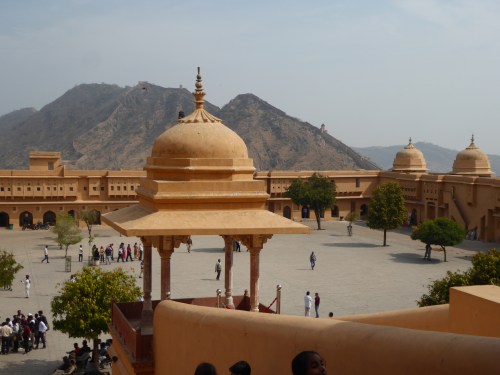
As we entered Amer Fort, also referred to as Amber Fort or Amber Palace, we saw beautifully decorated elephants dropping some tourists off. The Fort is a complex of buildings including elaborate palaces situated around large courtyards. Specifically, we wished to see the Ganesh Gate and the Hall of Mirrors.
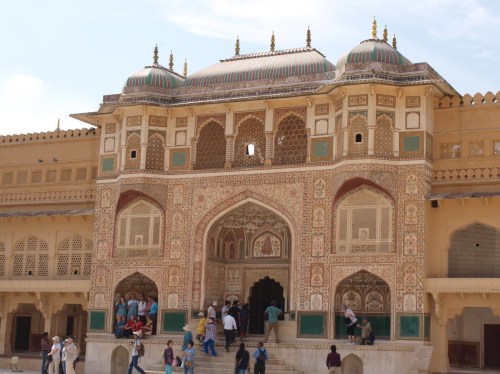
This regal gateway also referred to as Ganesh Pol (meaning gateway), led to the private residences of the Marharajas. Named after the Hindu god, the magnificent structure is painted with vegetable dyes.
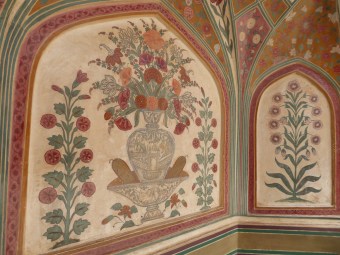
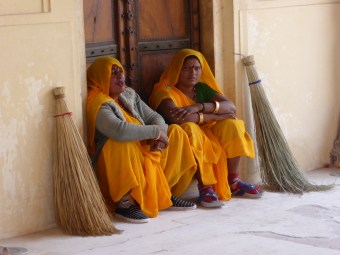
As we wandered through the interesting fort we noticed a couple of workers having a break.
A sandalwood door with inlaid squares of ivory has a glass protective screen covering it, as unfortunately, over the centuries, many pieces of ivory have been pilfered.
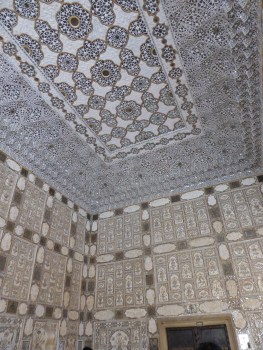
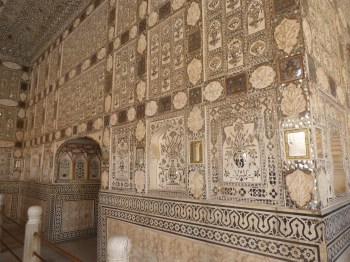
Gazing in awe at the intricately designed Sheesh Mahal (also called Palace or Hall of Mirrors) we simultaneously listened to the information from our guide.
This palace’s walls are covered with millions of tiny pieces of mirrors arranged in mosaic style, depicting vases of flowers and other intricate designs, creating a remarkable effect.
Although this type of architecture can be seen in various palaces, local folk lore says that the queen loved to see the stars at night but was not permitted to sleep outdoors. Therefore, the king instructed his architects to design a room that would shine like a starry night’s sky. The designers created this impressive hall. When night fell, mustard oil lamps would be lit and the effect imitated a night with million’s of stars twinkling. Pushpendra showed us a hint of this by shining his flashlight onto the ceiling.
We continued to explore the various edifices, courtyards and gardens within the fort. The diversity of the buildings together in this one place is astonishing.
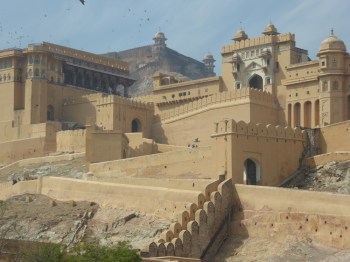
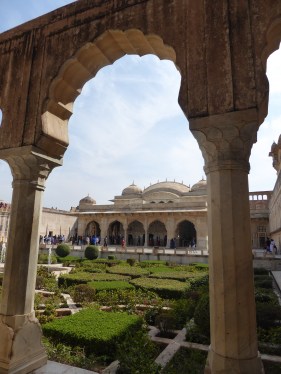
As we were leaving Amer Palace we were rewarded with some stunning views of Jaigarth Fort and also of stone built temples.
Our next stop was the Jal Mahal – Water Palace, and as the name perhaps suggests, it is situated in the middle of a body of water.
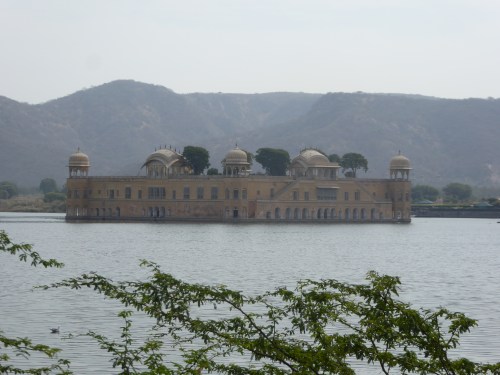
The Jal Mahal was originally built by a Maharajah as a shooting lodge, specifically for duck hunting.
Today however, the place stands neglected and unvisited; its future lies in the hands of the courts.
It was apparently leased out but some problems occurred. No one has been permitted to enter the building for ten years and it is unlikely that the problem will be resolved soon.
Dave and I spotted some pelicans in the distance. “These are not Indian birds” Pushpendra remarked, “their name escapes me, they have a big pouch for fish and they are like tourists, they visit at certain times of the year and then go away’, he continued.
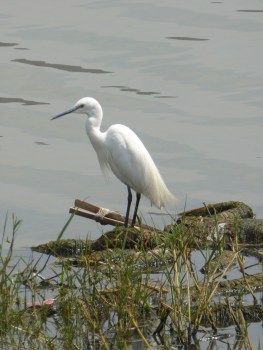
Herons, egrets, shags and a tiny warbler type bird were also amongst the migratory birds that we spotted.
Our guide told us that we had come at the best time of year, it is 25 degrees celcius today so not too hot for hours of sightseeing. In May and June, the temperature will reach 45 to 50 degrees and this is of course, followed by the monsoon season.
He asked if we were interested in souvenirs and if we would like to go to a handicraft place and see block printing or to a semi precious stones workshop to see how they are cut. I immediately opted for the 2nd choice knowing that Dave wouldn’t mind. I also told our guide that we couldn’t guarantee that we would purchase anything.
The ‘souvenir’ places make a note of the guides and drivers who take tourists. On special dates, throughout the year, the companies will treat everyone on their list and give them a gift, maybe chocolates..
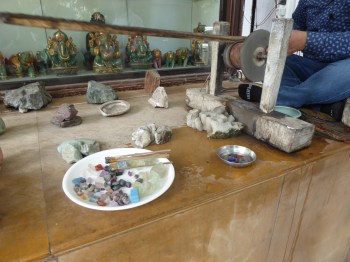
Outside the shop and workshop which sold jewellery and products manufactured from precious and semi precious stones, a man sat cross legged in front of a grinding machine.
The process was interesting; the grinding wheel was used to shape the gem. Using candle wax, stones are adhered to small bamboo sticks. Holding the stick, the man cuts the facets of the crystal and then polishes it.
A salesman showed us a piece of green amethyst, saying that it was a new stone, found recently in mines in Jaipur. The eager trader added that it could not currently be found anywhere else. We considered purchasing a small raw piece but in the end I decided against it. Later, I found it readily available in earrings and other forms on Amazon!
It was lunchtime and we were taken for a quick lunch at a restaurant for tourists. Although we always asked, the guides and drivers never joined us, always insisting they were eating elsewhere. Each of these places had a staff room for the workers that accompanied the tourists.
As we left the restaurant, I asked Pushpendra about the red mark on some Indian ladies hair parting. “The mark symbolises that she is 100% married” he answered.
Our final visit of the day was a visit to the City Palace. Just before we entered its gates, we saw some men sat under parasols selling food for the pigeons. According to our informative guide, the men were farmers from the local villages. He explained that there are no crops until March and therefore they have no work. Naturally the pigeons poop on the palace so the government employs people to clean the buildings – so the pigeons help to keep people in employment, by creating the cycle” he concluded.
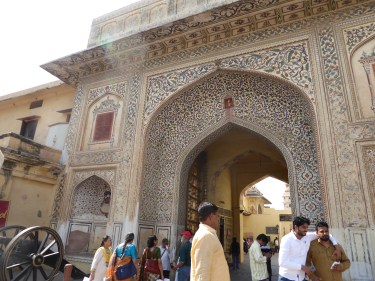

Preparations were taking place within the palace grounds for a huge wedding. Scores of workers were bustling about, a huge stage was being erected, and bolts of red velvet were being expertly attached to its rear wall. Florists were unwrapping thousands of carefully wrapped blooms and arranging them in elaborate and colourful designs. Garlands were also being rapidly and professionally made.
Deep plush red velvet jewelled sofas were being carried in and workmen were struggling with the weight of huge highly polished wooden tables. Some of the tables were already laid with candelabras at their centres; others had towering brass vases with long stemmed red roses. There were pieces of furniture laden with heavy ornaments here and there and the general effect was of a stately home.
An artificial palm tree was being created, millions of cream coloured flower petals were covering a metal stand and tiny lights were being draped over it. In a huge tented area, staff were busy preparing food. This was going to be an extremely expensive wedding!
Leaving the wedding scene behind we walked into a courtyard with four gateways. Each of them represents a season and their designs are extremely impressive.

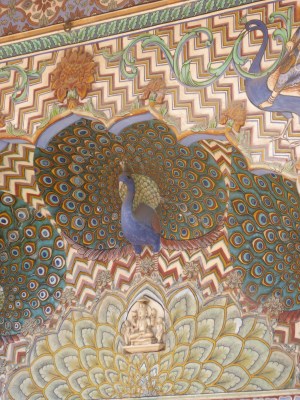
The Peacock Gate symbolises the autumn season and is dedicated to the god Vishnu.
A new ticket had been made available at the beginning of the year. It was called ‘Royal Splendour’ and holders of the ticket were granted access to private parts of the palace that had never previously been seen by members of the general public. The ticket was of course expensive compared to the price for general access. When we worked out the figures though, the cost was only a little higher than it would cost to visit some of the stately homes in England, so we decided to opt for the ticket and take the opportunity of a lifetime.
The entrance fees that we had been paying to sights were all reasonable in our opinion and Indian nationals paid approximately one tenth of what foreigners were charged. This, we thought, was fair. However, the ticket we were purchasing at a cost of 3,500 rupees was 3000 rupees for Indian nationals.
Prior to visiting the newly accessible parts of the palace, we explored the other parts of the palace that were available to the public.
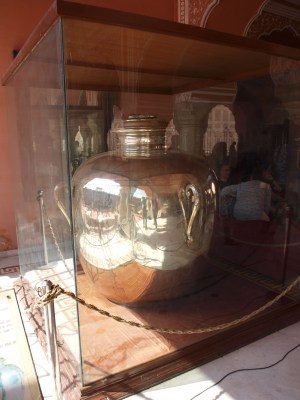
This huge silver urn was one of two that travelled by boat to England with the Maharajah and his entourage for the coronation of Edward VII.
The urns were 1.5 metres high and had a circumference of 4.5 metres. Each urn held 4,000 litres of water from the River Ganges for the Maharajas personal use.
Following our guide as he strode ahead along corridors and then into a lift to start the next part of the tour, he told us that he had done this before when he brought a visiting high dignitary from Germany. He also had dinner in the palace with another privileged guest on one occasion.
There was just Pushpendra and ourselves when we entered the beautiful Indigo Room. Aren’t we lucky!
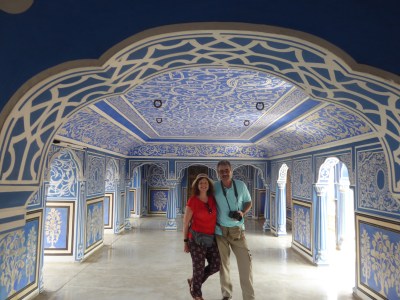

The beautiful shade of blue is apparently created using the leaves of the indigo plant. The white detailing contrasts perfectly with the pretty shade of blue.
The next hall we visited in this almost private tour of recently unseen parts of the palace was a lavishly decorated room in red and gold. Its Indian name Shobha Niwas translates to Hall of Beauty and it is used on occasion by the royal family for their morning puja (a prayer ritual). The security guard at its doorway instructed us to remove our footwear before we entered.

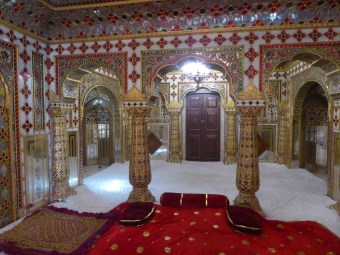
Plush red velvet cushions and bolsters are the seating within this room.
The next hall was in complete darkness as we entered. This was the Chhavi Niwas, the Hall of Reflections. The security guard lit two small candles to show us the visual effect that was created; looking upwards was, indeed, like seeing a starry night.
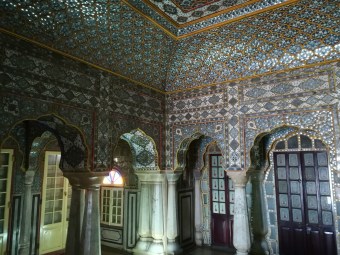
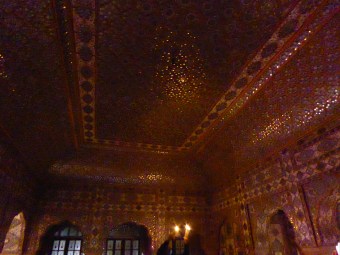
In one area of the palace there were quite a few family photographs. One such photograph was of the current maharajah as a boy, together with his brother and parents. His grandfather who made Padmanabh his heir was known as the last maharajah of Jaipur; he actually held this title for only a few months before privileges of the maharajahs were removed. Although the current ‘king’ of Jaipur is not recognised by law, the royal family remains greatly respected.
Apart from opening some of the palaces rooms to the public (“which tickets could be revoked at any time,” warned our guide), the young maharajah has made one of the palace’s suites available on Airbnb. The proceeds from the bookings will however go directly to a non profit organisation supporting rural women and artisans.
Amongst the photographs were some of Prince Charles and Princess Diana with Jaipur’s royal family. Another photograph showed Prince Charles with an artist who has a studio in the palace. Visiting the studio, we saw the man painting with brushes made from squirrel hair. One of his works was a fabulous painting of a tiger gazing at his reflection while drinking from a pool of water.

Walking through a picture gallery which overlooks plush gardens and lawns, Pushpendra told us how the present Maharajah in his younger days would skateboard along the open corridor. He would disappear quickly inside the palace if he spotted any tourists arriving.
From this gallery we could see a few of the royal family’s polo horses.
As we were approaching the final room that we were expecting to visit, a guard stopped us and spoke rapidly in hushed tones to our guide.
Apparently the ‘king’ (the maharajahs are often referred to as king), was in the room, obviously tickets were sold with the understanding that access could be denied to any part of the palace. Pushpendra suggested that we went for refreshments which were included in the price of our passes.
Our hot drinks were served in elegant cups and saucers with the maharajah’s coat of arms emblazoned on them.
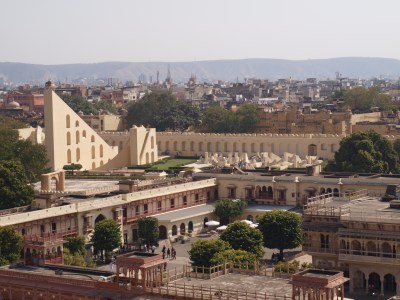
After the refreshments that were served in a pleasant gallery, Pushpendra took us to a private balcony which offered remarkable views, including vistas of the Palace of the Winds and the Jantar Mantar.
Jantar Mantar is the name of an observatory that has the world’s largest stone sun dial.
The word jantar is derived from a Sanskrit word meaning instrument and mantar from another word from the Sanskrit language meaning to calculate.
Pushpendra apologised but said that he didn’t think that the room would be available to visitors for the remainder of the day.
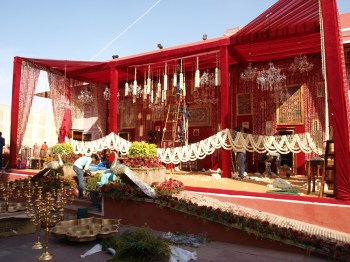
As we were leaving, preparations for the wedding were continuing. Thousands of tea light holders were stored in crates waiting to be put into place and there were exquisite arrangements of flowers everywhere.
Suddenly, our guide rushed into the ticket office instructing us “wait there!”. We could see our guide making a fuss and a couple of minutes later he came out of the office with a triumphant smile. He had managed to get the office to agree that we could visit again tomorrow to see the room that we had missed today. He said that it was on condition that we retained our tickets.
The architecture of the city palace is a superb blend of traditional Rajastani and Mughal styles and we thoroughly enjoyed our visit.
It was 4pm when we returned to our hotel after a thoroughly fabulous day, we relaxed on our patio for a while before changing for dinner.
At dinner the executive chef showed us around the buffet, explaining each dish and how they should be eaten, he gave us a small taste of dahl tadka together with a baati (whole wheat bread). Each mealtime we continue to try different dishes but we are finding that many are too hot or spicy for our taste
Previous Next

 lindaruddstravels.com