Saturday 11th February 2017
Sagrada Famillia: Hospital de la Santa Cruz i de Sant Pau:
La Pedrera: Casa Batlló: Children’s Fire Run: Flamenco Show.
We decided to walk to the cathedral rather than catching the metro. We had tickets to see the interior of the famous Sagrada Famillia and these permitted entrance between 10:45am and 11:15am.

We gave ourselves plenty of time to stop and admire the architecture along the way. We passed the fairytale-like Casa Batlló, with its balconies reminiscent of carnival masks. I couldn’t resist stopping to take a couple of photographs even though we intend to stop again on the way back. In the daylight, we could see the modernist building’s undulating roof and it’s unique chimneys.
We approached the Sagrada Famillia through the small park which is situated in front of the huge basilica. Our first glimpse was of the Passion Facade through the many leafy trees. I confess there were no ‘wows’ at this time, just absolute amazement at all the seemingly different styles of architecture. Together with the cranes, scaffolding and general building work, it was for me, a scene of excess.
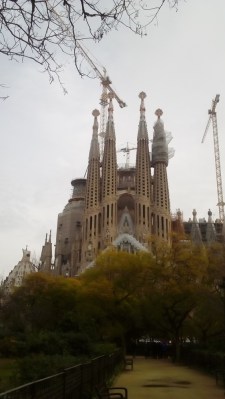
We walked slowly around the perimeter. One facade is a complete building site; new pillars that had recently been erected were covered with plastic sheeting.
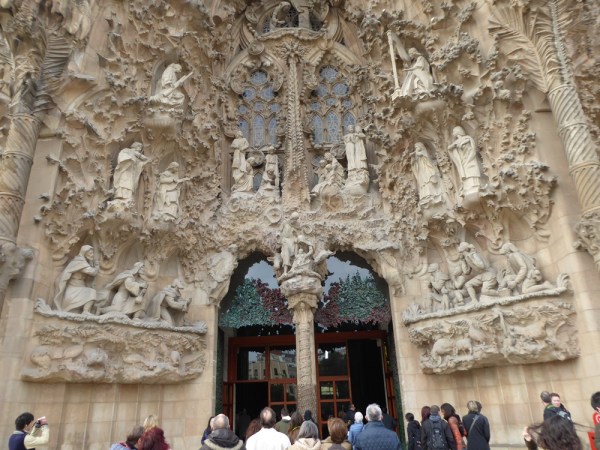
The final facade that we saw was the oldest, the Nativity Facade. This made us exclaim ‘wow, wonderful!’ So much detail, it really is awesome. What appears to be a green ornamental tree is a splash of colour amongst the stone; indeed all the facades have dots of colour. We stood and stared for quite some time at this unique facade.

Statues protrude from this immense building; stone musicians and their instruments come to life. Biblical scenes are portrayed in countless carvings.
In places, the stone appears alive like molten lava still running and bubbling forming curves and curls.
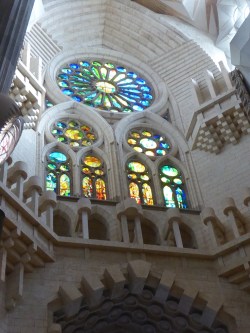
We entered the church at our allotted time slot and were pleased to find that it was not overly crowded. The interior is huge and spacious. Magnificent multicoloured stained glass windows are a focal point of the vast area.
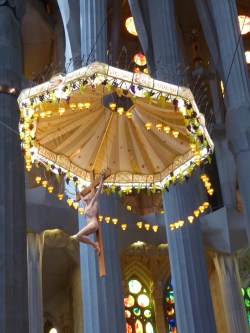
A seemingly dangling effigy of Christ is suspended from a parachute like canopy.
Personally, I didn’t feel like I was in a church, the feeling for me was one of being in a museum. There were a few audio stations for people to listen to information about different aspects of the building.
Antoni Gaudi took over the design of this monumental religious building in the year 1883. Apparently for the final 12 years of his life, he refused all other projects, making a total of 43 years working on the Sagrada Famillia.
We left the cathedral and once again stood marvelling at the nativity facade with its many details. We purchased a couple of takeaway coffees from a nearby cafe and sat on a bench in the small park gazing at the passion facade.
This is the largest unfinished Roman Catholic Church in the world; the hope and indeed the aim is that it will be completed by the year 2026 which will be 100 years since Antoni Gaudi’s untimely death.
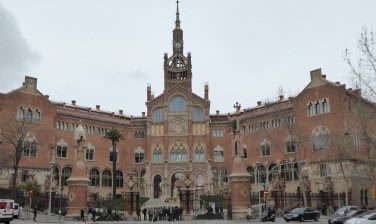
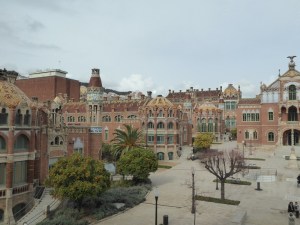
Only this morning I read about one of Europe’s famous Art Nouveau sites. The Hospital de la Santa Creu i de San Pau has apparently a remarkable design which consists of a number of buildings decorated with ceramic tiles laid out in pleasant gardens. It also boasts one kilometre of underground tunnels which originally connected the various wards, operating theatres and other facilities.
Dave checked its whereabouts and finding that it was close to the Sagrada Famillia, we agreed to pass by it if we had the time.
Well we did have the time so we set off. I turned around periodically to see the Sagrada getting smaller and smaller surrounded by tall cranes and other building plant. My final glance was from the gates of the UNESCO World Heritage Site, the Hospital de la Santa Creu i de San Pau.
The exterior of the main buildings were interesting so we decided to pay the entrance fee and explore its interior and gardens. We paid a total of 18 euro; 13 euro was the cost of a general ticket and just 5 euro for a ‘senior’ ticket; sounds so much nicer than OAP! It was worth every cent.
The gardens were laid out beautifully amongst colourful orange trees and Mudéjar style pavilions. I can imagine the patients found it a wonderful oasis, which assisted them on their road to recovery. This was, indeed, the belief and hope of the hospital’s architect Lluis Doménech i Mortaner. Apart from fresh air and gardens he also believed colour and art to be healing and therefore designed the pavilions in the decorative Mudéjar style.
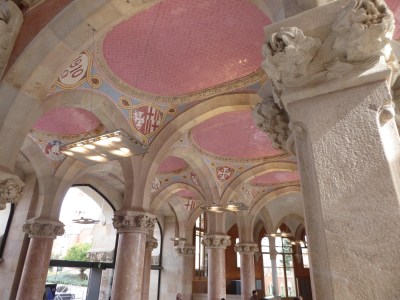
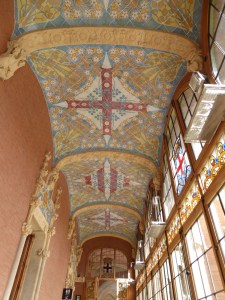
The final building that we were permitted to enter, was, as the young female guide informed us, the best. We walked slowly around with our heads tilted backwards admiring the captivating ceilings and stunning stonework.
The next place on our list of ‘must sees’ was Le Pedrera, this famous building was Antoni Gaudi’s last work before he decided to dedicate himself solely to the Sagrada Famillia. Once again we decided to walk instead of using public transport.

We were beginning to think the decision was a mistake, perhaps we had taken a couple of wrong turnings, but including a quick stop for refreshments, it took us over an hour and a half.
However just before we reached La Pedrera, we came across a remarkable building which we both assumed was a Gaudi creation. It was on the Corner De Corsega and definitely made the long walk worthwhile.
We later learnt that the modernist building was designed by the Catalan architect, Salvadore Valeri i Pupurull who, apparently, was an admirer of Gaudi’s works.
A few minutes later and after crossing the main boulevard Passeig De Gracia to enable us to get a better look, we stood and studied the modernist building named La Pedrera.

This unusual building was originally a residential property, named Casa Milà, Milà being the name of the couple who had commissioned Antoni Gaudi to design it.
Apparently, no straight lines exist on this structure and its facade is said by some people to resemble a huge block of stone hence its preferred name – La Pedrera, which translates to ‘stone quarry’.
We were surprised to realise that we were only a five minute walk from where we had turned off this morning in the direction of Sagrada Famillia. We definitely chose a long route back!
We continued the few steps to Casa Batlló, my favourite building in Barcelona, Casa Amatller stands proudly next to it with its beautiful facade. On the same block is another famous modernist house, the Casa Lleó Morera. This block of buildings is named Illa De La Discórdia, this translates to the ‘Block of Discord’, apparently so named due to the disparities of designs.
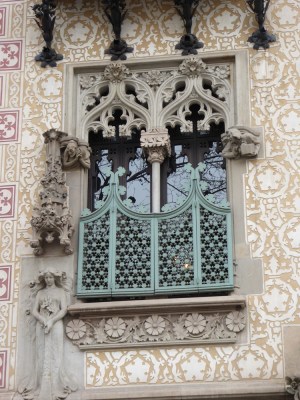

We sat outside a bakery and ate a late lunch of baguettes and soft drinks while gazing at the breathtaking buildings around us.
After taking a few photographs, we had a brisk walk back to our hotel, the weather forecast had promised rain and the clouds were getting darker.
A couple of hours later we went back out again, heading once more to Las Ramblas. This particular evening the boulevard had a festival atmosphere; many folk were slowly wandering. There appeared to be even more stalls selling multicoloured nougat, lollipops and waffles. We could hear the sound of drums in the distance. Although the threatened rain had not yet arrived, the sky looked very dark and even smoky up ahead.
We turned off Las Ramblas and headed into the smaller narrow streets of the city’s gothic quarter; we were on our way to a flamenco show at the Palau Dalmases theatre.
This evening is the start of the events in the Santa Eulalia Festival. The drums were becoming louder as we were getting closer to the procession known as ‘the children’s fire run’.

This parade portrays groups of devils, dragons and other creatures dancing and running to the beat of drums and accompanied by noisy fireworks.
A few minutes later we saw children as young as 7, 8 and 9 years old carrying what, at first glance we thought were Catherine wheels.
Later, however, we realised that they were similar to huge sparklers that culminated with a loud bang.
A firework was fastened onto a long stick which a child would hold while an adult ignited it; the child would then set off, courageously dancing and running while the firework sprayed large smoky white sparks all around. The child wore a protective mask which was similar to a welder’s mask.
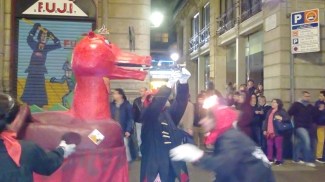
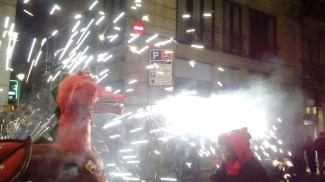
Other children ran behind the child who was carrying the large firework. Effigies of dragons and other creatures, some producing sparks and flames made up the parade. Many adults, me included turned away or huddled together to protect themselves from the many flying sparks. We continued walking in the opposite direction to the parade, dodging the sparks as it passed by.
There was a celebratory atmosphere, although it was scary at times! ‘If this is the children’s run I am glad we are going to miss the adult one’ I remarked to Dave.
The street led us into a huge square and we squeezed our way through the hundreds of people who were congregating there for another of the weekend’s festivities. We headed along more narrow streets, checking the time and hurrying.
A short while later we found the large arched wooden doorway with a poster pasted on it advertising the flamenco show which we had tickets for.
Passing through the wooden entrance, we found ourselves in an old cobbled courtyard. This place was originally a Baroque Palace that was built in the 17th century. The courtyard had a stunning carved stone balustrade.
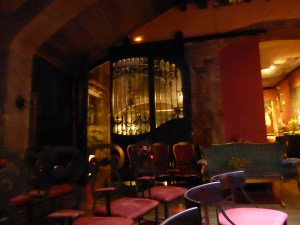
We entered the next doorway which led us into the small intimate theatre with its tiny wooden stage and between fifty and sixty chairs. A couple of flickering candelabras added to the intimate setting. A room to the side of the stage was decorated, I guess, like the original salon would have been with large framed artwork, ornaments and heavy furniture.
The one hour flamenco show cost 25euro per person, the price included the choice of a drink.
A mature female singer in traditional flamenco dress stepped onto the stage together with a male guitarist. A young man with a drum box who was still wrapping protective tape around his fingers joined them. Two young females danced together at the beginning of the show and then took it in turns to dance a solo routine, the other female joined the singer and musicians clapping and stamping passionately with the beat of the music.
The young man’s fingers soon became bright red and we wondered if the constant beating of his drum box could do permanent damage to his hands.
We thoroughly enjoyed the performance, it was fiery and intense and in our opinion, very professional.
We wove our way back through the maze of tiny streets, weaving our way once more through the Plaça de Sant Jaume. Once more this square was packed solid with people, a sound and light show was illuminating the City Hall, the square’s most prominent building. We continued into the square which boasted the city’s cathedral, buskers were singing classical songs and were surrounded by a small crowd of admirers. We saw the stalls, some of which were earlier selling traditional types of food, were now packing away and it reminded us that we hadn’t eaten for hours.
A few minutes later we were sat in a modern restaurant on Las Ramblas.
After our meal we returned to our pleasant hotel room just five minutes’ walk away.
Previous Next

 lindaruddstravels.com