
Tuesday 19th February 2019
Varanasi: Sunrise on the Ganges : Sarnath
Our alarm woke us at 5am and we met Dharam in the lobby as arranged at 5.45am. As we drove through the streets our guide constantly attempted to get an update on his phone to learn if a particular road would be barricaded.
He explained that as it was a full moon today, it would be like a holy day and many locals would come to the Ganges. With the additional thousands of pilgrims in the city, there was a likelihood of roads being barricaded by the police. It was also the last day of the Royal Baths in the Kumbh Mela festival which was taking place in Allahabad and therefore even more pilgrims were expected in the city.
The car dropped us off and together with our guide we walked through the still dark alleyways. One or two road sweepers were attempting to deal with the piles of rubbish and dirt. After a while we reached the main thoroughfare and joined the other hundreds of folk heading towards the Ganges.
Dharam stopped briefly at a chai stall. The cost of the tea that was served in small clay cups was just 1 rupee for two cupfuls. This morning’s chai was basil, but perhaps later, cardamom or another tea would be on offer.
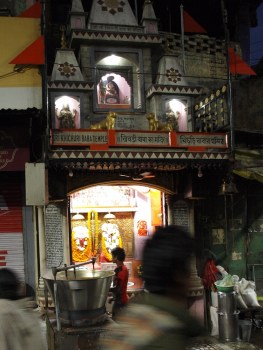
A couple of huge pots stood outside a small narrow Hindu temple, steam was rising from them, their contents bubbling away. Dharam said that the dish was called Khichuri, and that the temple was named after the man who originally cooked the dish. “Many people will come here for breakfast later”, Dharam added.
Khichuri is chickpeas with rice and vegetables and lots of spices.
After a couple more minutes we arrived at the Dashashwamedh Ghat. The scene in front of us was very colourful due to the bright clothing worn by the locals and pilgrims. A few tourists were wandering about but not many Caucasians, we only spotted four amidst the hundreds of people. There were a few naked sadhus with their faces and bodies covered in ash.
Dharam asked if we wished to receive a blessing from a Brahmin Priest. We both agreed.
Seated in front of the priest, he asked me to think of the family members that I would like blessing, then he told me to concentrate on their names.
He chanted some prayers rapidly and then instructed me to repeat the holy phrases that he recited.

After Dave’s blessing he instructed me to sit again and he blessed us both and using his finger, he painted the Shiva tilaka mark on both our foreheads.
The Shiva sect tilaka is three lines with a bindi (coloured dot) in the centre and is referred to as a tripundra. A U shaped tilaka belongs to the Vishnu Sect. The tilakas are usually made from sandalwood paste, clay or ash. Shortly after getting on a boat, we saw the sunrise on the River Ganges. It was incredible. We are so lucky!
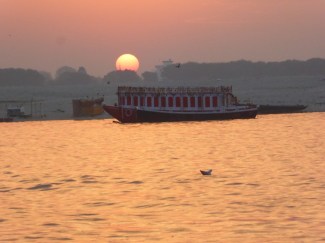
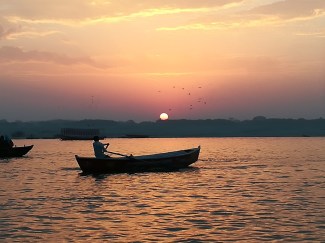
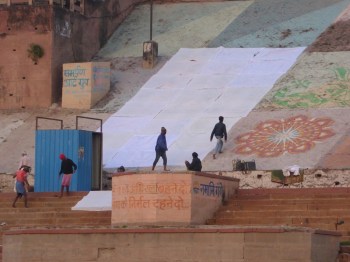
Once more we had an excellent view of life on the ghats.
We saw young men from the Dhobi caste laying sheets out to dry. Laundry is the traditional job of this caste.
Many people were bathing in the river. “These people are from Southern India” Dharam informed us. “Can you imagine how full their hearts must be right now? They have been saving for this moment all their lives and it is finally happening”, he said meaningfully.
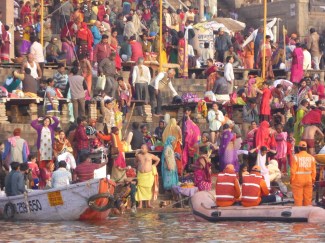
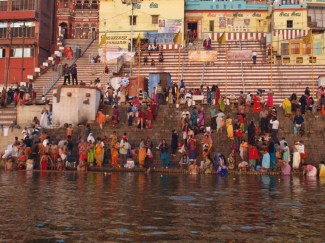
Every Hindu endeavours to bathe in the Ganges once in a lifetime; their belief is that the ritual bathing purifies the soul.
Passing by the Harishchandra Ghat, which is the other cremation ghat on the Ganges, we saw just one pyre burning. As we passed the Manikarnika ghat, we saw a couple of boats unloading logs. A couple of pyres were alight and a solitary corpse lay on the river bank. There were small piles of bright orange shrouds; these are removed from the deceased before cremation. Three municipal workers were collecting trash and the discarded shrouds. Cows and dogs were wandering around the site.
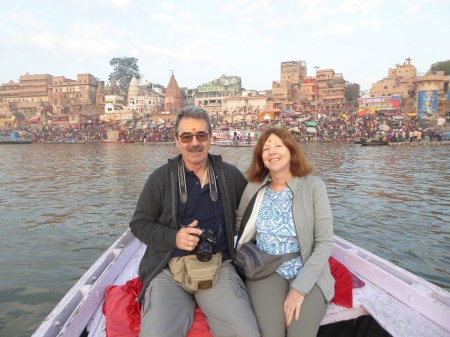
Dharam pointed out a large house on the ghat that is owned by the caretaker of the burning ghat. The job has been held by generations of the same family for 3000 years. Distant relatives have smaller houses in the area and they take it in turns to work at the burning ghat earning money that boosts their regular income.
Leaving the boat we headed behind the Manikarnika Ghat, I was momentarily startled when a mongoose ran out from a pile of logs. According to Dharam, the creatures are often found amongst the wood heaps and apparently they kill the snakes.
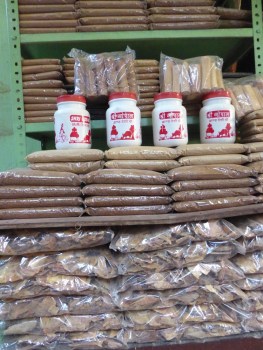
We passed the tiny shop selling products required for the cremations. There were 6″x 4″ bags of sandalwood which would be very expensive but some people would add one or two bags to the pyre. Bottles of ghee (clarified butter) that help the corpses burn quicker were also available.
Another shop was selling brightly coloured orange and gold shrouds.
A chief mourner passed by us scratching his newly shaved head. He had changed back into his ordinary clothes; the white garment he had worn for the cremation was now just draped around his shoulders.
Houses and some commercial properties are being demolished in the area to create a corridor to give easier access to the Shri Kashi Vishwaneth Temple. Often referred to as the Golden Temple, the beautiful temple is one of the holiest sites in the world for Hindus.
The demolitions of the residences are revealing some architecturally magnificent temples that were previously hidden behind the walls of the private houses.
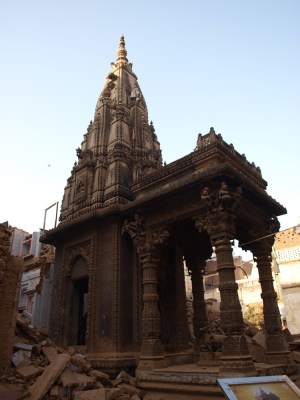
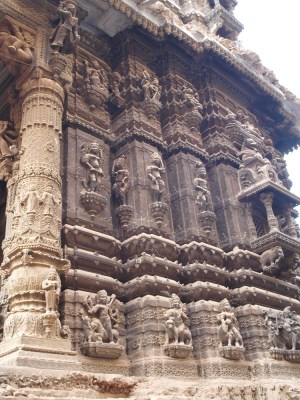
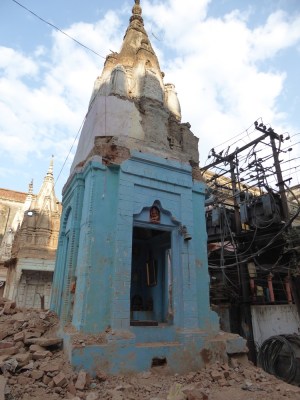
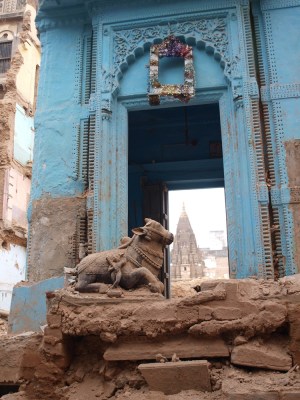
Some of these ancient temples are believed to be 500 years old. Their pillars and walls are intricately carved. Thankfully, they are being preserved.
Continuing to walk through the maze of narrow alleyways we saw a holy man slowly meandering. His clothes were brightly coloured and he wore flowers in his hair and sported a long tatty beard.
“Watch out Linda, there’s a body coming through” Dave warned from behind. Dharam and I quickly moved to the side of the path to allow the body and chanting mourners to pass by.
There was an armed police and army presence close to the Shri Kashi Vishwaneth Temple. Entrance to the revered temple was strictly reserved for permit holders. Unfortunately, this is a high alert area for possible conflict between the two religions. Apparently, some Hindus may try to remove a brick or two from the Mosque or a Muslim may attempt to take a brick from the Hindu Temple.
The Golden Temple has been destroyed and rebuilt a couple of times throughout its history. At one point after it was razed to the ground the Gyanvapi Mosque was built on its foundations.
Today the two places of worship stand just a few strides away from each other.

Passing the gate to an ashram, we popped into its grounds. We spotted a couple of monkeys roaming around.
This ashram has a temple, a dormitory and also an area for classrooms. It offers a Vedic education free of charge to boys from the age of eight. The ashram runs on donations; board and lodging is also given to the boys.
Vedic teachings are based on ancient religious scriptures known as Vedas.
The young boys are also taught about traditions and rituals, humility, modesty and respect for themselves and others.
Just outside the ashram was a man with a cobra in a basket. This is the second one we have seen this morning. The first was situated close to the Golden Temple. A policeman moved the man on when he saw me stepping back as the man approached me starting to lift the lid of the basket.
Dharam needed to pop into a religious shop to have his Shiva Beads repaired. The beads are also referred to as a Rudraksha Mala and are the seeds of an evergreen tree. ‘Mala’ is a Sanskrit word meaning garland and it is often used to count the number of prayers or mantras. It has 108 beads which is a sacred number in Hinduism. Shiva beads also protect the wearer from negative energies and research has shown that they also help to control hypertension.
Dave decided to purchase a set of Shiva Beads and they were taken by a young man to a nearby temple to be blessed. The shopkeeper instructed Dave to wear them next to his skin. He then placed a garland of white flowers over Dave’s head and made another tilka on his forehead.
Making our way through the narrow streets, we once again saw the hundreds of pilgrims patiently queuing behind the wooden barricades to enter the sacred Shri Kashi Vishwaneth Temple. These pilgrims would have to wait for around four or five hours.
Our guide dropped us back at the hotel for a late breakfast. We also grabbed an hours kip, these last few days have been hectic!
At 1pm we met Dharam again for our visit to Sarnath Deer Park. Traffic was busy as we left the city for the much visited Buddhist pilgrim site.
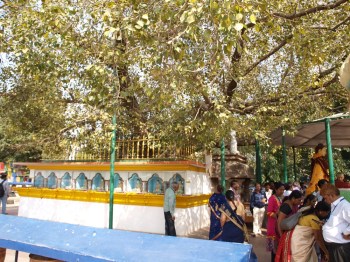
The Sarnath Deer Park is the place where Gautama Buddha delivered his first dharma (sermon) seated underneath the ‘Bodhi Tree’.
The tree situated in the park today is a 3rd generation tree from Bodh Gaya, where the Buddha became enlightened. The tree was actually a ficus tree but became known as a ‘Bodhi Tree’ after Buddha’s enlightenment.
Gautama was born a prince in India but since his birth, borders have altered and his place of birth is now actually situated in Nepal around 20km from the India border.
A highway from Varanasi leads to Nepal, the 300km drive takes around 9 hours, it is however, a further 300km to Kathmandu, the country’s capital. Dharam has done the journey numerous times as his speciality is Buddhism and he has taken many tourists there as part of his work as a guide.
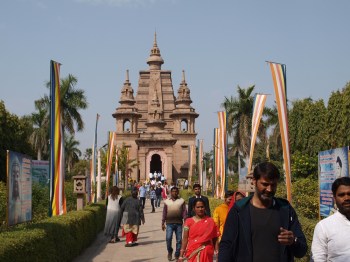
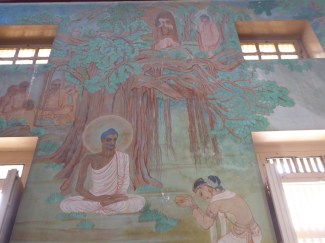
The Buddhist Temple situated within the site was constructed in the 1930’s. It’s interior walls are covered with incredible frescos depicting the life of Guatama Buddha.
These paintings are by a Japanese artist.
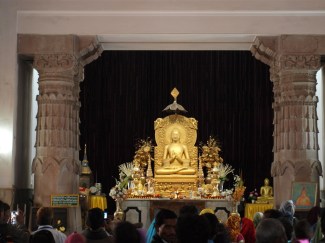
The temple has a gold statue of Buddha seated in the lotus position.
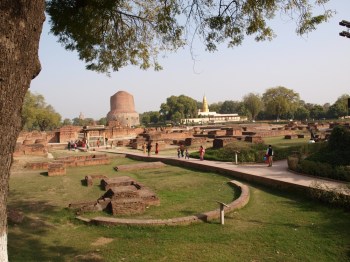
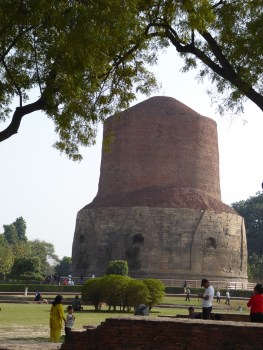
Next, we spent some time walking around the archaeological site looking at it’s relics of Buddhist monasteries and stupas. As expected there were many Buddhist monks and pilgrims wandering around the sacred site. We spotted some deer at the rear of an enclosed area.
To conclude our visit to Sarnath we spent a short time in the museum.
Travelling back to Varanasi, we saw the prime minister’s car with a National Guard motorcade.
Dharham said farewell as he dropped us back at our hotel; we thanked him profusely. He has been an incredible guide and his abundance of knowledge that he so willingly shared has enhanced our visit to this amazing holy city.
Dave and I agree that Varanasi is our favourite place so far. The city’s population is 3.8 million but these numbers have been considerably swollen during our time here with the thousands of pilgrims also visiting the city. Seeing the faithful pilgrims has also enhanced our visit.
Tomorrow we travel to Jaipur – the pink city.
Previous Next

 lindaruddstravels.com