Tuesday 4th April 2023
Bukhara – House Museum: Kulkedash Madrassa: Madrassa of Nadir Divan Begi: Nadir Divan Begi Khanaqah: Mir-I-Arab Mosque: Old Jewish House: Synagogue: Puppet Workshop
It was just 12 degrees Celsius when we set off this morning and by 9.30am there was light rain.
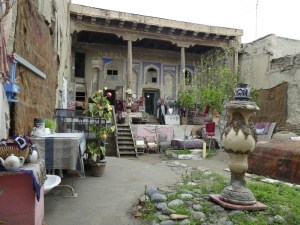
Our first stop of the day was the ‘House Museum’ that Pete and Anne had stumbled across yesterday. As Anne had described, the outside area of the house resembled a junk yard containing a myriad of unrelated items.
The small man was stood on the riwaq, he spotted us immediately. Smiling broadly, he beckoned us to join him. Standing with him on the riwaq, we realised how dilapidated the building was. It seemed in danger of collapsing.
The man welcomed us and indicated that we could look around. How I wished we could converse. I had so many questions! There was a mattress on the floor and by way of miming I enquired if he slept there. He nodded that he did.
Miming again, I asked if he lived in the house when he was a child. Once more he nodded in the affirmative but I wasn’t sure if he really understood. There was a television that was switched on and various evidence that he did, indeed, live there. But whether he actually owned the property or was perhaps its caretaker, there was no way of knowing.
I joined Dave who had started looking around the couple of rooms that at least appeared to be structurally safe. My goodness, the ganch work and other decoration is superb. In its heyday, the property must have been incredible.

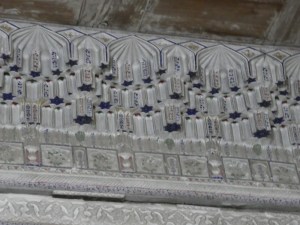

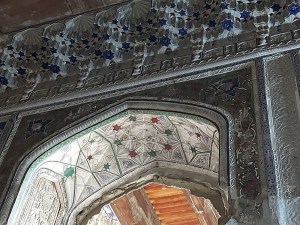 Both Dave and I were awestruck at the beauty of the decoration. This included blue and white ganch work, some of which had blue stars.
There were also green and red decorative stars in the window niche.
Being a geometric shape, the star is an example of Islamic decoration.
Dave declined the man’s offer to climb a rickety ladder to the upper floor.
After giving the guy some cash, we left, sincerely hoping that someone would restore this house to its former glory.
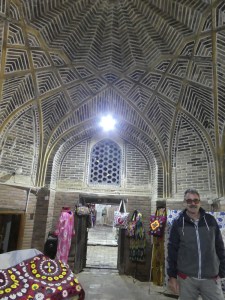
Just a few minutes walk away, we entered the Kulkedash Madrassa. Inside its entrance there were quite a few art and handicraft sellers.
My first thought was that the people were so lucky to be selling their wares in such a beautiful place.
They are surrounded by wonderful examples of Islamic architecture including domed ceilings, a beautiful mihrab and fabulous ganch work.
One or two artists were painting some scenes of Bukhara’s architecture onto ceramic and metal plates. A young man told us that his ‘paint medium’ was actually coffee.
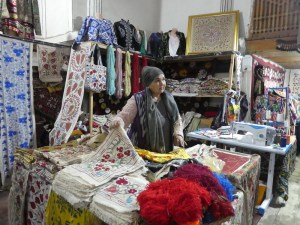
One lovely lady showed us her suzani work. She teaches the art of suzani at one of the colleges.
She explained that suzan is the Uzbek word for needle and that suzani is the word for needlework
Suzani can be created by hand or machine. Suzanis decorate walls and are always part of a bride’s dowry. A suzani with a firebird symbolises happiness, cornflowers depict men and poppies denote young girls.
Now the proud owner of a modern machine which she painstakingly saved for, she no longer suffers from extreme shoulder pain which the old and heavy machine previously caused her.
She showed us some of the products that she uses to dye the threads and fabric with, including madder root, walnut and onion skins. Apparently the longer you boil the onion skins for, the darker the colour becomes.
This is one of Bukhara’s largest madrassas; it had 160 cells for students. Wandering around its huge courtyard, we again saw signs of its deterioration. Although not to the extent of the crumbling walls and cracks that we saw on its exterior perimeter wall which we saw yesterday.
Its entrance showed no evidence of decline, perhaps the area has already been renovated.
Staying in the Lyabi Hauz Square, we went to the Madrassa of Nadir Divan Begi; this is where we ate dinner and watched a dance show on the first evening here.
Just a few people are in its courtyard this morning, the majority of the outlets selling souvenirs are covered in plastic sheeting in an attempt to keep the rain off.
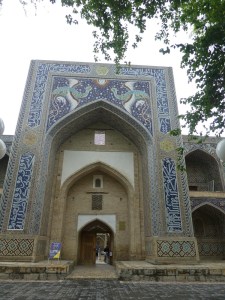
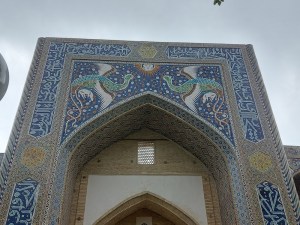
The magnificent facade of this madrassa is adorned with mythical birds which is extremely uncharacteristic in Islamic architecture, as is its lack of a mosque.
The reason for these anomalies is that the building was originally planned to be a caravanserai.
The third building which makes up the monumental architectural ensemble within this square is the Nadir Divan Begi Khanqah.
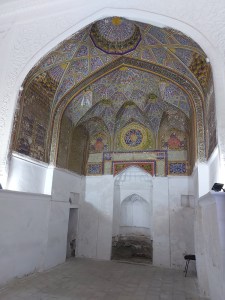
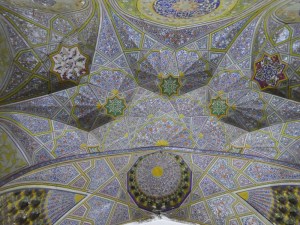
A Khanqah was a place for Sufi’s, the holy men would stay there and meditate
Today, the building serves as a ceramic museum and charges a nominal fee for entrance. It’s colourful and beautiful mihrab is a ‘must see’ in my opinion.
Information engraved on the entrance to a coffee shop advised that the building had once been a mosque. Drinking our coffee in ‘The Book Cafe’ I wondered why the mihrab was covered by a heavy piece of material.
With the help of Google Translate, I asked a member of staff who advised me that as the building was no longer a mosque; its mihrab had to be covered.
In the Poi Kalyon, we decided to pay another visit to the Mir-I-Arab Mosque. As we looked through the metal grated windows, we saw many young men all smartly dressed in black suits, white shirts and black skullcaps.
Also, we noticed that a couple of the cell’s balconies were decorated with plastic flowers and greenery. Realising that I had already seen these cells through a gateway, with a sign stating ‘No Unauthorised Access’ we realised it must have been part of the same courtyard.
Walking at the side of the madrassa, we came once again to the gateway, this time quite a few young men were walking out of the gate.
I asked a couple of them if they spoke English but they indicated that they didn’t. One young man, however, told us that he did speak English and chatted to us for a few minutes.
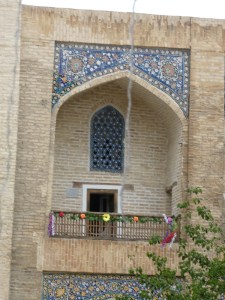
The personable young man told us that the Mir-I-Arab was a working madrassa teaching the Koran and Islamic Studies as well as English, Russian, Sciences and Computer Technology. He pointed out their cells (rooms) and the row of classrooms.
I asked him if some of the rooms were decorated as it was Ramadan, and he confirmed this.
He told us that the students would study at the madrassa for four years and then either go onto a university to continue their education or go to a mosque to work (as an Imam).
It was lovely chatting to the friendly young man who we guessed was in his early twenties.
After taking more photos of the Poi Kalyon we headed to the ‘Old Jewish House’, part of which is a hotel. A young lady explained that one of the doors of the marble tiled small courtyard was locked as the room was awaiting restoration by UNESCO.
She offered to get the keys to show us the room which, of course, we gratefully agreed to.
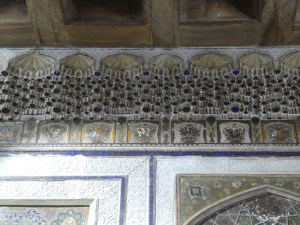
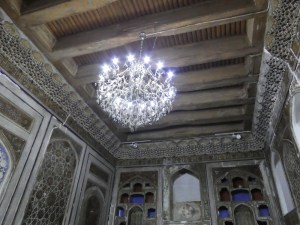
The room is stunning and similarly decorated to the ‘House Museum’ which we visited earlier today. The niches and decorated ganch work are all fabulous.
Next to the Jewish House is the Synagogue. On entering, Dave put his hood up to cover his head. A man welcomed us, told Dave that he could remove his hood and showed us around the beautiful synagogue.
He showed us a miniature torah and pointed to the main torah. He encouraged us to take photos and offered to take one of the two of us.
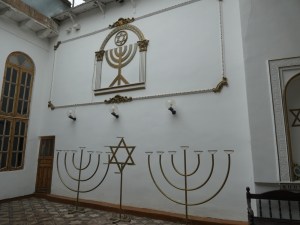

The man saw me looking at another room across the courtyard and handing Dave a black skullcap he said “Come” and we both followed him into the room.
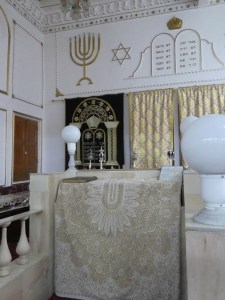
He explained to us that this synagogue was used for Shabbat, Hanukkah and other Jewish Celebrations and Holidays.
He pointed out the women’s gallery and again encouraged us to take photos.
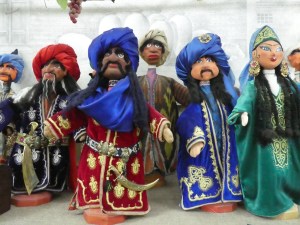
Just a few steps away; there is a puppet workshop and showroom. This is a fabulous place and you can watch the skilful young guys creating the paper mache faces of the puppets.
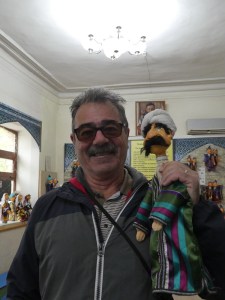
While we were there, a tour group entered the showroom and the manager put some music on and performed a short puppet show. He then told everyone that you could order a puppet that looked like you. He picked up a puppet and put it next to Dave’s face, it did look quite similar!
The rain showers continued but at least we had managed to dodge some of them.
The temperature had dropped too and we were feeling a little chilly. So, we stopped off at a small eatery and ordered a chick pea soup and a traditional dish of plov. The hot food worked and we left feeling warmer than before.
Unfortunately, the rain had become much heavier and after sheltering in doorways for a while, hoping that the weather would improve, we decided to head back to the hotel.
A couple of hours later the weather improved and we went out for a wander and to watch the sunset in this stunning city. Everywhere was deserted, perhaps due to the earlier bad weather.
The sunset wasn’t as beautiful as many we have seen but it still made some of the mosaics shine and twinkle in the Poi Kalyon.
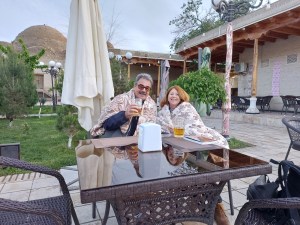
There were just the two of us sat outside a bar gazing at the architecture surrounding us.
One of the waiters brought two blankets out and draped them over our shoulders smiling and saying “It is a little chilly.”
Both of us were amazed at the music that the bar was playing; one track was an instrumental of the Beatle’s song ‘Yesterday’.
Later we met up with our friends for our last evening meal in Bukhara.
Tomorrow we will be on the road to Samarkand!

 lindaruddstravels.com