Monday 18th February 2019
Varanasi: Banares Hindu University : New Vishwanath Mandir : Tulsi Manas Mandir : Durga Temple : Mother of India Temple : Ghats & Ganges : Aarti Ceremony
Well it’s the first time I’ve had garlic bread for breakfast! It was in a basket with all the other containers of bread and I helped myself to a piece. After toasting it and spreading honey on it, I bit into it! I love garlic bread but not for breakfast and not with honey on!
Deciding to have a look at one of the restaurants in the hotel, we took the lift to the 5th floor, as we got out of the lift, a mouse scurried across the floor! Hmmm well, we think we’ll give this restaurant a miss!
Dharam our guide was waiting for us at 10am and we set off to the south of the city to visit the Banares Hindu University. “This is the best part of town” our guide informed us. He continued to tell us that the university is known as the ‘Oxford of the East.’ Driving into the university campus with its tree lined roads, he pointed out the dormitories, the medical classrooms, the economics department, the engineering department. Dave and I were not impressed; we could visit identical sites to this in England!
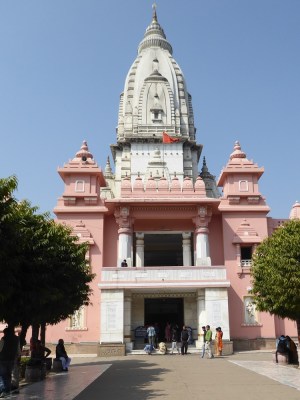
Still on the campus, we visited the New Vishwanath Temple. Dedicated to Shiva, the edifice was built by the Birla Family (wealthy industrialists). It is an interesting temple to visit.
Dave and I voiced our disappointment to Dharam and we discussed our itinerary for the remainder of the day.
We enquired about a possible visit to the ‘old’ Vishwanath Temple also known as the Golden Temple. Our guide informed us that access to certain places could be restricted at the moment. “India is on high alert due to the terrorist attack, so usually crowded areas maybe a no go” he added.
I could sense that Dharam was a little disheartened about our disappointment; however, he turned the remainder of the day into a memorable one!
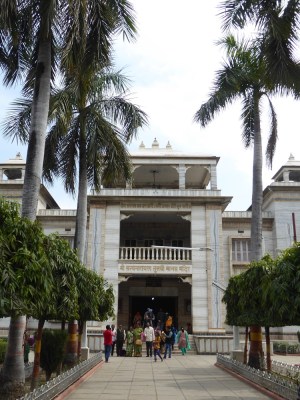
“Every Hindu home has two holy books, the Bhagavid Gita and the Ramcharitamanasa” Dharam informed us and he took us to the site where the second book was written. The Tulsi Manas Temple was constructed in white marble on this site and verses and scenes from the holy book are inscribed in its interior.

Our next stop was the beautiful red Durga Temple which is dedicated as the name suggests to the goddess Durga. We passed stalls selling flowers and other offerings before reaching the temple’s small entrance. Dharam suggested that I purchase an offering and for a few pence I received a small basket with a hibiscus garland, two incense sticks, a tiny piece of cloth and a bag of candy. I queued for a few minutes and then gave the offering to a priest together with a few rupees; he blessed me and placed a red mark on my forehead.
He returned the tinfoil basket to me with the incense sticks and Dharam led me to the place where I needed to burn them and make a wish.
The temple was busy and had an amazing atmosphere, Brahmin priests sat chanting on a terrace. Apparently, people often go to the temple to request that one of the priests go to their home to bless it or to say prayers for something specific. These services are charged for.
Unfortunately it was prohibited to take photographs in either the Durga or the Tulsa Mansa Temples.
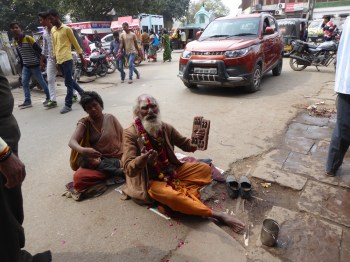
As we left the temple we saw a man sat on the road with his wife and small baby, he was playing a wooden instrument similar to a tambourine.
As we drove between each place our guide was a wealth of information. He spoke to us about astrology and said that it was usual for people to visit an astrologer in India on a regular basis but especially regarding life changing decisions.
One needs to know three things in order to see an astrologer, their date of birth, and the time and place of their birth. For a couple planning on marrying, the astrologer would look into their characters. Each person has thirty six characters, if around twenty four of them are the same it is considered a good match, under eighteen is not so good, only twelve than the couple would not wed. If thirty or more are the same, this is also considered not to be compatible as both members of the couple could be wrong about a decision, choice or plan…
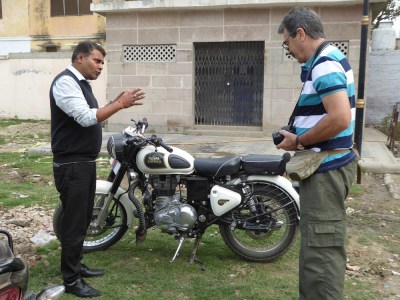
As we stopped at the ‘Mother of India, Temple’ Dharam and Dave spotted a Royal Enfield Motorbike; they admired it, and discussed its performance and history.
The motorcycle has been in production since 1901 and has earned the slogan ‘the oldest global motorcycle brand in continuous production’.

The Bharat Mata Mandir, more familiarly known as the Mother of India Temple was inaugurated in 1936 by Mahatma Ghandi.
This temple is a symbol of nationalism and secularism. It has no statues of gods or goddesses. It has instead, a large relief map of an undivided India that is carved out of marble.
The detailed map is to scale and Dharam pointed out the Hindu Kush amongst other places.
Two of the symbols on the exterior of the temple are a swastika and a shaktona which resembles the Star of David. The swastika has been used in many religions for thousands of years and in Hinduism it is an auspicious symbol representing the sun and means good luck and prosperity. The shaktona represents the union of the male and female form.
Our friendly guide pointed out a neem tree in the temple’s grounds, it is a member of the mahogany family and is used extensively in Ayurvedic Medicine.
A guy hanging around outside the temple had two small monkeys that were holding guns, he was hoping to charge tourists for photographing them. Another man lingering in the background removed a cobra from his bag, he too was aiming to make cash …
After a short lunch break where we grabbed a McDonalds in a shopping mall, we headed back to the hotel for a jacket as Dharam said that we would perhaps need it when we went to the Aarti Ceremony early evening.
The traffic was extremly heavy and vehicles were criss crossing in front of each other without any indication and horns were continually blaring. En route to the city’s old town, our car got bumped quite firmly from behind and throughout the rest of the day we received seven or eight glancing bumps.
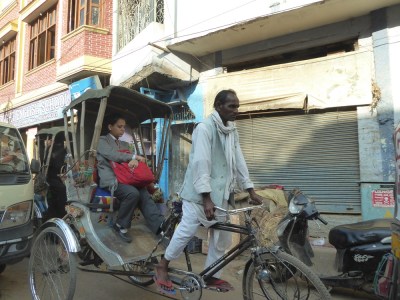
In addition to the usual traffic, children were making their way home from school. Some were packed tightly together in the rear of small trucks.
Other school kids sat nonchalantly in rickshaws, seemingly undisturbed by the traffic whizzing by them.
According to our guide, the best way to cross a road in heavy traffic was ‘like a cow’ – slow and uncaring, unconcerned and not blinking. Easier said than done!
Talking about cows, it was along this busy road that we saw a cow helping herself to fresh fruit from a handcart. The fruit seller very gently shooed her away.
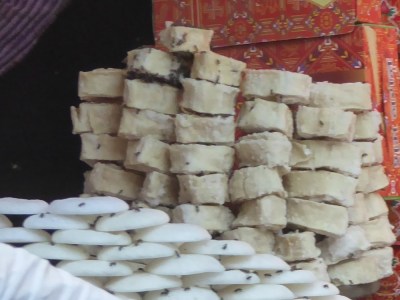
Outside a bakery we noticed piles of small cakes; fancy cardboard boxes were available to carry then home in. Unfortunately they were covered in flies.
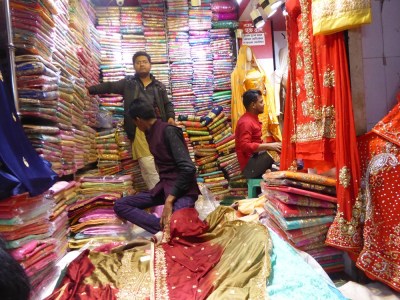
The driver dropped us off and our guide led us through the Muslim Quarter. Underneath part of a mosque, there is a bustling textile market where colourful sari outlets compete with each other.
Many females sat cross-legged feeling the quality of the numerous different fabrics.
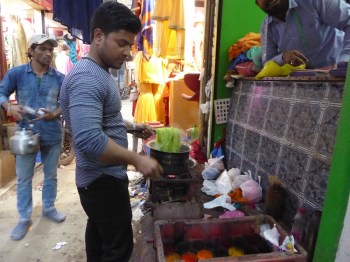
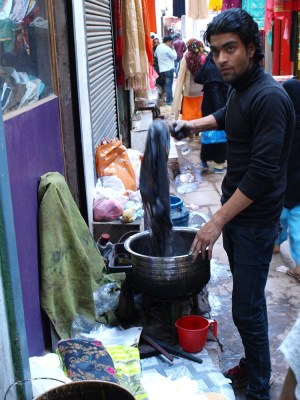
There are hundreds of different colours available. However, just in case the one you desire is not available in the shade you require, it will be dyed for you. Small pans hold the bubbling dye and the material is soon transformed.
Crossing over the road, we entered the Hindu area. Peering in a jeweller’s window, we saw a large family seated on the floor. They were choosing jewellery, perhaps for a wedding and it was being passed around and scrutinised by each family member. Apparently the family would have a long standing relationship with the jeweller. The purchases would be paid for in instalments, sometimes over a few years.
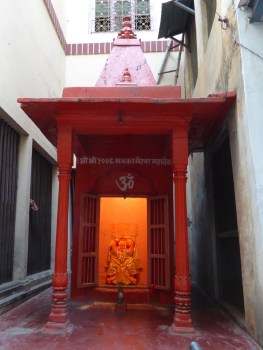
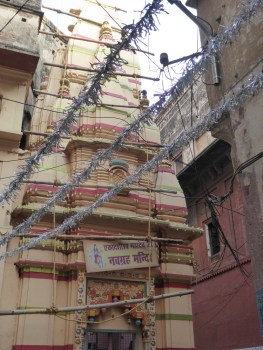
There were many small temples and each home also has its own shrine or temple.
Many pilgrims were wandering around; Dharam said that they would be offered free shelter while in the city on presentation of their ID cards.
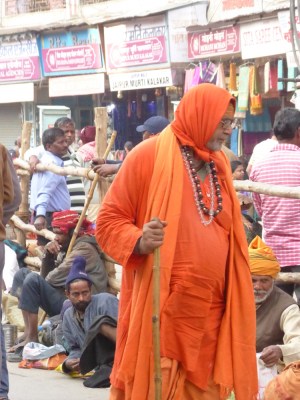
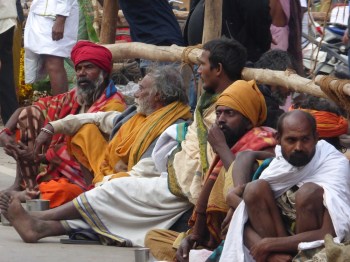

The three of us headed down to the Dashashwamedh Ghat, Dharam warned us not to shake hands with anyone as the person may be a massage man and not wish to let go. He also told us to expect to pay to take photographs of people or to do so surreptitiously. The hand shaking business had happened with Dave yesterday although it didn’t cause us a problem.
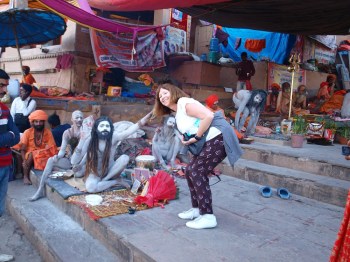
There were a few Naga Sadhus (Hindu sages) sat on the ghats. We dropped a couple of notes in front of one of the men and took a photo. Dharam instructed “give him more”, I did, and as I was doing so he tapped me on the head with his wand made from feathers.
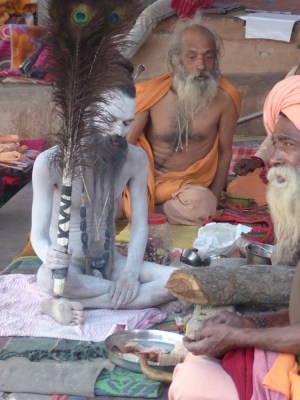
These religious ascetics usually live in caves or in the mountains but come down to the ghats for the religious festivals.
Leaving the wonders of the ghats, we stepped into a boat for a tour on the holy Ganges. There were quite a few vessels on the river; we first headed over to see the Alamgir Mosque. It was built in the 17th century by a Mughal Emperor after he had seized the city which was then known as Banares. He razed a Hindu temple to the ground and then proceeded to build the mosque on the same site.
Non Muslims are not permitted to visit the mosque.
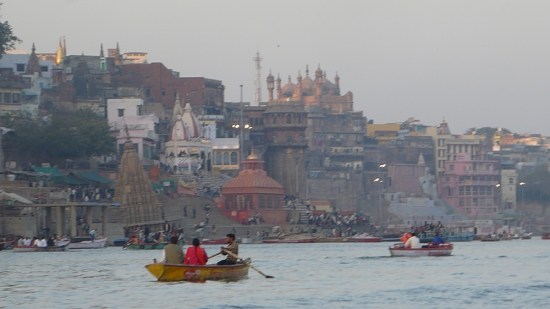
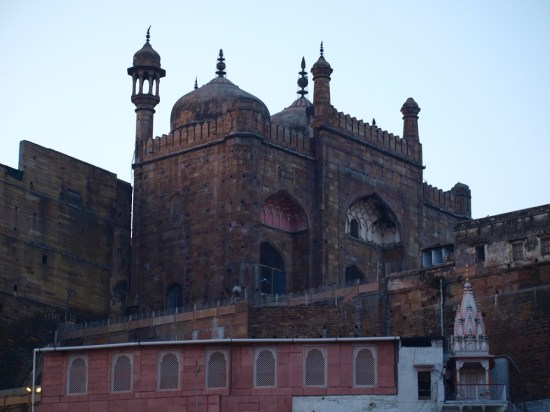
Moving slowly on Hinduism’s holiest of rivers, we continued to see life on the ghats. We had a bird’s eye view of the palaces and temples that were situated periodically alongside the busy ghats.

From a respectful distance we were permitted to take one or two photographs of the burning ghat. There were a few pyres burning on the riverside and more cremations would be taking place inside the shed in the background.
After the passing of a person and the issue of the death certificate, a ritual takes place in the home. If the deceased is a female the females wash the body, males will prepare the body of a male. The body is wrapped first in a white linen shroud and then, as this will be the last gift to the deceased, in a colourful bright shroud.
The body is then carried on a bamboo stretcher to the ghats. The bamboo used is green, as if it is the brown colour of the older bamboo, people will assume that the family have been preparing for the death for some time.
A few male members of the family accompany the body, taking turns to carry the stretcher. The men chant as they walk to the Ganges. The stretcher is placed in the Ganges for the final bathing of the body before being carried to where the cremation will take place.
The head mourner goes to the barber’s shop which is situated behind the burning ghat and his head is shaved. He then washes in the Ganges and changes his clothes for a white gown, the colour that represents respect. The other men would have meanwhile purchased the wood required for the pyre. The head mourner takes a flame from the holy fire that burns continuously and walks around the body five times before lighting the pyre. He then walks away as Hindus believe that showing emotion to the deceased’s soul could prevent its release.
The remains of the bodies, usually the pelvis of a female and the ribs of a man (being the strongest bones) are then thrown into the Ganges.
To conclude the ceremony, a clay pot is filled with water from the holy Ganges, the head mourner, with his back to the fire throws the water over his shoulder onto the pyre.
The true name of the Ganges is Ganga. ‘Ganga’ always deserves respect and the river is therefore referred to as Mother Gangaji. The suffix ‘Ji’ is a term of respect in the Indian culture and often tagged onto the end of a respected person’s name. However, during British rule, the name ‘Gangaji’ was overheard and it was incorrectly assumed that the river’s name was Ganges.
Dharam offered us the choice of watching the Aarti Ceremony either from the boat, from the ghat mingling with the crowds, or from a balcony above the proceedings. Both of us immediately chose the second option. “That would be my choice too” our guide said smiling.
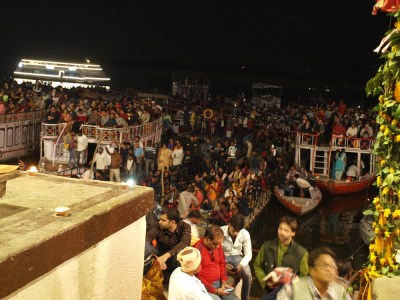
Dharam led us through the crowds and found us an excellent place to view the ceremony. We perched on a small wall amongst many pilgrims and Indian families.
Our excellent guide mentioned that the blowing of a conch would symbolise the end of the ceremony. He added that he would return later and disappeared into the throngs of people.
Apparently five to six thousand people attend the ceremony on the Dashashwamedha Ghat every day. The crowds of people watch either from the ghat itself or from a boat on the river.
The Aarti Ceremony symbolises putting the river, referred to as ’Mother Ganges’, to bed. It has taken place every day for 3000 years. Varanasi is the oldest living city in the world, as other cities from ancient civilisations like Egypt are no longer inhabited.
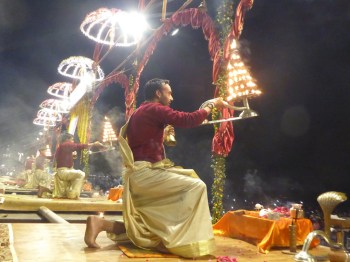
Young trainee priests perform the rituals, each has his own wooden platform facing the river with various religious paraphernalia and a small makeshift altar which is covered with a saffron coloured cloth. The blowing of conchs announces the beginning of the tradition.
From our vantage point and with the moon illuminating the proceedings we watched mesmerised. The devoted novices chanted and waved various shaped oil lamps in circular movements. The glowing flickers of flames from the numerous lamps highlighted the faces of the young priests. Their features seemingly set in a look of pure dedication and concentration. The aromas of incense drifted in the air as the smoke wafted by adding to the atmosphere of this spiritual ceremony.
At one point the ringing of bells by the priests was accompanied by a naked holy man in the crowd beating two hand held drums together.

Dharam suddenly appeared at our side just one minute before the blowing of the conch signified the end of the ceremony. He led us swiftly away, up the ghat’s steps winding our way through the crowds, and then with the aid of a flashlight he led us through a dark derelict building. Then we continued through a myriad of streets before we arrived at the street corner where the driver would meet us.
Returning to our hotel we felt exhilarated, it has been an absolutely AMAZING day.
Our day tomorrow starts at 5.45am when we will meet Dharam in the lobby.
Previous Next

 lindaruddstravels.com