
Monday 3rd April 2023
Bukhara: Mausoleum of Bakhauddin Naqshbandi: Sitorai Mokh Khosa Palace: Chor Minor: Kulkedash Madrassah:Bolo Hauz Mosque: Khodja Zaynidden Mosque: Poi Kalyon
Rain continued through the night with occasional episodes of thunder and lightning. Our breakfast this morning included pancakes, sweet scones, stewed fruit, eggs, sausages, a variety of bread and semolina. Not bad eh?
Today, Dave and I have decided to go to the Mausoleum of Bakhauddin Naqshbandi which is about 10km outside Bukhara. The complex is considered to be one of the holiest sites in Central Asia and is often referred to as ‘Central Asia’s Mecca’.
Dave has checked how to get there on public transport (all part of the fun) so let’s see how we get on…
Only just managing to bring the bus to a halt (we were expecting a larger vehicle), I climbed over a folded seat to get into the back seat. I shared it with a pretty young female and her huge bag; she smiled and indicated for me to rest my arm on her bag.
Dave sat on the small folding chair next to two females. Next to the driver was another passenger, we were in a narrow minivan and the cost of the journey was 6000 som, a total of 60 cents. The bus trundled along, surprisingly stopping quite a few times to drop passengers off or to pick them up. Dave and I however, were not surprised to be the only foreigners on the bus.

After paying the equivalent of 1 euro per person entrance fee, we entered the complex.
A plaque on a wall gave a list of ten rules that should be adhered to while visiting the mausoleum.
It was in English and entitled ‘The Rules of Visiting Sacred Places’.
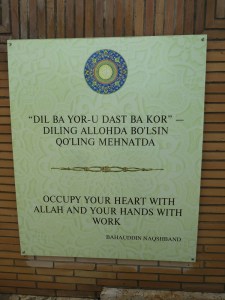
Bakhauddin Naqshbandi was a famous 14th century Sufi Saint. He lived his life by the principle ‘Occupy your heart with Allah and your hands with work’.
Muslims from all over the world make pilgrimages to this holy site.
The large and interesting complex has a necropolis, a minaret, a khanqah, mosques, and various other structures as well of course as the tomb of Bakhauddin Naqshbandi.
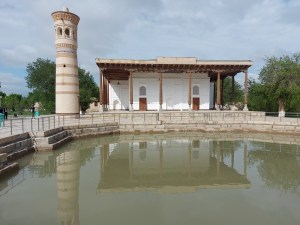
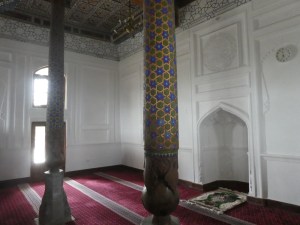
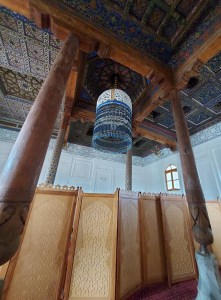 One of the mosques had two entrance doors, one for men and one for females. The interior was divided into two by a wooden screen.
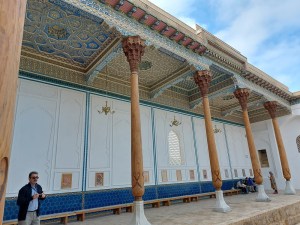
Its wooden decorated ceiling, blue and white beaded lamp and pillars are all spectacular.
A member of staff showed me the entrance to another women’s mosque and indicated that I should go in and that I was welcome to take photos. Smiling and nodding my thanks, I started to remove my boots again (and wished for the umpteenth time that I had worn sandals!).
Today it is around 15 degrees Celcius. The temperature here in Uzbekistan has to date varied from 14 degrees to 30 degrees in the shade. However, we all have clothing that can be worn in layers and two types of footwear so we are prepared for all weathers.
In one of the mosque’s was a tiny kitten cowering in a corner, I picked it up and stroked it for a while. When I put it down, it proceeded to follow Dave around the mosque.
One of the woman’s mosques had a wonderful decorated ceiling, a young woman sat quietly reading, the Koran, no doubt. She looked up and nodded and smiled at me. These people are so lovely and friendly.
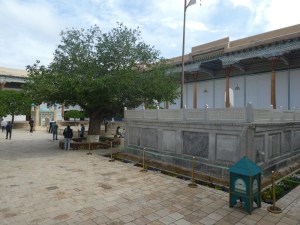
Through the window I noticed a courtyard. The courtyard has a riwaq (arcade) around it with a beautiful decorative wooden ceiling. Inside the courtyard is the tomb of the famous Sufi Saint Bakhauddin Naqshbandi. The tomb is protected by a grey marble wall and cordoned off.
Many years ago, pilgrims kissed the tomb and also circumnavigated it. This is no longer permitted and is, indeed, on the list of rules at the entrance to the complex.
Leaving the complex and crossing the dual carriageway, we stopped for a much needed cup of coffee or as Dave called his drink, “sugar with coffee in it”.
After coffee we jumped into a taxi and headed to the Sitorai Mokh Khosa. The palace was built in the early 20th century for the last Emir of Bukhara.
Our taxi was a rather old and dilapidated Fiat Matiz, the driver bombed along at 100km an hour, one dial indicated no petrol, and another showed that the vehicle was overheating! Perhaps, a wiring fault somewhere.
The palace had a colourful and impressive entrance portal. A member of staff who spoke perfect English explained to us that there were various buildings to visit. Declining the offer of an English speaking guide, we explored the palace and its grounds.
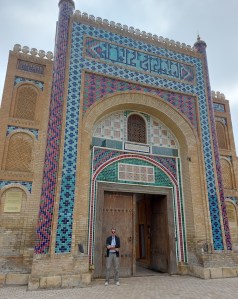
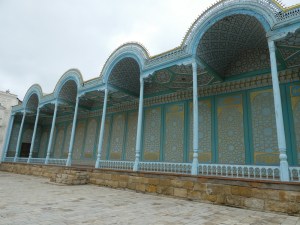
Sitorai Mokh Khosa Palace
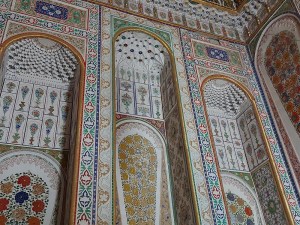
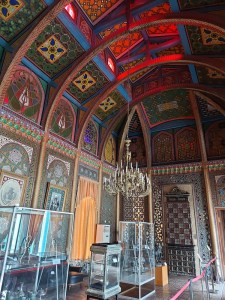
In the first courtyard we entered there was an elegantly decorated riwaq.
All the rooms in the palace that we visited were sumptuously decorated, some, however were quite dark
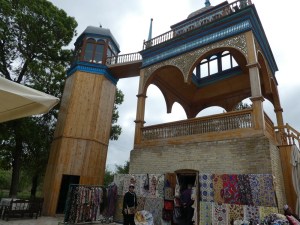
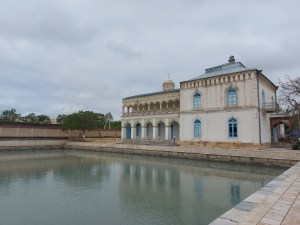
At the front of the harem is a pool where the Emir’s many concubines would relax.
Apparently the Emir would throw an apple to the female of his choice for that evening.
A wooden pavilion has numerous suzanis and other embroidery on show. A couple of experts sit working away at the craft.
The grounds are quite extensive and nowadays unfortunately quite rundown.
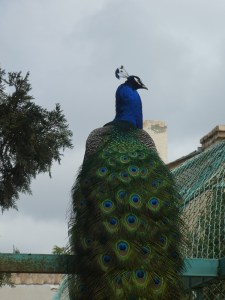
Its aviaries are now empty; however, peacocks still roam the grounds. The birds are quite tame, and one allowed Dave to get close enough to stroke its tail.
Another taxi took us back into Bukhara to the Chor Minor Madrassah. Chor Minor translates to four minarets. Indeed, the building has four towers but none of them has ever been used to call the faithful to prayer.
Some say that the four minarets were built to represent the four main world religions. Indeed, each minaret is different and symbols of fish and crosses (Christianity) and prayer wheels (Buddhism) can be seen.
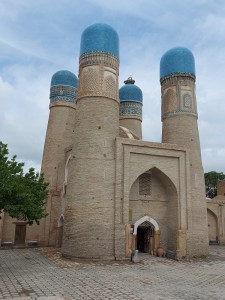
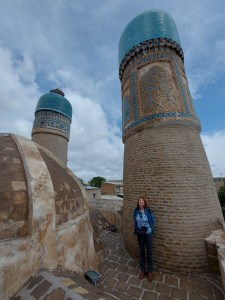
With our bodies bent and heads bowed, we climbed up the windy stairway to the rooftop to see the minarets up close. One of them has a plastic stork nest on the top of it; this is deterring the real storks from nesting there.
We have seen an old sepia photograph of the structure with a real stork’s nest on top of one of its towers.

Leaving the Chor Minor, we walked through the back streets towards the Lyabi Hauz Square.
We came across a building with some mosaics around which we assumed were once student’s cells or classrooms.
The structure had some huge cracks in it and other signs of major deterioration.
Following its perimeter, we were surprised to learn that it was the Kulkedash Madrassah, one of the 3 monumental religious structures surrounding the Lyabi Hauz Square.
After a late light lunch we continued to the Bolo Hauz Mosque, unfortunately, its doors were locked.
I attempted to converse with a couple of guys who were selling jewellery in the mosque’s riwaq. I understood that we could visit the interior half an hour before prayer time on condition that my head was covered.
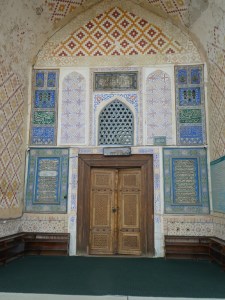
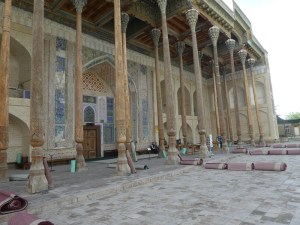
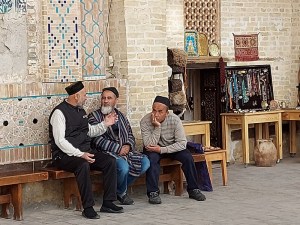 The mosque’s riwaq with its carved wooden pillars that reflect in the structure’s pool is an amazing example of Islamic Architecture.
Red prayer mats lay rolled up waiting for the next prayer time.
Knowing that it wasn’t prayer time, we went once more to the Khodja Zaynidden Mosque. We were hoping to visit for more than a couple of minutes this time. Our guidebook states that the mosque has some of the best mosaic and ganch work in Uzbekistan.
Humbly, with my hair covered, bare footed, and my eyes cast down I followed Dave into the mosque.
An Imam was sat cross legged reading to two young children. After we had all nodded and smiled at each other, he asked “Where are you from?” “England” we replied. He then enquired if we were Muslim and when we said no, he asked if we were Christian.
Continuing with a great deal of respect, I wandered around the small mosque trying to absorb its beauty. Tentatively, I took a photograph and when he didn’t object I continued.

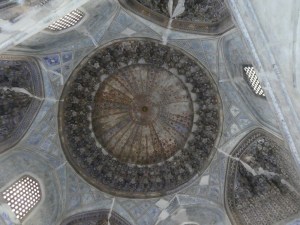
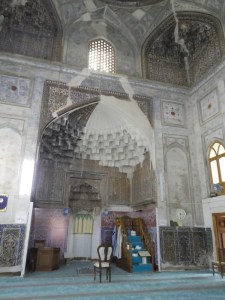 The mosque is small with a striking and captivating dome which is over 8 metres in width
I didn’t use my mobile phone to photograph the mosque as there was a poster on the entrance stating ‘No Phones’.
We were both taken aback and glanced at each other with raised eyebrows when the Imam’s phone rang. Perhaps the instruction refers to prayer time.
Dave waved goodbye as we left, the man was still chattering on his mobile. He nodded and indicated for Dave to put a donation in the box.
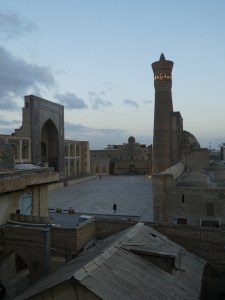
After an hour or so back at the hotel, we were out again and on our way to meet Peter and Anne for a drink in the ‘Café Chasmai Mirob. Hopefully we would see the sunset over the Poi Kalyon.
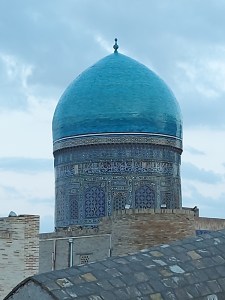
Our friends were already there, seated on the upper terrace and Anne said that just a few minutes earlier the sun had been shining on the dome of the Mir -I- Arab making the turquoise and other colours glitter.
Together, we headed to the Lyabi Hauz Square for dinner. Anne & I as usual were lagging behind as we chatted about our day.
“Walk and talk” one of the guys shouted to us (one of their favourite sayings!)
Our reserved table was overlooking the reservoir and we watched the rain bouncing on the water.
The four of us continued to swap information; Anne and Pete decided they would go to the mausoleum and palace the following day. Dave and I agreed to add a visit to a house to our list; our friends had come across it today and said it was well worth a visit.
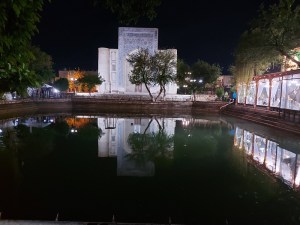
As we left the restaurant, we stopped to admire and photograph the Nadir Divan Begi Khanqah and its reflection.
Another fabulous and fascinating day here in Uzbekistan

 lindaruddstravels.com