Sunday 2nd April 2023
Bukhara – Poi Kalyon: Kalyon Minar: Kalyon Mosque: Mir-I Arab Mosque: Taki Zargaron: Ulug Beg Madrassa: Abdulaziz Khan Madrassa: Khodja Zaynidden Mosque: The Ark Fortress: Magoki Attori Mosque: Ismail Samani Mausoleum: Bolo Hauz Mosque
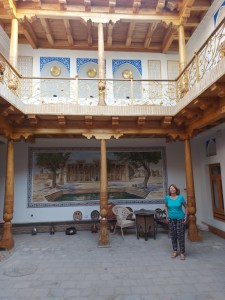
After a delicious breakfast, all freshly cooked in our small traditional hotel, we took a taxi to the railway station.
The station is around 12km outside of the city and we needed to purchase our tickets for the journey to Samarkand later in the week.
The two so called ‘fast trains’ were already fully booked, so our only option was to buy tickets for the 16.08 ‘slow train’.
Having secured the tickets, we set off to see the sights of Bukhara.
The Poi Kalyon is the most famous square in the city and is situated in the centre of the old town. It is home to three impressive buildings.
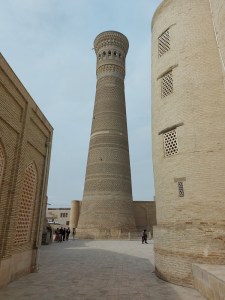
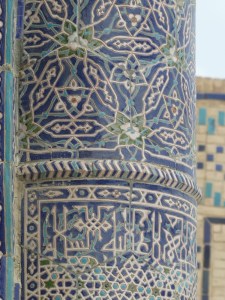
The Kalyon Minar, a tall stone minaret built in 1127, has a rim of glazed blue tiles as its only colourful decoration.
There are, however many different ornamental carvings within its stonework.
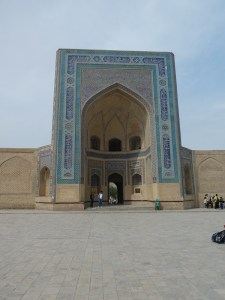
The Kalyon Mosque built in the 16th century replaced a mosque that was built in the 8th century which Genghis Khan destroyed.
It is also known as the Juma Mosque (Friday Mosque) and is, therefore the main mosque of Bukhara. The mosque can hold 10,000 people.
There are a couple of stalls in one corner of the courtyard and one of the ladies started following us around showing us embroideries, shawls, ornamental plates etc.
We had to tell her a number of times that we were there just to see the architecture before she left us and approached another couple.
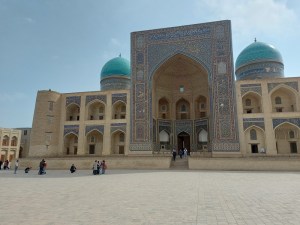
The magnificent Mir-I Arab Mosque is considered to be one of the most important Islamic educational institutions in Central Asia.
As it is still a working establishment, only the entrance hall is available to visitors.
However, we could see through into its large courtyard via a metal grated window.

Time for a coffee stop in an open square with astonishing views. In front of us we could see the stone domed Taki Zargaron (once again, various spellings including Toqi and Toki).
The domes and minaret of the Poi Kalyon are also visible. A taki is a bazaar, selling many hand crafted products and souvenirs
To our right, stood the imposing Ulug Beg Madrassa. I was particularly drawn to the curved spiral detail around its arched doorway. There are so many aspects of the building to take in, the geometric designs, and the calligraphy. There is a calligraphy museum inside the madrassa.
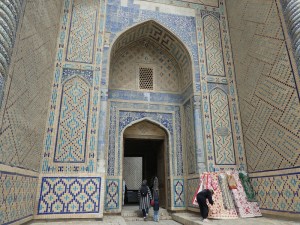
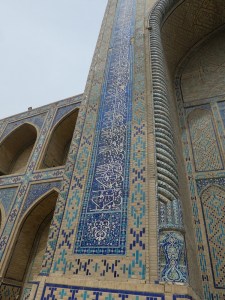
On its portal, there is an inscription taken from the Koran “The pursuit of knowledge is the responsibility of every Muslim man and woman”.
Directly opposite is the Abdulaziz Khan Madrassa, this was the highlight of my day. Its exterior has stunning ganch work and mosaics
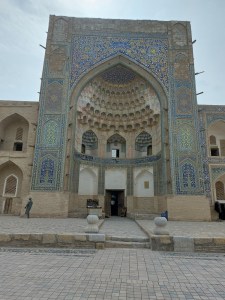
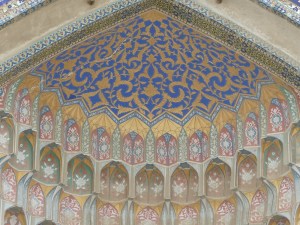
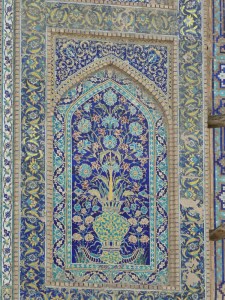
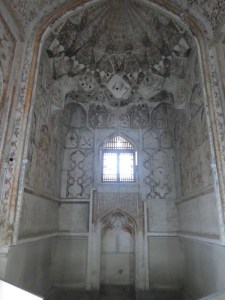
Inside the madrassa there is a wood carving museum which you can also visit for a nominal cost.
This small museum was once one of two mosques within the madrassa, this one was the Winter Mosque (the other the Summer Mosque).
The mihrab in the Winter Mosque is mesmerising, with its stalactite ganch work, (one of Uzbekistan’s oldest and exquisite architectural artworks).

The Abdulaziz Khan Madrassa’s courtyard has been partly renovated.
As in many of the courtyards, there are locals selling an assortment of items. A young man stood in front of one of the old cells that was cracking and crumbling, as were the colourful mosaics around it.
When Dave pointed at one of the paintings of a hoopoe, the young man told us that the bird is a symbol of Sufism. He went onto explain that a crane represents freedom and that a pomegranate is a sign of many children.
Our next visit was the Khodja Zaynidden Mosque. While standing on its intricately patterned wooden veranda, which was in need of repair, a man approached us and said that we were welcome to go inside.
First, we removed our shoes and I covered my head, as we stepped inside, we first noticed a man who was swaying a little while reading to a small child. On seeing us, he immediately put his hand up and said “No!”
Another man walked rapidly over to us and said that we were okay to stay, but just for five minutes as prayers would soon begin.
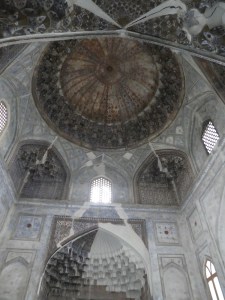
The mosque is spellbinding with elaborate decoration. We stood and stared around us for a couple of minutes and then unfortunately had to leave.
Dave and I agreed to try and return.
Just a few minutes walk away is the Ark Fortress, in front of which is a large square known as the Registan. Once, this square served as a slave market and as a place of execution. Today, various stalls sell cold drinks, snacks and trinkets

The Ark was originally built in the 5th century and is the oldest construction in Bukhara.
It was the residence of Khans and Emirs, government officials and certain professions from when it was built until 1920, when fire destroyed 80% of the citadel. The Ark was a town within a town.
It is still being restored today.
The Ark’s Juma Mosque has a sign stating that the mosque was restored in 2009 with the help of the American Embassy in Uzbekistan.
It is definitely my favourite part of the Ark. It is remarkable, a brightly coloured mihrab and a wonderfully embellished ceiling.
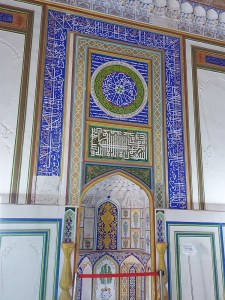
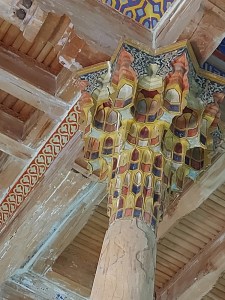
Ark Fortress
Juma Mosque
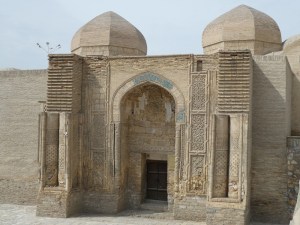
Walking back to the centre, we passed this lovely old building and I exclaimed “Wow!”
After further investigation, we realised it was the Magoki-Attori. Some claim, that this is the oldest surviving mosque in Central Asia!
A plaque states that it is now a museum of the history of carpet making, but we suspect this closed some time ago.
Apparently on this site, there has previously been a Zororastian Temple and a Buddhist Monastery.
The stonework is impressive and there are still a few turquoise tiles around the arched portal.
Early evening, we met up with Pete and Anne and we walked to the Bolo Hauz Mosque.
After a quick photo (as we knew we didn’t have long before sunset), we continued into Samani Park.
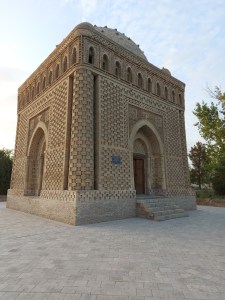
The park takes its name from the Ismail Samani Mausoleum which is situated in the park and has elaborate stonework.
The four of us enjoyed the views of Bukhara from the heights of the park’s Ferris wheel.
There were barriers around the Bolo Hauz Mosque as we passed it again and there was a high police presence, as the faithful left after their prayers.
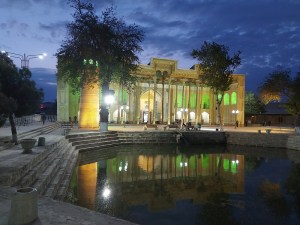
Once more we stopped for a quick photo and this time, managed to catch the mosque’s reflection in its pond.
The four of us had a lovely dinner at the ‘Old Bukhara Restaurant’. Separate interior dining rooms of the eatery surrounded a lovely courtyard with trees, plants and additional tables set for dinner. However, due to rain being forecast we chose to a table inside.
It’s a good job that we did, as shortly after we had arrived a deafening clap of thunder preceded a heavy downpour. The waiters were soon running around with plastic bags on their heads or alternatively using an upturned tray to shelter them.
I think in an attempt to dodge the downpour, one of the young waiters chatted to us for quite some time. He told us that children here often start work as young as eleven or twelve. “Cleaning cars or doing something like that” he added.
Previous Next

 lindaruddstravels.com