
Sunday 17th February 2019
River Ganges : Ghats
Our early morning flight landed into thick smog at Delhi airport.

Walking to the gate for our connecting flight to Varanasi I spotted an interesting statue. It depicted the yoga sequence that is known as the ‘Salute to the Sun’.
The next flight took just an hour and covered 733 kilometres to Varanasi which is situated on the banks of the River Ganges in Uttar Pradesh.
We were met at the airport by a representative from the travel company and taken directly to the hotel. Following our check in, we put our luggage in the room and after a quick freshen up we left the hotel.
At the end of the street we saw a number of tuk tuks and approached one of the drivers to take us to the ghats (river front steps that lead down to the Ganges). However, the driver we had spoken with was not allowed to take us and after agreeing a price with ‘his boss’ we set off. He was a friendly chatty fellow and he pointed out one or two sites including a Muslim cemetery where he said his mother and grandparents were. He added that the Muslims and Hindus who lived in the city were brothers and all Indians.
He said that he couldn’t take us all the way to the ghats due to the sheer volume of traffic; instead he dropped us off on a corner and pointed the way which was down a long street. I jumped out of the tuk tuk and looked in dismay at the heavy traffic. “How do we cross the road?” I enquired rather pathetically. The friendly guy got out of his vehicle and led us confidently and safely across the noisy road ignoring the blaring horns.
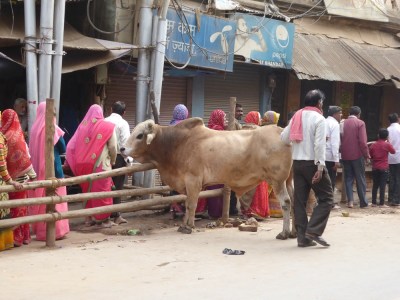
We started to walk down the long street; it continued to be extremely noisy. The noise was caused by both the traffic and the people. There was a seemingly endless queue of people; they were standing behind makeshift railings that had been erected on the already narrow and busy or even nonexistent pavements. They were patiently waiting for their turn to enter the Vishwanath Temple which is dedicated to the god Shiva.
The hundreds of Hindu pilgrims were visiting the holy city after their pilgrimage to the Kumbh Mela festival in Allahabad, around 120 kilometres away.
We spotted a body being carried through the streets on a stretcher; its frame was made from bamboo. A group of eight men formed the cortege; four carried the body periodically changing with the other four. The men were solemnly chanting as they made their procession to the Ganges.
Knowing that the cortege would be heading for the ghats we intended to follow it to ensure we walked in the right direction. But due to stopping to take photos and standing still to avoid tuk tuks, bikes, cars and rickshaws, the men soon disappeared from view.
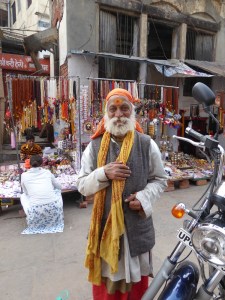
Spotting a sign for the Dashashwamedh Ghat we followed the masses of people, the majority of them were pilgrims in colourful clothing and many sported various colourful marks on their foreheads too. There were many stalls selling a large selection of goods in the pedestrian only area that we were now walking through.

As we turned a bend, an awesome sight greeted us. There, directly in front of us, was one of the ghats leading down to the River Ganges.
We took a few steps down and stood watching the scene below us; there were lots of boats and a guy appeared at our side enquiring if we wanted a boat ride on the Ganges.
Another guy offered to show us around, we declined all offers explaining that we were just meandering. There were one or two holy men with extravagantly painted faces; one put his hand in front of his face as he saw me raise my camera.
A naked holy man known as a nagu sadhu was sat under a makeshift wooden shelter, his face was painted and his body was smeared with ash. Another nagu sadhu a little further along beckoned to me pointing at some burning logs in front of him, I have no idea why, perhaps he was an astrologer… However, I did notice a tiny jewel glinting in his penis!
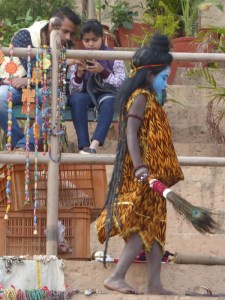
Behind us higher up on the ghats, we watched a young female wafting a duster made from peacock feathers over her produce.
Her face was painted blue and her dark long dreadlocks almost reached the floor.
Cows and water buffalos roamed freely along the ghats.
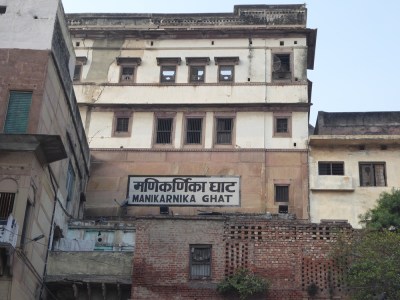
Continuing to walk along the Ganges, we saw up ahead numerous piles of logs, smoke and fire. We were of course approaching the Manikarnika Ghat, otherwise referred to as the Burning Ghat. The bank of the River Ganges is the most auspicious place for Hindus to be cremated.
There were some stone temple like buildings and an ugly red corrugated iron shed higher on the steps with steel chimneys. We noticed a building with a plaque stating ‘Pilgrim Shed’.
As we stood looking at our surroundings, a young man approached and introduced himself. The well spoken Hindu was named Sonny and he told us that he volunteered for three hours each day at the ghat to teach foreigners about the Hindu culture. In return he asks for respect, no photos of the actual cremations and “perhaps a little donation” he added. He said that some extremely sick people arrived at the ghat knowing they would soon die and they were cared for in the Pilgrim Shed. Donations could go towards the cost of food or medicines or more likely towards the cost of the wood to cremate their bodies.
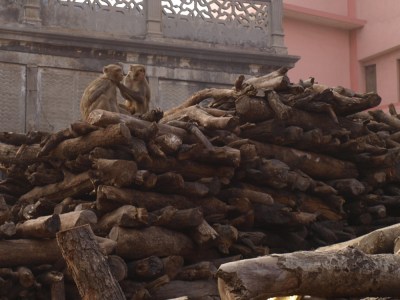
Various types of wood are used for the cremations, all of which are priced differently. We noticed two monkeys grooming each other on a nearby pile of logs that must have been five metres high.
Around three hundred kilos of wood are required to cremate a body and it takes three to four hours to burn.
Usually it is only the male members of a family that attend a cremation.
A strict caste system is in operation at the burning ghat and it depends on which caste one is from as to where the cremation will take place.
The Brahmin caste (the top caste) is cremated on the top level of the ugly looking corrugated shed, the next caste is on a level down. A lower caste body will be cremated on the upper level of the river bank while the lowest caste is cremated on the edge of the Ganges. Dave and I were surprised to hear this; we would have expected it to be the other way around with the highest caste having their funeral rituals directly on the river bank.
Sonny gave us a tour of the different levels. He pointed to a burning body, its charred head and feet were painted red.
The bodies belonging to higher castes are placed in a metal frame before cremation; the lowest castes are simply laid on a log pile on the river bank.
The so called burning ghat operates continuously and between two and three hundred bodies are cremated in any 24 hour period.
We saw a boat arrive with a body wrapped in an orange shroud and covered with flowers. It is usual to cremate a body within 24hours of the death and the ashes of all castes are placed in the River Ganges.
The flame for all the pyres comes from the holy fire which has been alight for over three thousand years. It is one of the ‘Dom’s’ sole job to ensure that this holy fire continues burning. ‘Doms’ is the name given to the people who deal with the dead and they are from the caste known as the untouchables.
Sonny took us to the ‘boss man’ and we made our donation. He also introduced us to another man who was the manager of the workers who stacked the pyres. He spoke fluent English and said that for an additional donation we could take photographs throughout the site but we declined, preferring to respect the deceased and the grieving.
Sonny was an informative young man who gave us an insight into the Hindu funerary rites. While seemingly macabre to non Hindus these rituals of being cremated on the banks of the River Ganges is what people of the Hindu religion aspire to all their lives. Their belief is that being cremated here in Varanasi will end the eternal cycle of life and death.
Our eyes were stinging from the pyres, and a burning odour had seeped into our clothes and onto our hair. The experience had been both emotional and fascinating, this is the real India.
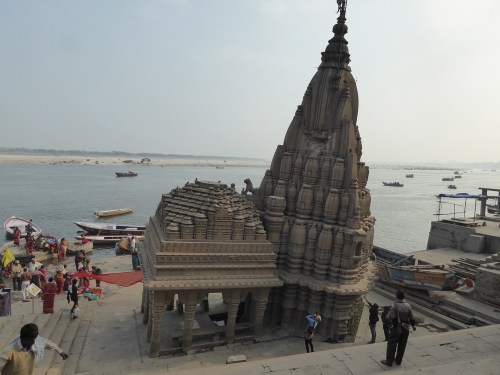
On leaving the ghat we passed the sand coloured Ratneshwar Mahadev Mandir which has been leaning for many years and appears to be slowly sinking into the Ganges. Indeed for some of the year it is partially submerged in the river.
Setting off back to the hotel we entered what turned out to be a warren of narrow, bustling and noisy backstreets. Not at all sure which way to go we just wandered taking one turning and then another. After a while, however, we decided to ask an Indian gentleman who was walking behind us the way to the main road. “This way” he said and motioned us to follow him. He continued to stop at each small crossroads pointing the next direction until finally we came out on the main road where we had started this incredible afternoon. We jumped in a tuk tuk and headed back to the hotel.
A couple of hours later we heard drums and from the hotel’s window we saw a procession of people dancing and going through a gate into a large open area. Wondering if it was a festival we decided to have a look.
It turned out to be a ring ceremony that we were gate crashing! This event, also known as a Sagai Ceremony occurs when the future bride and bridegroom formally announce their betrothal and exchange rings.
There were many people, all dressed in their finery. Music was playing and some young women were already dancing energetically.
Realising our mistake, we started to leave but we were approached by the groom’s brother who introduced us to his mother. She was dressed in a bright red sari and they told us that we were most welcome. Another couple of people offered to get us chairs and someone else offered us food but as it appeared that we were now the centre of attention instead of the young couple, we politely declined and left.
Sounds of music and firecrackers went on into the night.
Previous Next

 lindaruddstravels.com