Thursday 16th February 2023
Gellert Hill Cave: Liberty Bridge: Heroes’ Square: City Park: Vajdahunyad Castle: The Zoo: Air Balloon: Széchenyi Spa: Szimpla Kert Ruin Bar

Gellert Hill Cave was our first stop of the day, to reach it we walked across another of the city’s bridges, Liberty Bridge.
The bridge is the shortest of the city centre bridges and was built in 1896 as part of the Millennium World Exhibition; its original name was the Francis Joseph Bridge.
Continuing, we walked up to a pretty stone building which we believed to be the entrance to the cave and started to walk into it. However, I yelped and quickly stepped back, the area was full of stinking rubbish. It looked as if lots of bins had been emptied in this small interesting building. It took us by surprise as this city is extremely clean.
Turning in the opposite direction, we soon found the entrance to the cave which has a couple of chapels inside. The cave was once home to a hermit monk who healed the sick. The cave is often referred to as Saint Ivan’s Cave.
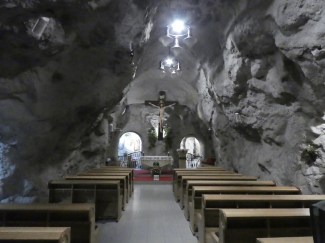
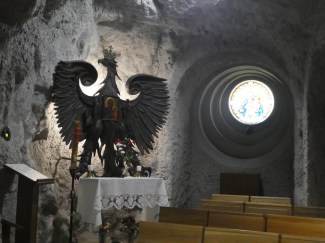
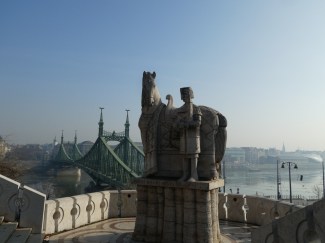
Just outside the cave was an impressive statue of King Stephen I, with a beautiful backdrop of the Liberty Bridge spanning the Danube.
This was our last day in Budapest so we decided to take a tram to save time to our next stop, Heroes’ Square.
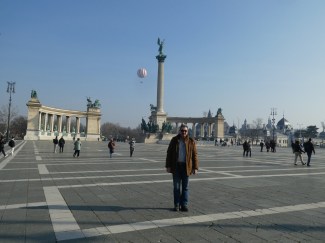
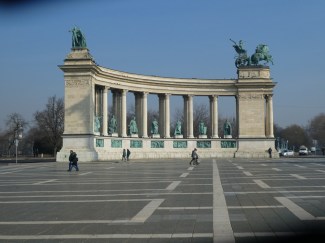
The square is perhaps the most important square in the capital city; its impressive statues pay homage to the country’s leaders that founded the city.
Adjacent to the square is the huge City Park. Within the popular park, one can find a circus, a zoo, a castle, an ice rink, an air balloon, thermal baths, cafes, bars, restaurants and this list is not exhaustive!
Noticing the air balloon that we had indeed, seen each day from some part of the city, we walked over to it. There was no one there and we decided that it was perhaps used for weather research.

The interior of the castle is an agricultural museum, directly outside is a large ice rink where people were practising their skills and having fun.
In 1896 the country celebrated one thousand years since its founding. Part of the celebrations was an exhibition which included the construction of Vajdahunyard Castle.
The castle was originally built from wood and cardboard as it was expected to be a temporary exhibit, but the people of Hungary apparently loved it and early in the 20th century, the permanent structure was built.
After hot drinks in one of the park’s cafes, we visited the zoo. The zoo is one of the oldest in Europe. It has over one thousand different species of animals and birds.
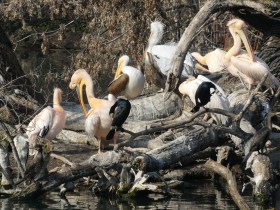
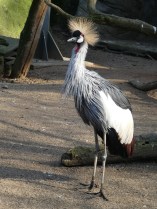

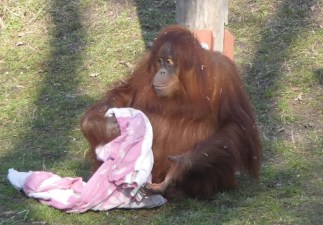
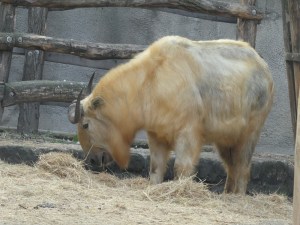
Some of the species we had never seen before. The primates include Sumatran orang utans, tamarins and gorillas. Young orang utans ran around with small pieces of material, seemingly playing hide and seek or peek a boo with each other. Some of their larger relatives also carried and played with pieces of fabric.
The zoo is home to various species of big cats and also the much smaller Pallas’s Cats. There are rhinoceros, hippotamuses, giraffes, polar bears, gnu goats, camels and elephants, including a baby elephant born just last year. The biggest surprise or maybe shock was to see an anaconda.
On entering the zoo, we came across a lake with an island. The trees had lots of nests and we spotted herons, pink backed pelicans, cormorants, cranes and other birdlife, some of which were flying overhead.
We agreed that it was interesting to see all the varied species and to hear about the different breeding programmes. Unfortunately, in our opinion, some of the enclosures are on the small side.
Our lunch in the park was goulash soup; we sat in the conservatory of one of the cafes with the sun shining and a view of Heroes’ Square.
After learning that the air balloon did do fun rides, we decided to give it a try.
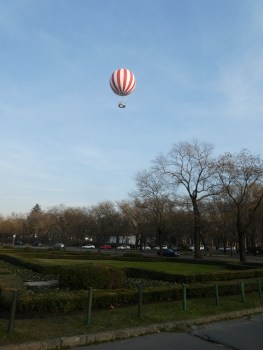
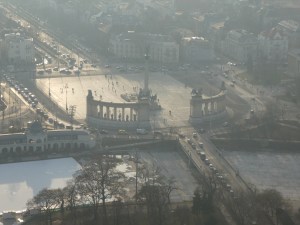
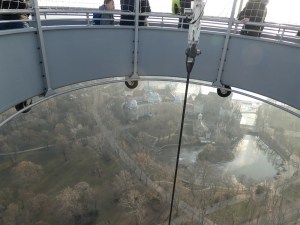
The hot air balloon could carry a maximum of 30 people and it was fixed to the ground. It rose to a height of 150 metres; we were then free to walk around the perimeter to enable us to see the views for a few minutes before it descended. The views were spectacular!
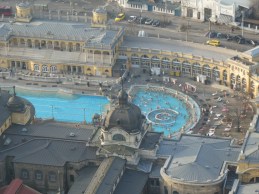
Our final stop in the park was the famous Széchenyi Spa. The natural spring baths is one of the largest in Europe with 15 indoor pools and 3 large outside pools. There are also saunas, steam baths and an array of massages and treatments are offered.
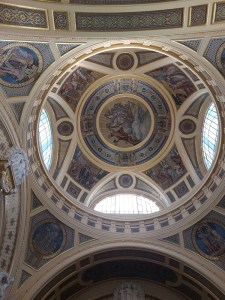
All of this is set in a stunning palace with Neo-Baroque and Neo-Renaissance architecture.
While queuing to purchase tickets we admired the ornate ceiling in the foyer.
Well, it was such a treat, especially after all the walking we have done over the last few days. Relaxing in the outdoor thermal pools was just what we needed!
We alternated between the outdoor pools, almost shivering and walking tentatively on the icy ground between them. One of the pools had a lazy river that wasn’t so lazy and pushed you around fairly quickly!
Both of us thoroughly enjoyed the warm therapeutic waters in the lovely setting, watching the sun set and afterwards the sky turn dark.

It was a little before 7pm when we took a metro from the City Park to the area where we had eaten on the first night. Transport Police requested our tickets at the station, I gave him mine and Dave offered his driving licence (which showed his date of birth) to prove he was eligible for free travel. The policeman thanked us and waved us through.
Seated outside a bar with a couple of beers, we commented on how lucky we were able to do this in February and chatted about where we fancied going for dinner. Checking our list of ‘things to see’, I mentioned that we hadn’t yet ticked off a Ruin Bar. With the help of Google Maps, Dave found one not too far away.
On the route there we passed various bars, restaurants (including a Jamie Oliver eatery) and party places.
A Ruin Bar is a bar that has been founded in an old dilapidated building (a ruin), usually a pre World War II building, and often in the city’s Jewish Quarter.
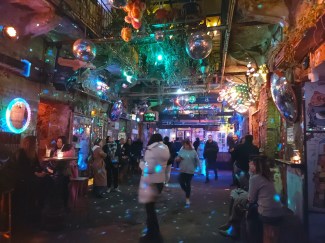
Szimpla Kert Ruin Bar happened to be the first ruin bar in Budapest. It is huge, with various small seating areas and small bars. The music is loud, the lights bright and yes, it looked like a dump, full of a myriad of unwanted items.
There is an old bath, and an old wooden barrel. Disco balls of different sizes hang from the ceiling along with pre loved scruffy cuddly toys and various styles of lamps. An eclectic mixture of pictures, paintings and other type of décor adorn the walls.
I had read that there is an old Trabant car, (one of the most popular cars in the former East Germany) that has been cut in half and is now used as two benches, but I didn’t see it.
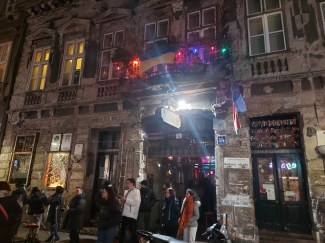
Deciding not to stay, we found a quieter bar for a pre dinner drink. Then we went for dinner at Hâcek, the restaurant that we ate at on the first night.
Once again the atmosphere was cosy and the food was delicious.
It had been a long but fabulous day.
Tomorrow, we travel home. We have thoroughly enjoyed our few days here, we have managed to tick off everything on our ‘must see’ list but there are still plenty of places to see. So, perhaps, we shall put this wonderful city back on our bucket list for a repeat visit.

 lindaruddstravels.com