Wednesday 9th April 2025
Hot Air Balloon Ride : Goreme Open Air Museum : Çavușin
This morning our alarm rang at 4am. A minibus was picking us up at 4.50am.
It is now 5.30am and along with many others, we are sat waiting to see if the morning’s balloon flight will go ahead. Minibuses have collected folk from around the area and brought everyone to a central place where a breakfast buffet is available while we wait.
Staff issued us with printed boarding cards and safety instructions. When landing and the pilot instructs us to, we must hold onto the ropes that are attached to the sides of the basket and take the ski position. This is a safety precaution in case the basket tips and lands on its side.
They told us that the pilots had control of ascending and descending but could not control the direction, for that, we would be in the hands of the four wind gods.
Near perfect weather conditions makes Cappadocia one of the most well known hot air balloon flight locations in the world. During one year, there are approximately 260 suitable flying days, as opposed to just 60 days in Europe. Around 150 balloons take to the sky before sunrise. It is of course a stunning way to see the magical landscape.
As soon as the go ahead for the flights was received from the Meteorological Centre, it was all systems go. Everyone was quickly ushered out of the building, and into the waiting minibuses ( to which people had already been assigned ).
It was extremely well organised, there was a magnetic board on each bus which gave the name of our pilot, Bozad and our driver, Mustufa. These details were also printed on our boarding tickets.
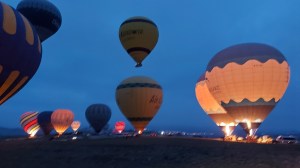
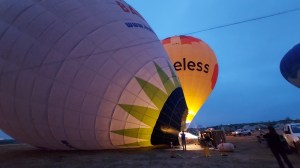
As we approached the take off area, it was an incredible sight to see the hot air balloons inflate. They were huge and there were many different coloured ones. As we got closer, we could hear the whooshing sound of the gas warming the air up.
We had booked a ‘Deluxe Balloon’ which meant that there would be sixteen people rather than twenty eight in the balloon. The difference in price was minimal.
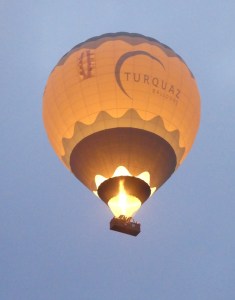
It was an amazing feeling rising above the extraordinary scenery below. The scenes were breathtaking; we spotted the red and rose valleys which we had seen the previous evening.
It was quite surreal and totally peaceful (apart from the spasmodic whooshing to keep us airborne!).
When we reached an altitude of 600 metres, we were above Love Valley. At this point we had started to go into cloud so Bozad lowered the balloon until our view was clear again.
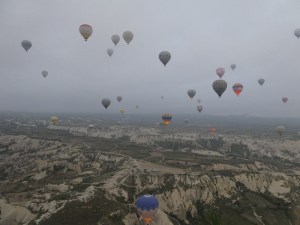
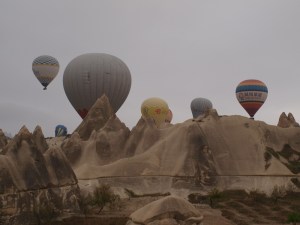
It was also a striking sight to see all the other balloons surrounding us.
As the balloons start to descend, the trailer drivers (that delivered the balloons to the take off site) have no idea where they will land. They communicate with the pilots via radio.
As we descend further, we see the many trailers racing in different directions to meet their balloons. Very close to the ground, men pull on the ropes from the balloons to place it on the trailer. I’m pleased to say that Bozad with the help of his ‘ground crew’ made a perfect landing. Unfortunately, we did see one balloon that had tipped onto its side.
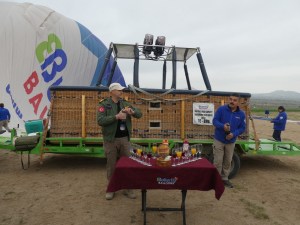
All of us in the balloon were first timers and we all thoroughly enjoyed the new experience, agreeing that it was absolutely awesome.
A champagne and strawberry breakfast was served after landing.
The transport returned us to our hotel where we were offered the third breakfast of the day!
After setting off walking to the Goreme Open Air Museum, what had started as light rain soon turned heavier; fortunately we were close to a taxi office.
The ‘Open Air Museum’ is a UNESCO site where a great many religious buildings have been carved out of the soft rock which is known as tuff . Millions of years ago, flowing lava and ash from volcanic activity covered the area. Over time, years of erosion and weather conditions moulded the area into the incredible landscape it is today.
Numerous ancient chapels, monasteries and a nunnery exist on the site, which was at one point a sanctuary for early Christians. Another time in history the Christian buildings were used as dovecotes, this obviously caused a great deal of damage to the frescos.
A row of shops selling mainly souvenirs varying from balloon key rings to huge framed religious artworks lead you to the entrance of the site.
As we walked down the row, a couple of enterprising shopkeepers were bringing out buckets of umbrellas, I quickly purchased one.
The site is easy to wander around, a path leads from one structure to the next. Some, but not all, have information relating to the chapel/church on a placard outside.
There was a little controversy regarding photography. Some information said no flash photography, one or two of the buildings had guards inside stopping people taking any photographs.
There were also a few large placards with pictures of the interiors, so at least you could take a shot of those. However, many people were taking photographs in the majority of the places we visited.
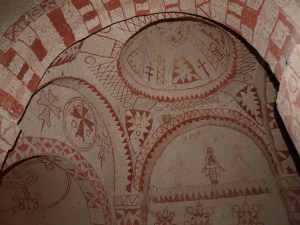
Firstly, we visited the small Saint Barbara’s Chapel.
Some of the frescos are fairly simple with basic drawings. Other places of worship have sophisticated, detailed and colourful frescos.
The carving of the arches and domes are, however, astonishing.
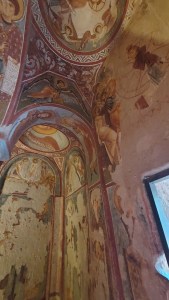
The Elmali Kilise otherwise referred to as Apple Church, (the word ‘elma’ translates from Turkish as apple), clearly shows the early red ochre drawings and geometric patterns.
It also has the later colourful frescos depicting various biblical scenes.
The building cut from the tuff has been dated back to the 11th century.
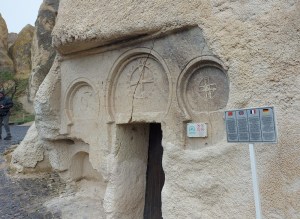
St. Catherine’s Chapel was, unfortunately closed. It has a pretty carved entrance.
A nearby sign warned of rock fall and we assumed this was the reason for its closure.
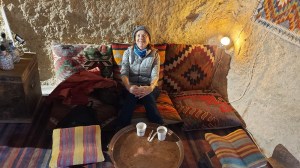
The next religious building on the walk had quite a queue, so we decided to stop for a coffee in the conveniently placed (for us) rock café (‘soft rock!’).
It was cosy and gave us an opportunity to remove our waterproofs and relax for a while. Dave sat on a tiny wooden stool and I made myself comfy on a large colourful cushion. The cave café was traditionally Turkish and had a welcoming atmosphere.
The entrance to the small Çarikli Kilise is by way of a small metal stairway. A guide was sat in this church to stop anyone taking photographs. Çarikli is otherwise known as the ‘Church with Sandals’.
This name is due to footprints carved out of the stone floor below the fresco of Christ ascending to heaven. Unfortunately although we knew about the ‘footprints’, we missed them. We just completely forgot to look for them, perhaps due to the fact that the place was very busy.
The Karanlik Kilise is one of the top sights to see, some say in the whole of Turkey. It was featured on the TV programme ‘Joanna Lumley’s Silk Road’.
Perhaps because it is one of the star sights of the open air museum, there is an extra fee but it is well worth it. This church also has an alias and is more often referred to as the ‘Dark Church’. This is due to the lack of light in it’s interior. The lack of light however, has assisted in preserving the captivating colourful frescos.
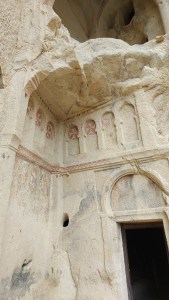
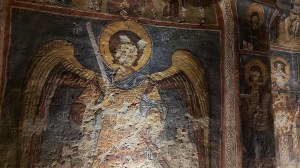
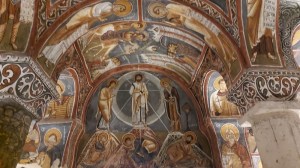
Disappointingly, as in some of the other religious buildings, some of the eyes of the artwork have been scratched out. One belief for this defacement is that people held superstitious beliefs and were afraid of what they suspected could be the ‘evil eye’.
Another possibility is that the paint was scraped off and used in healing rituals.
Kizlar Monastery is another so called ‘top sight’. As we searched one of the large placards for it’s whereabouts, a guide overhearing us, pointed it out and informed us that it was closed due to its dangerous condition.
The open air museum this morning is a scene of brightly coloured plastic ‘pac a macs’ and multicoloured umbrellas. The rain won’t stop the visitors but perhaps it has stopped the workers. Unfortunately, there is no sign of any current work taking place, so no buildings that are now classed as unsafe will open again in the foreseeable future.
The final church we visited, which was perhaps my favourite is the Tokali Church, this church is referred to more often as the Buckle Church. Like the other religious buildings on this site, it was dug out of the soft rock.
It dates all the way back to the 10th century when a monk lived in a simple hermitage. Over time, a church was carved out of the rock adjacent to the hermitage. Gradually, more spaces were carved and it became larger and larger.
The previously named ‘Old Tokali’ was replaced by the ’New Tokali Church’.
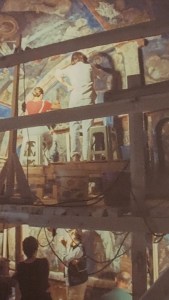
Today, a section of the frescos are being meticulously restored. Thick wooden scaffolding has been erected in one area of the church. Peering through the scaffolding where the artists are at work, one can see some of the remarkable repaired frescos. The main background is a vivid blue and apparently at one time in the past, gold has been used in the artwork.
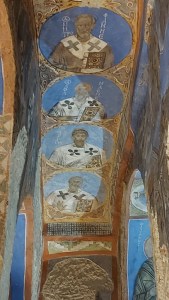
 The building has a barrel vaulted ceiling with pale coloured frescos still intact.
This church will be absolutely magnificent when the restoration work has been completed and surely then, it will become, the site’s ‘top sight’.
On leaving the open air museum, we decided to get a taxi to Çavușin. This was actually on our agenda for another day but taking the bad weather into account, we decided to go.
Çavușin is just a few miles from Goreme, it is a small village with fewer than 500 inhabitants. A castle and many homes were hewn out of the soft rocks. The homes were lived in until the 1950’s when the cave like abodes were declared unsafe.
As we wandered around in the rain, a man stopped us and asked if we would like to visit a small mosque. He explained that the mosque was originally a Greek Orthodox Church but was altered at the end of the Greco-Turkish War 1919-1922, at the same time that a population exchange occurred.
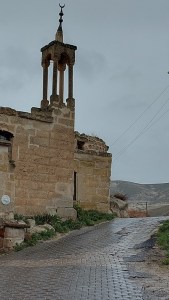
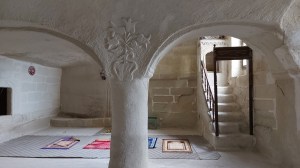
He continued saying that he lived in his Grandfather’s house next door and had taken it upon himself to care for the mosque. He said he allowed visitors to see it and encouraged them to take photographs.
The man then mentioned his guide and tour services, then his taxi services. He was clearly trying to get some business. Finally, as we started to leave he tried to get us to visit his souvenir shop.
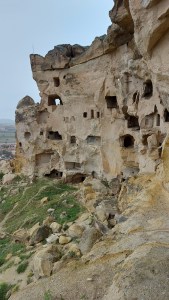
We set off uphill to visit the Church of John the Baptist which according to our research had stunning frescos. The surrounding scenery is breathtaking.
The huge cave church is one of the largest in the Cappadocia region. It’s entrance is located via quite steep narrow paths
Luckily, Dave had a flashlight with him which greatly helped us to see the frescos. Three girls from a small group of young people wandered over when they saw Dave pointing out the archangels to me. They asked him how he knew that they were archangels and also a couple of other questions.
After a short while I wandered off to explore more of the cave church, I think Dave quite enjoyed his few minutes masquerading as a history professor.
When we reached the bottom of the hill, a young man rushed out of the souvenir shop trying to tempt us inside. When we declined and continued walking, he shouted after us, saying that we were unkind.
A walk around the old village was also on our self made itinerary for Çavușin but the weather was rapidly deteriorating. Many shops had plastic sheets on their products. I felt sorry for a middle aged female worker getting wet outside her large souvenir place. The stall/cum shop had a plastic roof but no frontage.
The eateries were empty and the village appeared to be deserted, as the rain became even heavier we saw a sole taxi, so we quickly decided to return to Goreme.
For lunch, we ordered traditional gözlemes. A gozleme is Turkish flatbread filled with a choice of fillings, we chose one cheese and one spinach.
During lunch we chatted about a plan B due to the weather forecast (which was not good) and we decided to book an excursion which would take in some of the local sights for the following day.
After we had done this, as it was still raining, we returned to the hotel to relax for a while and have a siesta after our two consecutive predawn alarms.
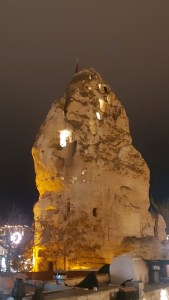
Later, we had a wander, once again admiring the amazing cave hotels.
For our evening meal, we went to a cave restaurant that had been recommended to us.
A chickpea and beef casserole served in a clay pot and a beef and vegetable dish served in a skillet were the two traditional dishes we chose this evening. Both were extremely tasty!
After our meal we took the direct route back to our hotel as it was still raining.
Previous Next

 lindaruddstravels.com