Sunday 24th February 2019
Jaipur to Agra – Fatehpur Sikri : Taj Mahal at Sunset
Checking out of the hotel at 8.30am took rather a long time as many people were leaving at this time and all the minibars had to checked. We chatted with some of the other departing guests, swapping travel tales and enquiring about onward journeys. Someone commented on how long it was taking to check the rooms and Dave quipped “well no one would consider nicking a towel that’s for sure”. The other guests laughed and agreed, the towels had definitely seen better days!
It was a Sunday, so traffic was easy leaving the city and we soon joined the highway which had a sign stating Agra 227 km. Ten minutes further along the highway we noticed another sign that stated Agra 228km!
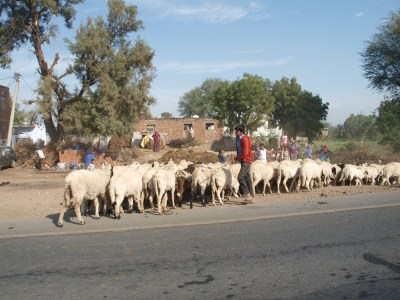
There were some flocks of sheep here and there on the main road. Flocks are moved on a daily basis to find food, the shepherds stay overnight at various farms.
Usually after about six months their route is reversed and they stay at the same farms as they retrace their steps.
The driving is what we have become accustomed to here in India- bad! Trucks staying permanently in the outside lane, causing other vehicles to overtake on the inside. Cars and bikes weaving in and out of the lanes and then suddenly braking hard after attempting to manoeuvre through a gap that is too small.
Apart from these examples of atrocious driving we also came across a couple of vehicles driving on the wrong side of the road, flashing their lights at approaching traffic. There were numerous overloaded trucks and we wondered if weighbridges were in existence in the country.
There were four or five toll booths along the route.
There were a few small houses made from cattle dung bricks. Some of these were constructed from circular bricks decorated with swirls, other houses were decorated with embedded pieces of discarded rubbish. The dung bricks are of course also used as fuel for both cooking and heating.
One 5km stretch of road had more than fifty stone factories, the statues and large ornaments were displayed in front of the works.
Stopping to use a ‘clean washroom’, we were charged six times the usual price for snacks and soft drinks.
Around 3 hours into the journey, we left the state of Rajasthan and entered Uttar Pradesh. A short time later, we arrived at the UNESCO World Heritage Site Fatehpur Sikri. The name translates to Victory City and was constructed in the 16th century by the Mughal Emperor Akbar. The city was for a few years the capital of the Mughal Empire. The site built mainly in sandstone comprises of mosques, tombs and palaces.

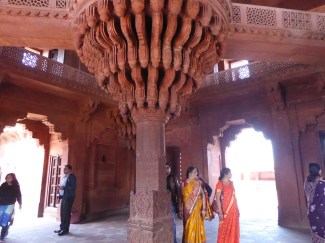
Emperor Akbar had three wives, one Muslim, one Hindu, and one Christian, each of the three wives had their own set of rooms. The rooms of the Muslim wife were quite small. The Christian wife’s rooms were larger and had sandstone corridors crossing symbolising a cross. The Hindu wife gave the emperor a child and her rooms were huge, and included two rooms for her maids. Eunuchs guarded the entrances to the Hindu wife’s rooms.
All the palaces had different carvings which symbolised the different religions.
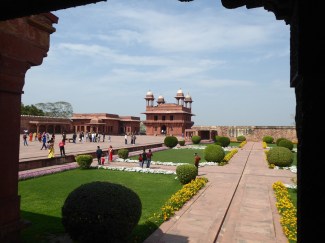
The palaces are spread out, pathways, well kept lawned gardens and ornamental ponds separate the interesting buildings.
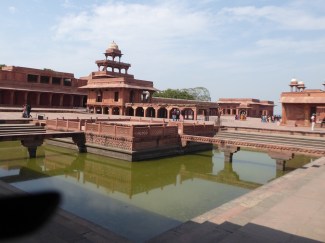
The guide asked if we wished to see the temple part of the site and of course we said yes.
As we walked to the religious area of Fatehpur Sikri, we were warned of touts, pickpockets and beggars.
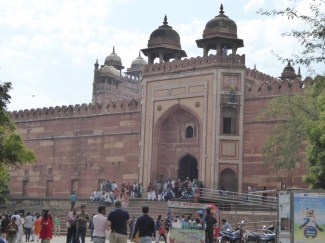
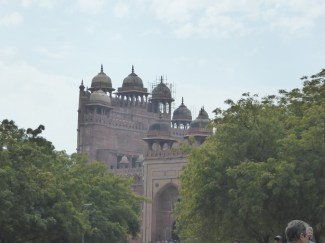
A hugely impressive mosque dominates the area, the Jama Masjid Mosque. The main stone entrance gate stands at 54 metres and is apparently the largest in Asia.
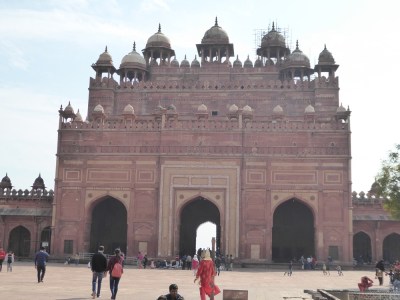
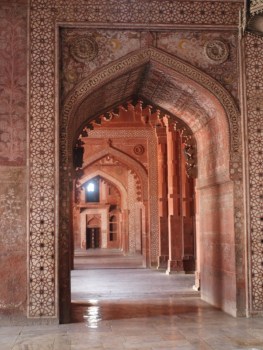
Entering the huge mosque, we noticed a few worshippers were praying facing the stone mihrab. A man strode quickly towards me and I said rather defensively ‘I’m not taking photographs’. The man wore a white skull cap and sported a long grey beard. He said that he was a holy man and that we were free to take photographs, he kept walking with me but I told him firmly that we did not require a guide. As soon as I wandered away, he approached Dave and asked him for money.
A beautiful white marble mausoleum is the tomb of a Sufi saint named Salim Chishti.
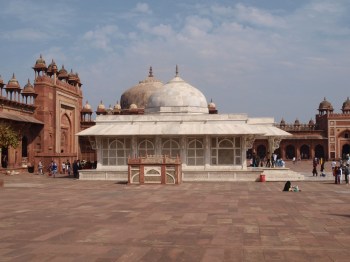
Walking barefoot we approached the tomb. An Iman was receiving blankets from a line of devout people and laying the covers on top of the tomb. He was also blessing people as they walked by and he patted both Dave and I on the head with a peacock’s tail.
A smart young lad wearing a small plastic Tupperware basket on his head appeared at our side and encouraged us to walk around the outer gallery of the building. Although we told him that we already had a guide who had given us lots of information, he proceeded to inform us about some of the many Arabic texts that adorned the walls. He continued talking rapidly, and running a few paces in front of us. As we reached the exit he asked Dave if he had an English quid for him.
This site is a beautiful holy site but our visit was completely spoilt by the dogged determination of the touts attempting to sell necklaces, books, postcards and all manner of other things and refusing to take no for an answer even after the tenth time! One young girl followed me constantly, at first asking for a pen, I explained that I didn’t have one so she then requested a lipstick and continued requesting other items in an extremely persistent manner.
When Fathepur Sikri was built, huge underground water tanks were installed and filled with water from the Ganges. Unfortunately just a few years later when the water was depleted and the rains were not sufficient, Akbar and his people had to return to Agra.
As we left Fatehpur Sikri, Devendra told us that we should be in Agra in about an hour’s time. He kept in touch with the agent and our original plan to go directly to the Taj Mahal had been altered, first we would be going to check in at our hotel before proceeding to the Taj Mahal. This change concerned me as I did not want to miss sunset at the Taj Mahal.
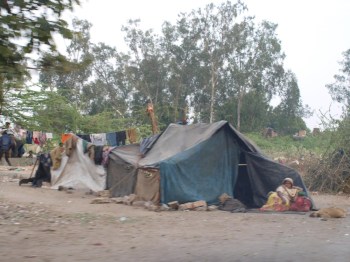
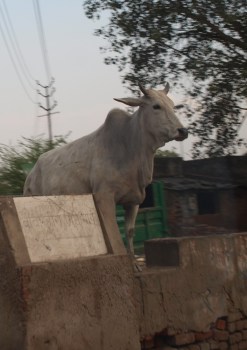
There were a few makeshift abodes along the road to Agra and we also spotted the odd holy cow along the way.
“Oh, that building looks posh” I remarked just before Devendra slowed down and pulled into the building’s long drive. Our original choice of hotel had been altered, the 5* Jaypee Palace and Convention Centre was obviously an upgrade.
Partway through the check in procedure, the helpful clerk mentioned that he didn’t have the correct paperwork and suggested that we proceed directly to the Taj Mahal assuring us that everything would be in place for us when we returned.
Ten minutes later, on the road to our sunset destination we picked up our guide, Malik.
Devendra dropped the three of us close to the Meghal Bagh, a garden on the banks of the Yamuna River directly opposite the Taj Mahal. The garden’s name translates to ‘Moonlit Garden’ or ‘Garden of Light’.
With our guide Malik we walked through the garden and there it was –the Taj Mahal. Wow!
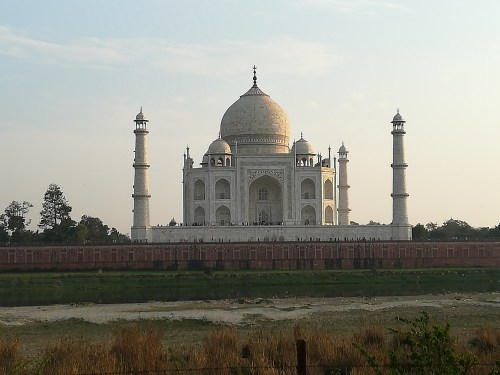
Standing in awe, we gazed at this majestic structure for a long while.
Malik informed us that the name of the white marble mausoleum, built as an eternal symbol for love and remembrance – Taj Mahal, translates as ‘Crown of Palaces’
Many birds flew around the elaborate edifice as they made their final flight of the day.
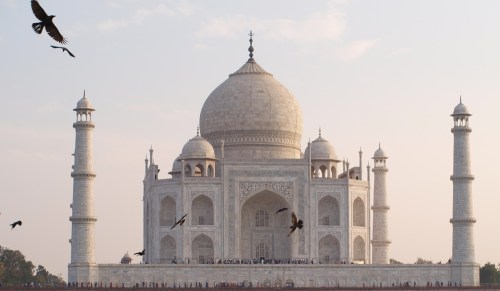
Seated on a wall with our legs dangling and continuing to gaze at the Taj Mahal we couldn’t help but overhear a conversation that three females were having. “Are you okay Mum?”, “Oh yes, very happy right now, how about you, are you okay?” was the reply. The older lady continued “ Are you missing your little one?” “No” the younger woman answered. “Not at all?” the older lady enquired turning her head to look at the younger woman. “No!” came the emphatic reply while she continued to gaze at one of the seven wonders of the world.
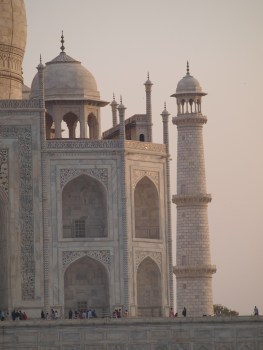
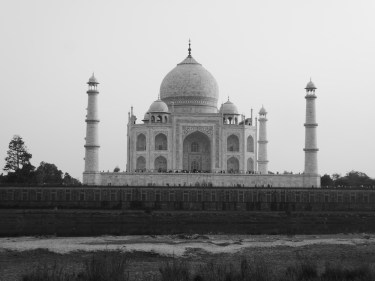
Continuing to look at the Taj Mahal, we noticed the changing colours as the sun descended. Zooming in with my camera I saw parts of the building glistening as the last rays of the sun shined on it. Dave took photographs in sepia and also in black and white.
After a little prompting from Malik, we pulled ourselves away from the remarkable landmark and walked back to the car.
On the route back to our hotel, the traffic was chaotic, horns were blaring continuously and there was constant queuing before moving just a few metres. Devendra managed to park at the side of the road for Dave and Malik to nip into a shop. As Devendra and I were chatting, suddenly there was a tremendous bang on the back door of the car and then another equally loud bang on the passenger door, a mean looking policeman wielding a large wooden truncheon was shrieking and waving his hands at our poor driver. He was obviously telling him to move along in no uncertain terms! Devendra managed to pull out into the slow moving traffic and turn into a side street a short way from the shop, he then quickly telephoned Malik to tell him where we were.
Back at the hotel, after the lengthy check in procedure was completed, we headed to our room. The hotel is huge. I think it would take me a week to learn my way around it; it’s a good job Dave will soon suss it out!
I noticed a colourful poster advertising a classical dance performance in the hotel, tonight is our only opportunity to see it. However we are quite grimy from our long journey and we do need to get a hot shower and we also need to eat! I would love to see it though…
Deciding to eat in the hotel’s Chinese restaurant, we were taken to a table facing a huge window through which we could see one of the pools. Next to the pool was a small stage where the classical dance took place. Obviously we couldn’t hear the music but at least we could see the dance while we were served with a delicious meal. As it happens the dance wasn’t very impressive, the experience would have obviously been enhanced if we could have heard the music

 lindaruddstravels.com