Friday 7th April 2023
Day 11 – Samarkand – Samarkand and Bukhara Carpet Workshop: Khodja Abdi Darun Shrine: Ishrat Khana Mausoleum: Guri-i-Amir: Amir Temur Statue: Bazaar: Registan
The places we are planning to see today are at opposite sides of the city so rather than spending a lot of time walking we decided to get a taxi to our first stop of the day which was the Samarkand-Bukhara Carpet Workshop.
As we arrived we saw a huge vat bubbling away with dyes, which was being stirred by the owner Haji Mohammad Ewaz Badghisi. A female worker just arriving introduced us to the owner and told us that she would show us around the workshop.

Haji Baba is the name by which the owner is usually known. Haji, his title, means that he has done the pilgrimage to Mecca. Baba is an honorific name meaning Father, Grandfather or wise man.
This wise man and his ancestors from Turkmenistan have practised the art of carpet weaving for 300 years.
Due to the soviet invasion in the early 20th century, Haji Baba and his family had to move to Afghanistan to avoid the loss of their home and business.
Unfortunately history repeated itself with the Soviet invasion in 1978 and the Taliban regime in 1992. Once again Haji Baba and his family had to move, this time to Uzbekistan, where he continued to teach and preserve the Central Asian art of carpet weaving.
The tour was fascinating. Madder root is cultivated in the workshop’s garden, this perennial plant’s root used in dyeing gives between 40 and 50 shades of red and orange.
The ladies are trained to a high level to weave the carpets. They work for six hours per day plus they have two hours break which includes one hour for lunch. It is important they have these breaks so they can move about and stretch a little, as they sit on cushions at the looms for the majority of the day.
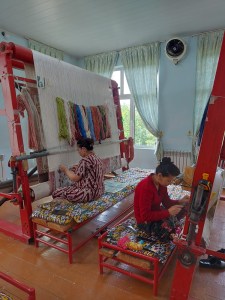
They get paid by piece work, the rate depending on the intricacy of the pattern. They follow a pattern which is similar to a cross stitch pattern.
The work is quite strenuous, continuously pushing and pulling the knots down to keep them compact.
Some ladies work at home, which allows them to continue to work while caring for a young family.
It’s a good place to work, everyone seemed content and of course completely focused on counting while following the pattern.
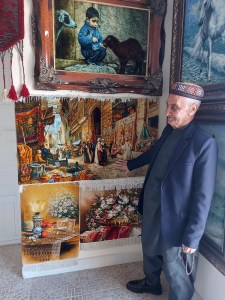
Haji Baba showed us the completed carpets. Apparently, his son and daughter run the business now but he is obviously passionate about the work and I suspect he still enjoys overseeing everything.
These carpets, I’m sure will always be displayed on a wall and never be stepped on.
There are varied topics, animals, people, a market scene, a huge carpet portraying a country scene with a bridge, Mona Lisa, flowers, the list continues…
The cheapest carpet sells for $1500.
Leaving the workshop, we managed to stop a passing taxi and set off to the Khodja Abdi Darun Shrine. Ten minutes later we passed the carpet workshop again, the driver had no map although he did have a smart phone.
Luckily, Dave had a map on his phone and he managed to direct the driver.
The shrine holds the tomb of a man who lived in the 9th century. Over the years many buildings have been added; they include a mosque and a small madrassa which remains active today.
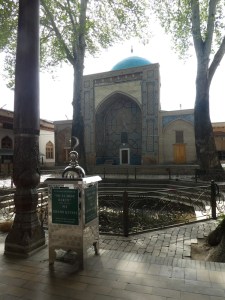
Adjacent to the small complex of buildings, a new construction is underway.
The building boasts a huge green dome and will serve as the new madrassa.
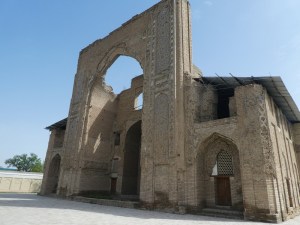
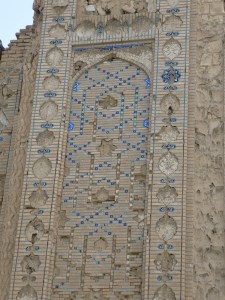
Across the road from here is the Ishrat Khana Mausoleum. While the vast majority of the building that was erected in the 15th century is in disrepair, a couple of new wooden doors have recently been fitted on the ground floor.
Some of the brickwork that is still intact boasts beautiful decoration. This mausoleum is believed to hold the tombs of aristocratic women.
Another taxi took us to the Gur-I-Amir. Taxis are cheap here; the total cost for the three cabs this morning is less than 7 Euro.
We bumped into Anne and Pete as we arrived at the Gur-I-Amir. As usual, we swapped information of what we had seen so far that day and then Anne pointed at the monumental building behind her and said “It’s not really worth going in”. Pete quickly added “Oh they may as well while they are here”. I had a feeling Anne was winding us up!
Then we saw our Russian friends and had a quick chat with them. Meanwhile a couple of coaches had pulled up filled with tourists about to enter the Gur-i-Amir.
So having seen a sign stating ‘coffee’, we decided to follow it. The sign led us to a small pleasant hotel where we enjoyed coffee and purchased a couple of postcards before heading back to the mausoleum.
The Gur-i-Amir which translates as ‘Tomb of the King’ is the burial site of the Timurid Dynasty.
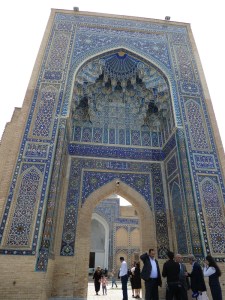
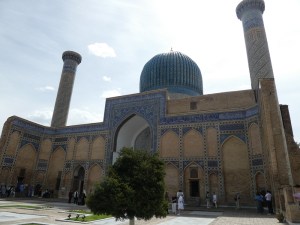
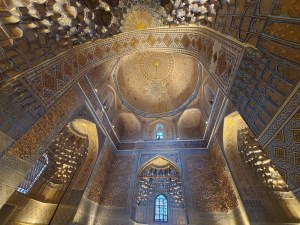
The mausoleum has been fully restored recently; it boasts an impressive gateway which leads to the main building with a magnificent azure blue ribbed dome.
Its interior is breathtaking with its exquisite domed ceiling, mosaics, niches and ganch work. Its tombs, one of which is decorated with Mongolian jade are an actual indication of where the bodies are buried in the crypt below.

While searching for the Oksaray Mausoleum, we ended up in someone’s garden, one of the two ladies who were perched on boxes waved us away. A few minutes later we found the plain bricked building which was surrounded by a black metal railing. Unfortunately the gate was padlocked.
According to the internet, the building should have been open but of course this information requires someone to constantly update it.
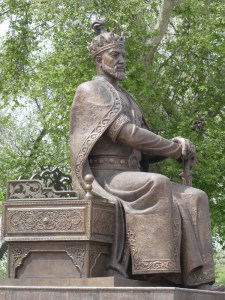
An imposing bronze statue of Amir Temur who founded the Timurid dynasty stands in the middle of a busy dual carriageway.
After relaxing back at the hotel for a while, we headed out again for a walk around 5pm.
Once more, we stood and stared at the incredible Registan before we headed to the bazaar.
Although one or two of the stalls were starting to pack up for the day, there was still plenty of business going on.
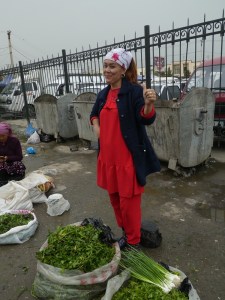
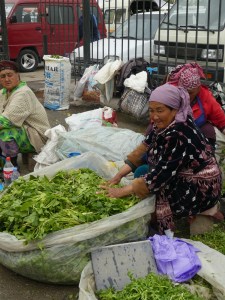
Female stall holders were sat on the concrete floor with piles of aromatic herbs in front of them. One of the ladies saw me taking photos and posed. There were a few flower and plant stalls and we purchased some black basil seeds. People were purchasing their bread, carrying the large round loaves under their arms.
A while later we met up with our friends at the restaurant where they had booked a table for our final dinner in Samarkand.
The lovely looking restaurant had an impressive view of the Bibi Khanym Mosque. Unfortunately, there was a mistake with the reservation and they didn’t have a table for us.
Therefore, we decided to return once more to the Labi G’or restaurant.
Anne asked what we had thought of the Gur-i-Amir, and her face dropped when, teasing her, we told her that after what she had said we had decided not to visit the mausoleum. I couldn’t keep my face straight for long though and soon told her that we had of course seen the wonderful site.
After dinner we couldn’t resist visiting the spectacular Registan one more time.


 lindaruddstravels.com