Friday 22nd February 2019
Jaipur: Birla Temple : Galtaji : City Palace
At 9.30am we left the hotel for the day’s sightseeing tour. Our first stop today was the Lakshmi Narayan Temple. This beautiful white marble religious building is usually referred to as the Birla Mandir. Birla is the name of the family of well known industrialists and philanthropists who constructed it.
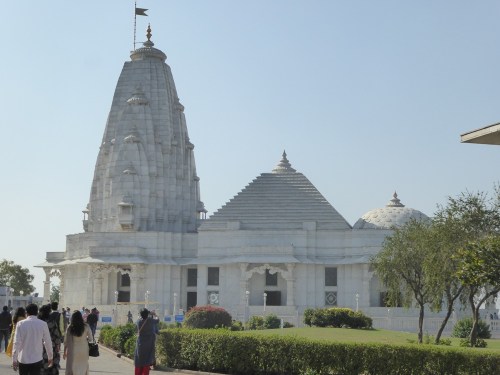
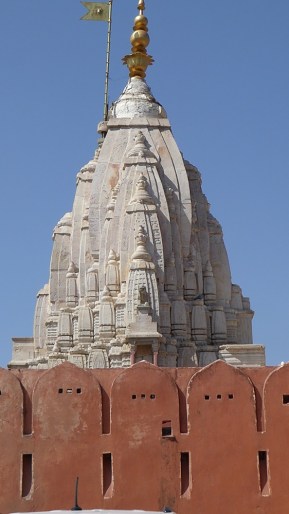
The Mandir is dedicated to the god Vishnu and his wife Lakshmi although other Hindu gods are also depicted. Unfortunately, photography is not permitted in its interior.
I was spellbound by its interior. White marble bas relief carvings of the gods adorn the walls and only their lips, eyes and tilkas are in vivid colour giving a spectacular effect. The white marble ceiling is intricately carved. A colourful stained glass window portrays the goddess Durga riding a tiger. Different gods are depicted on other windows.
I don’t think we have seen stained glass windows in any other religious buildings apart from Christian churches.
Our guide chatted a little about some of the Hindu gods. Shiva is Ganesh’s (the elephant headed god) father. Durga is his mother. The goddess Durga also takes other forms and is known as Parvati when in a peaceful mood and as Kali at other times. As Kali she is usually portrayed with her tongue out.
Circumnavigating the exterior of the temple we were surprised to see carvings of Madonna and child, Jesus Christ, Moses, St. Peter, Confucius and Zarathustra. Pushpendra said that Hindus believe there is only one god but various forms of the god.
Leaving the temple behind, we set off to the Monkey Temple otherwise known as Galtaji. Situated approximately 10 kilometres outside of Jaipur in the Aravali Hills the temple is surrounded by lush green countryside.
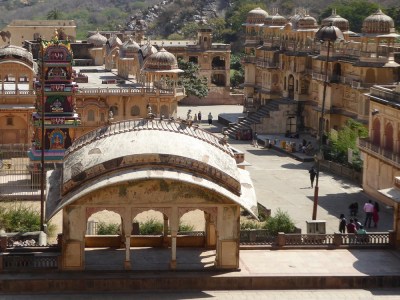
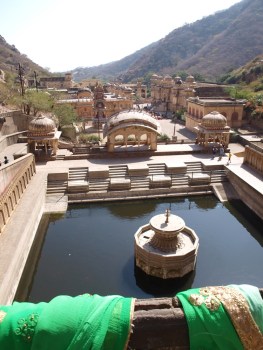
Pushpendra explained that one thousand years ago, a holy man who had healing powers spent 100 years meditating in the wood nearby. He would feed the local monkeys with some of the fruit that he was given in payment for his healing work. The monkeys of course multiplied and stayed.
The Galtaji Temple was built to honour the man, who was later known as Saint Galav. Due to the number of monkeys it also became known as the Monkey Temple. Natural water springs flow through the complex of temples and into seven kunds (water tanks). Pilgrims flock to the site to bathe in the waters that are considered sacred. The belief is that the bathers will be cleansed of their sins.
Walking through what appeared to be a deserted one street town, we passed ornate temples on either side of us. Continuing we saw a waterfall, its water was going into a square shaped kund, where a few people were bathing in the holy waters. A few metres further and we came across another kund with steps leading down to it, this time a group of monkeys were swimming and simultaneously cleansing themselves of their sins.
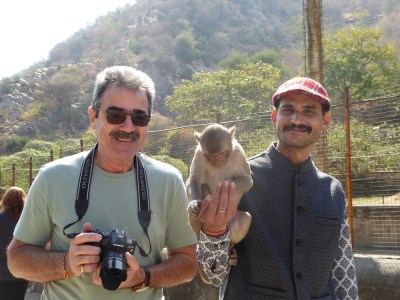
Pushpendra warned us about the monkeys. “They may jump on your shoulders” he said.”If they do, do not shout or scream” he instructed.
I asked him what the monkeys would do if someone was startled and did indeed scream. He said that it would probably scare the creatures and they may bite.
However when Dave and Pushpendra fed peanuts to some of the monkeys, they appeared to be fairly tame. One of them did jump onto our guide’s shoulder and didn’t seem to want to get down again. At one point the small primate started to fiddle with Pushpendra’s earring and for a second or two he thought it was going to attempt to pull it out.
It was a steep walk along a crazy paved path to the Sun Temple, we passed tiny temples and a couple of holy men on the way.
At one point there were some young cattle on the pathway and a young couple stood close by. The man was extremely apprehensive about getting too close to the cattle. His pretty wife was laughing at him while taking a video of him backing away from the animals.
During our time here in India we have noticed one or two cows suffering from one ailment or another. One had a bleeding hoof and another one that we saw was limping. Cows are of course sacred here in India but we wonder who is responsible for actually taking care of them.
Finally we reached the small Sun Temple. Due to its elevated site, its grounds offered excellent views over Jaipur.
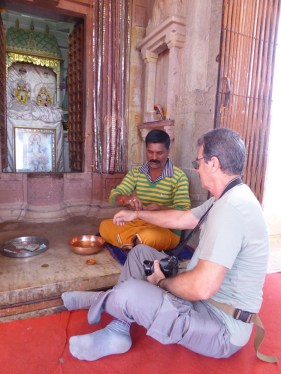
The priest blessed the three of us in turn. A cord was tied around our wrists during the blessing. I offered my right arm forward but the priest shook his head and said that it was the left arm for women. As I already have one on my right wrist from Arkshadham this was a little confusing. The priest also placed a bright orange tilka on our foreheads.
There were many monkeys running around as we headed back down the pathway.
More people had arrived and the men were bathing in the sacred pools, ladies clad in colourful saris were sat chatting with each other. Apparently they would enter the kunds fully clothed and change into dry clothes afterwards.
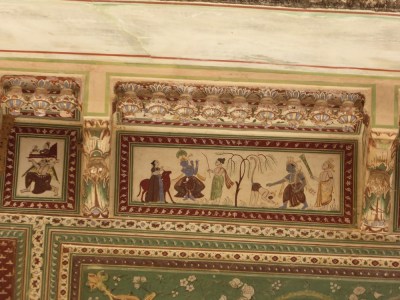
Walking slowly past the temples again, we admired both the architecture and the detailed artwork.

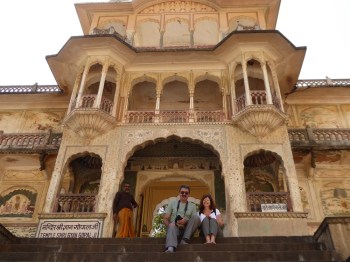
A small tower had brightly coloured gods portrayed on each of its four sides.
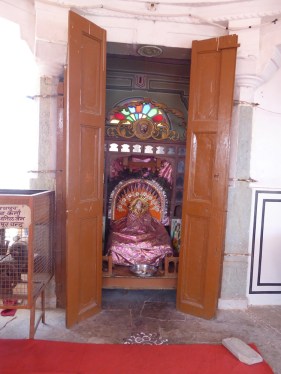
As we entered one of the temples, an older man shouted to a much younger man who quickly appeared with a large key. The young man then offered to take us to an underground temple, ‘’where only special guests go” he added. He led the way down some steps and along a couple of narrow corridors before he stopped in front of a large wooden door. As he unlocked the door he told us that the temple was dedicated to Ganesh.
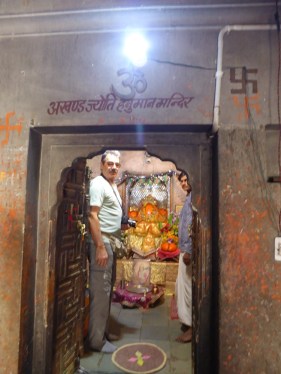
Dave had to bend to enter the small space and there was just enough room for the three of us to stand in front of the small altar. When I questioned the man about what his role was in the temple, he said that he was a priest. He told us that he was 35 years of age and that he had been a priest for 3 years.
The priest started chanting and whacked me on the head three times with a bunch of peacock feathers. Then he proceeded to wrap a piece of cord around my left wrist. After giving the same blessing to Dave he pointed at the donation tin.
Suddenly the older man appeared and he saw us place ten times the recommended donation into the box but he commented that it wasn’t enough. Well, we definitely weren’t giving them any more money so it would have to be enough.
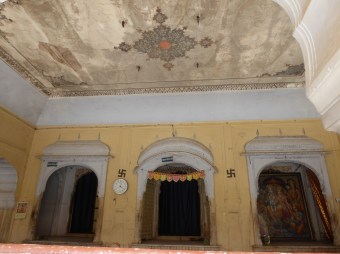
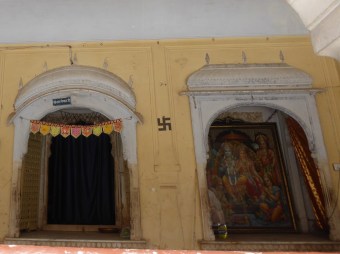
As Dave and I started to make our way back to the main part of the temple, the young priest offered to show us other parts of the temple; for an additional cost of course. Declining the offer, we started to make our way towards the exit.
As we stopped to look at a ceiling he said that he would show us what was behind some curtains, again for an extra cost. Again we declined and as we left the temple he put his hand out and asked for a tip!
Dave and I agreed that the 35 year old priest appeared to be no more than 17 years old. Our guide said that we had given too much money.
Galtaji is a magnificent place to visit and I couldn’t resist turning around and taking one more photograph as we left the site.
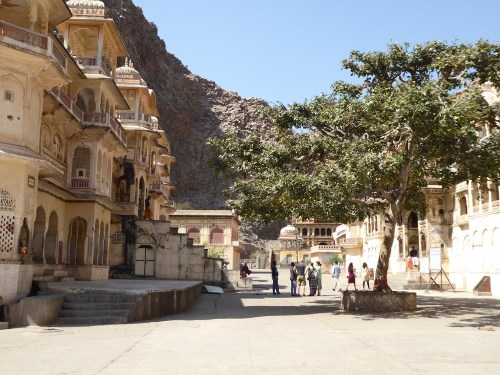
As we headed back into Jaipur to the City Palace, we enjoyed the scenery and we noticed quite a few crumbling, once ornate buildings.
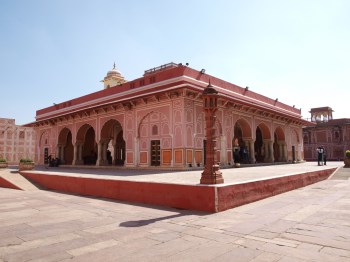
The grounds of the palace had been completely cleared of all evidence that an elaborate wedding had taken place.
Apparently the wedding party would now be at another opulent venue where the wedding rituals would be continuing.
Pushpendra led us to the reception room in the palace that was unavailable for viewing the day before.
As one would perhaps expect, it is extravagantly decorated, with 24 carat gold embellishments throughout the room. A lalique crystal table engraved with a peacock which was a gift from France is one of the many items of furniture crowded into the room. Many framed photographs stand on various surfaces. One of the photographs was of Prince Charles and Princess Diana; another was of the Maharani with her two boys.
An extremely tall guard in uniform watched our every move. Unfortunately, once again, we were not permitted to take photographs.
On the journey back to our hotel, as the vehicle slowed at traffic lights a skinny man pushed his face to the window and asked for money, repeatedly putting his hand to his mouth. He then started to bang on the window. Pushpendra, who had been ignoring the man, started to shout at him. I interrupted and asked if the man was hungry.
Our guide told us that if we gave him money we would find him drunk in a few hours. He also said that if he offered to take the beggar home and give him somewhere to sleep and something to eat in return for working in his house or garden that the man would refuse.
Earlier in the day, a young girl had asked for cash. I confirmed with Pushpendra that she would receive a meal if she went to school. He said that this was correct but added that the girl was probably from one of the villages.
He reminded us that there were no crops to gather until March, therefore many villagers would come into the city.
However, each village has a headman who via the government could find the people work for 190 days. The person wanting work must open a bank account where the earnings would be paid into. It is guaranteed work for 190 days but it is 8 hours a day and it is hard work. It may be the building or repairing of roads and many folk don’t want this work.
We recalled seeing a team of workers yesterday building a retaining wall at the side of a road; the females were carrying mortar etc in pots on their heads.
Returning to our hotel mid afternoon, we had time to relax around the swimming pool.
An hour or so later I went to the hotel’s spa for a foot massage. It was absolute bliss!
Previous Next

 lindaruddstravels.com