Thursday 6th April 2023
Day 10 – Samarkand – Registan Square: Tilla Kari Madrassa: Ulug Beg Madrassa: Sher Doh Madrassa: Hazrati Khizr Mosque: Shah-i-Zinda: Siyob Bazaar: Bibi Khanym Mosque: Amir Temur Park
I woke at 6am and I decided to go straight out to the Registan, Dave was just stirring but agreed to come too.
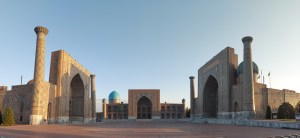
For around ten amazing minutes, there were just Dave and I; we stood on the steps in front of the barrier gazing at the spectacular sight in front of us.
A security guard wandered over and started to chat. ‘Where are you from?” he enquired, followed by a couple of other questions until he got to his main point; asking “Do you want to climb the minaret?”
He was obviously trying to earn some extra money, but we knew that it was prohibited to climb the minaret due to safety issues so we declined his offer.
We stood staring at the incredible architectural ensemble for a few more minutes before returning to our hotel for breakfast. As we entered our room, our 7am alarm was still ringing loudly.
Immediately after our breakfast, we returned to the Registan, this time purchasing our tickets to gain entrance into the square.
Samarkand was once called Maracanda and was the capital of Sogdiana, which at that time was a province of Iran.
Samarkand was the half way point on the Silk Route; few traders traversed the whole route, many leaving their produce in Samarkand. Samarkand traded in numerous products which included leather, cotton and silk, rice, fresh and dried fruits.
The historical Registan was once a public square where executions and public announcements would take place.
Three magnificent madrassas surround the square. Our intention had been to go directly to the Tilla Kari madrassa to see its famous mihrab. Our guidebook had warned of busloads of tourists arriving at around 9.30am.
However, we couldn’t resist stopping and taking a few shots of the square first.
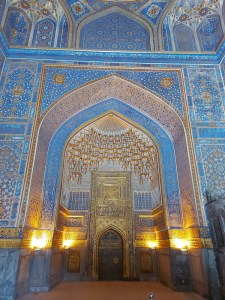
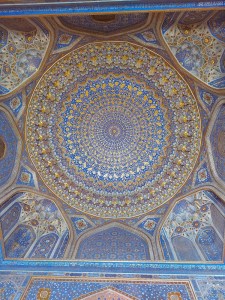
Tilla Kari translates to ‘gold covered’. The madrassa built in the 17th century definitely lives up to its name.
The combinations of gold and brilliant blues on the holy mihrab create a breathtaking result.

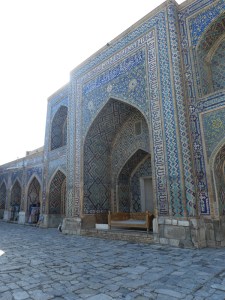
In the madrassa’s courtyard, females were busy sweeping around their stalls and arranging their merchandise.
This madrassa was the last one to be built in the Registan replacing a mosque that fell into disrepair.
Returning to the beginning of the square, we proceeded to visit each building in turn, wandering slowly around the ‘schools’, into their courtyards, admiring the mosaics, the colours, the patterns, all of which are enthralling.
Many of the cells that were once classrooms or accommodation for the students are now small outlets selling souvenirs including ceramics, suzanis and scarves. “Made from silk” one vendor shouted while holding up a scarf, “Made from camel wool” interrupted his neighbour waving another scarf.
However, there was no sales pressure and many vendors were happy to chat.
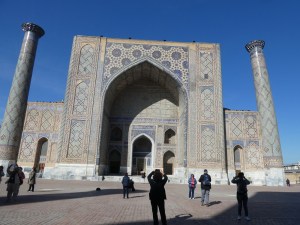
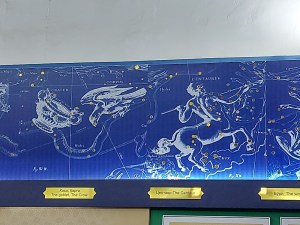
Ulug Beg Madrassa is the oldest madrassa in the Registan Square. The students studied science subjects and mathematics.
Ulug Beg was a renowned astronomer, astrologer and mathematician.
A hall inside the madrassa is dedicated to astronomy and astrology with various exhibits.
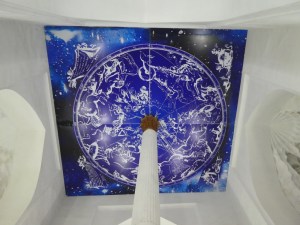
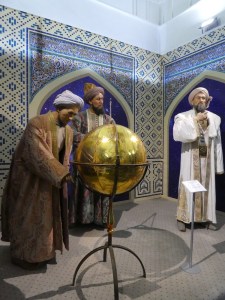
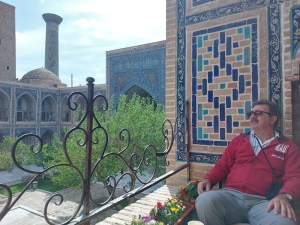
In the courtyard I spotted Anne waving at us from the first floor. She pointed the way up and we climbed the steep curved stairway (of course Pete was at the top, camera in hand!).
One of the cells had been turned into a small coffee bar so after swapping information with our friends, Dave and I sat and enjoyed a coffee on the small balcony. Wow what a view!
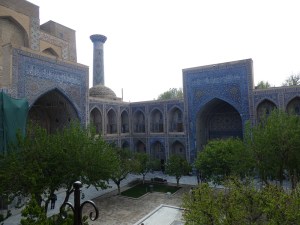
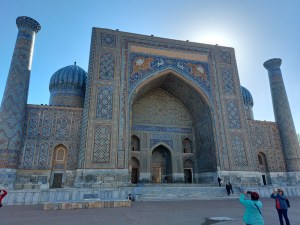
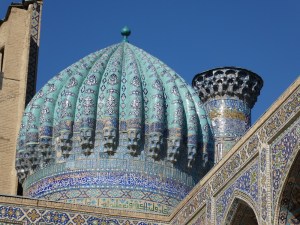
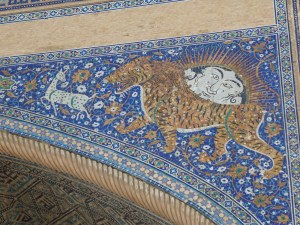
Completing the monumental ensemble in the Registan and standing opposite the Ulug Beg Madrassa is the Sher Doh Madrassa. The name of this magnificent madrassa translates as ‘Madrassa with Lions’ from Persian
Two wild striped cats are embellished on the entrance portal, one could be forgiven for thinking they resemble tigers but apparently they are lions.
The madrassa is flanked by two stunning turquoise ribbed domes.
After reluctantly, (I could stay there all day, but there are other things to see) leaving the Registan we walked down the newly pedestrianised street, Karimov.
Shops that appeared to be newly built lined each side of the street, they were selling mainly souvenirs but there were one or two boutiques too.
Continuing in the direction of the Shah-i-Zinda Tombs we passed by the imposing Bibi Khanym Mosque which was on our list for later.
However, we came across a beautiful mosque with a sign which read ‘Everyone Welcome’, we also heard an Imam reading so we decided to take a look.
I saw another sign which read ‘Ish Vaqti’ and mistakenly understood it to be the name of the mosque. I did a quick voice recording using my mobile phone. As we were taking so many photos it helps to note the time and the place periodically in order to organise the pictures later.
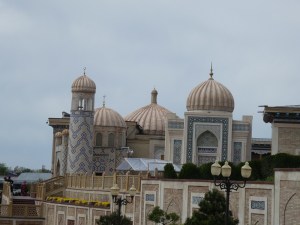
However, a few moments later, another sign stated Hazrati Khizr Mosque, this confused me.
It was later in the day before we learnt that Ish Vaqti means opening hours! Unfortunately there were no hours written against the sign, or we would have perhaps guessed the meaning!
The beautiful mosque was built in honour of Hazrati Khizr, an Islamic Saint.
Adjacent to the mosque is the tomb of the first president of independent Uzbekistan, Islam Karimov. Photography is not permitted inside the actual site.
Walking alongside a huge present day cemetery, we noticed that some of the tombs were very elaborate. Some gravestones had a portrait of the deceased lasered into the marble.
The Shah-i-Zinda is a necropolis with tombs dating back to the 11th century.
Outside its gate is a list of rules which should be adhered to when entering the holy place. The rules are ones that you would expect to find at a holy site, females should cover their heads, one should dress appropriately, show respect, be quiet etc.
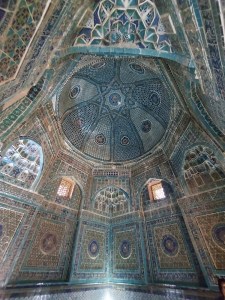
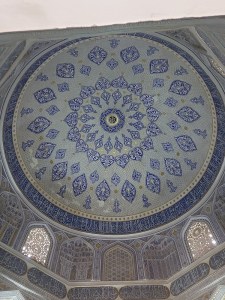
On entering we walked up a steep walkway, we could see glimpses of lapis lazuli and turquoise shining through a double archway.
Well, the sight before us was absolutely breathtaking. We were awestruck and simply, stood and stared.
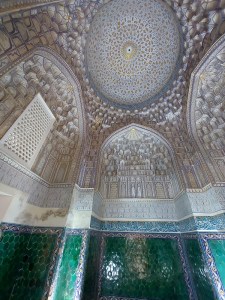
In front of us was an avenue of mausoleums decorated in complex Islamic mosaic patterns and calligraphy. The mosaics were created from precious stones and majolica tiles which glinted in the sunlight.
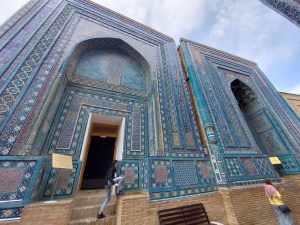
Shah-i-Zinda
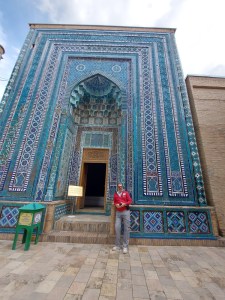
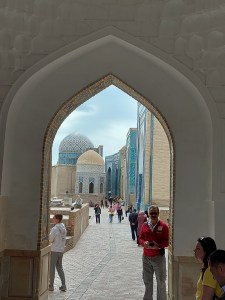
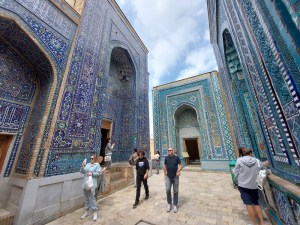
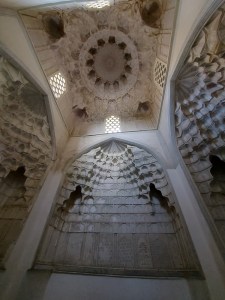
Some of the mausoleums had colourful interiors, others were simply painted white. Some of the domes had ganch work, others were intricately painted, and others were covered with mosaic artwork.
It is believed that the sacred tomb of Qusam Ibn Abbas lies in the centre of this funerary complex. The man, a cousin of Prophet Mohammed brought Islam to Uzbekistan in the 7th century. Shah-i-Zinda translates as ‘Tomb of the Living King’.
Photographing and the taking of videos were permitted throughout the site apart from the photographing of tombs. When we reached the innermost sacred shrine, an Imam was reading from the Koran. A number of Muslims sat listening, we joined them and took in the beauty of the shrine but felt it inappropriate to take photos.
It was rather hot with a scarf covering my head but there was no way I was removing it. We were both appalled at the behaviour of some people in this holy site. Young females were posing and pouting for photos in front of the religious buildings and many were inappropriately dressed. I saw one woman remove a long jacket for her ‘photo shoot’; she was wearing a cropped T shirt, which revealed her midriff, and shorts!
A few budding artists were sat around patiently sketching and painting, attempting to capture the uniqueness of this place.
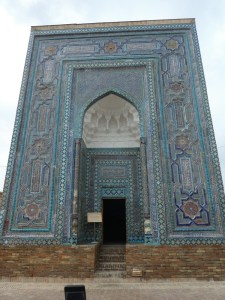

Shah-i-Zinda
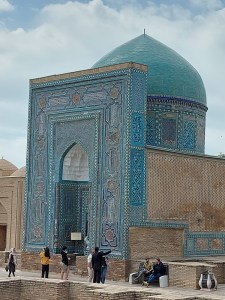
Leaving the magnificent site, we decided we were ready for a bite to eat and a sit down. When we entered the bazaar, we saw stalls with piles of grated carrots, shredded red cabbage amongst many other readily prepared salad products.

There were spices and nuts and thousands of eggs, brown, white, small, medium and large all in trays stacked up high.
Stopping at the first eatery we saw, we removed our shoes and sat at one of the traditional tapchans, stretching out our legs and relaxing.
After we had eaten an energy boosting samosa and some Uzbek traditional soup (and scribbled some notes down) we continued to wander around the bazaar.
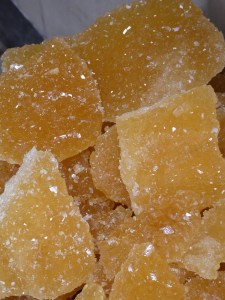
For a couple of seconds I thought there were some pieces of quartz crystal on a stall but it turned out to be a honey product.
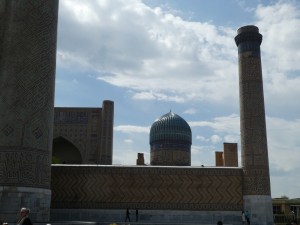
The Bibi Khanym Mosque was the next place we visited. For a few years in the late 14th and early 15th century, this mosque was the largest in the world.
An earthquake in 1897 almost destroyed the mosque. Renovation has been going on for almost fifty years. Today, access is still not permitted in a couple of areas which are locked due to them being unsafe. Huge cracks run through the walls, caused apparently by the earthquake.
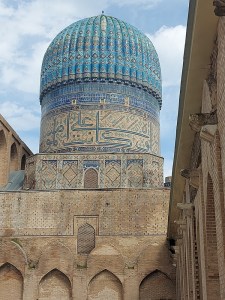
The mosque has a huge turquoise ribbed dome.
When we left the mosque, we jumped on a small trolley bus to return us to the Registan and then we headed back to the hotel.
People here are very friendly, they often acknowledge us with a smile, a nod of the head or with the Muslim greeting ‘As salaam alaikum’ to which we reply ‘Wa alaikum salaam’.
Leaving the hotel later, we saw Anne and Peter and agreed to meet up at the same restaurant. Anne shouted after us “If you get there first, ask them to put some white wine in the fridge.”
The Amir Temur Park is often referred to as ‘Tiger Park’ and has two bronze statues. These sculptures are a memorial to Caspian tigers that once roamed Uzbekistan. Sadly, this tiger species was declared extinct in 2003.

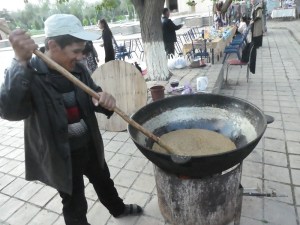
Wandering around the park, we came across an artisan’s area. The workers were just closing their doors and preparing their meal. A huge dish of plov was being stirred with a wooden paddle.
A long table was set and some dishes were being placed on the table.
As we were chatting to the man who was stirring the plov, one of the ladies came over and said “Please Madam” and indicated that we should take a seat at the table and join them. After thanking them and declining their kind offer we set off to the Labi G’or.
On arriving at the restaurant we saw the couple from Moscow that we had seen and chatted to on a couple of occasions. The last time we saw them had been in Bukhara and we asked them ‘Who is following whom?” They asked if we would like to join them for dinner, we declined our second invitation of the evening in favour of our good friends and travelling companions Peter and Anne!
All of us enjoyed a lovely meal with slightly chilled wine.
Previous Next

 lindaruddstravels.com