
Monday 10th November 2014
Temple of Heaven Park – Lama Temple – Hou Hai Lake
Our alarm woke us at 6.15; we have arranged to have breakfast at 7am and to set off on our days sightseeing by 7.30am. As Pete says ‘we will be early but perhaps not bright.’ It is still dark outside. The light takes a little longer to penetrate through into the narrow courtyards of the hotel in Beijing’s few remaining hutongs. This is our last day in China’s capital city and the four of us have created quite a list of ‘things still to see’, let’s see how many we can tick off.
The complimentary English morning paper, which is delivered to our door daily, tells of the ‘Apec blue sky’. As I mentioned earlier the factories were closed a week or so ago in preparation for the Apec Congress (Asian Pacific Economic Conference) which is currently taking place here in Beijing. As expected the closure of the works has cleared the city’s smog, and now the city has a beautiful blue sky that has been christened ‘Apec blue’. The press, reports that people are now saying that the acronym stands for ‘Air Pollution Eventually Controlled’. Off course all the leaders attending the congress know that the city is usually shrouded in smog so it seems silly to go to such extremes. I wonder if the workers are being paid for this enforced ‘holiday’.
We take the metro to our first stop of the day – the park at the Temple of Heaven. Many people are rushing purposefully through the turnstile, some carrying balls, some racquets. It is not yet 8am and there are many things happening in the park. There are different groups of dancers. A team of ballroom dancers appear to be very professional. Lots of people are practising tai chi; one female tai chi leader is dressed in a red velvet martial art costume. Another young male instructor is being watched like a hawk by an old master and the elderly man adjusts the younger man’s posture to perfect his stance.
We wandered around the park; a man was selling the colourful shuttlecocks that many people were playing with. He kicked one of them towards Dave who managed to pass it back, Anne and Pete joined in while I tried to capture the short game on video. We thought the game was called ‘keepy uppy’. Dave purchased a couple of the bright shuttlecocks for our grandson Jaymes who loves football so we think he will like to play this game. We learnt later that in China the game is known as ‘jianzi’ and that the aim of the game is to keep the shuttlecock in the air by using one’s feet or any other part of the body except the hands.

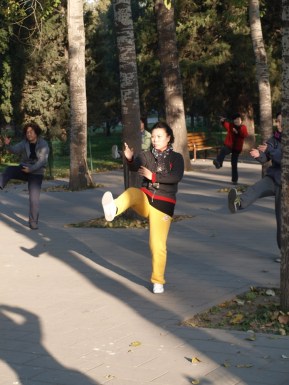
I stood for a while and videoed a group performing their slow gentle flowing movements of tai chi underneath some trees.
We watched a game that was being played with unusual racquets. The racquets had small holes in them, and the pa kua symbol (a symbol used in Chinese philosophy and Feng Shui) was in the centre of the racquet. This was not a bat and ball game to be played between two people. The ball had sand in it and the people danced around imitating the teacher, moving and swirling the bat around, while keeping the ball all the time on the bat. It was very impressive to watch.
We spotted an elderly lady with her leg raised high on a barrier; she was stretching her hamstrings and slapping her thigh muscles. The tell tale deep creases in her face showed that she was probably over 75 years of age.


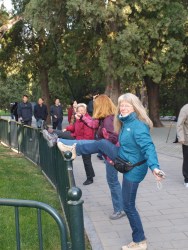
I smiled at her and not quite so easily raised my leg in the same way, making a bit of a fuss ooohing and arrgghing. The lady lifted her head back and laughed heartily. Anne joined in and we messed about helping each other to get our legs higher. We copied the lady and slapped our muscles asking her if we were doing it right. We were all laughing and one or two passers by, stood watching and they laughed too. Although we couldn’t understand one another’s language I truly felt that we had communicated.
We are all surprised at the flexibility and balance of these people. I imagine the incidence of falls in the elderly is much smaller here in the East than in the West. All the exercise that they do can only enhance their balance and coordination. Therefore if they do slip or trip up it gives them a better chance of correcting their step and stopping themselves from falling. I also assume that there is a much lower incidence of osteoporosis here, as the daily exercise will strengthen their bones. Thinking about the Chinese people’s health in general, while wandering around we have seen very few overweight people.
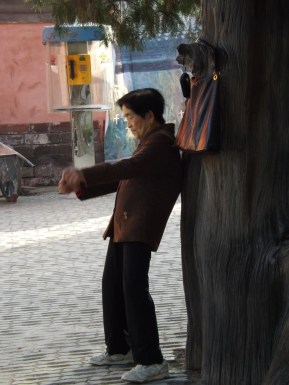
Another elderly lady was leaning against a huge tree continually banging her back against it. This was done with quite considerable force. At one point she stopped and checked her watch and then continued as if she still had another few minutes to do.
This is a wonderful park and watching all the local people participating in these very different activities is amazing and extremely interesting.
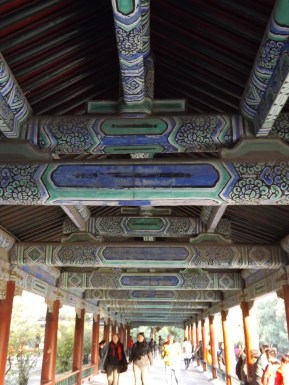
We walked towards the so-called ‘long corridor’ where we had enjoyed watching the Chinese play chess etc a couple of days ago.
Many people were once again gathered under this beautifully painted wooden roof.Some were playing cards. One couple were sat playing what at first glance appeared to be maj jong but the tiles had the Latin alphabet on them and they seemed to be playing a game similar to scrabble.
A few ladies were knitting or crocheting, some were selling their handicrafts and we purchased a lovely pink handmade handbag for our granddaughter Niamh. Further along the corridor were six men, three of whom were playing instruments, the others were singing. One of the men was in a wheelchair covered with a blanket to protect him from the early morning chill (we had seen some frost in the park). He had a banjo type of instrument and was strumming away. I wondered what he would be doing if he lived in the UK, I feel sure that he wouldn’t be in a park playing an instrument. I cannot imagine English people exercising like the Chinese in the park. It wasn’t just groups of people, there were many a solitary figure stretching, doing tai chi. One perhaps married couple were ballroom dancing with their tiny music player playing the music of their choice.
Back in the main part of the park we heard some more singing and headed in the direction of the voices. We soon came across about a hundred people, all gathered together early in the morning and singing their hearts out. The phrase ‘we do it for happiness’ comes to mind. ‘We do it for happiness’ was the answer that Pete received from Li Biao when he asked the question ‘do they play for money?’ regarding the card players in the park. I don’t know if these people are strangers, neighbours or friends but they gather together and sing in this beautiful park early on a very cold morning. The four of us all found it very moving.
We left the peaceful haven of the park; the city’s noise’s was an immediate contrast, with the honk honk blaring of the car horns, amongst other noises. We walked in the direction of the hutongs. By now it was 11am and we stopped for a quick coffee at a McDonalds. There was a little confusion when ordering the hot drinks, we were quite sure that the young lady had only charged us for two. Perhaps she didn’t want to lose face and admit to making a mistake, as when we offered her the extra cash she just looked blank and refused to accept it (losing face is apparently a big thing in China).

We walked along the oldest commercial street in Beijing. The street has a history of almost 600 years and is home to the oldest pharmacy in the city. The pharmacy was founded in 1669 and these days it deals in both Chinese Traditional medicine and Western medicine. Its ornate façade has been beautifully preserved, as have many other impressive shop frontages.

A huge silk store has an interesting stone façade and apparently the store is famous for making the first flag for the People’s Republic of China. A three-storied shoe shop has more traditional Chinese architecture. The store still manufactures shoes made entirely from cloth today. One large shop had a beautiful intricate green metal filigree façade. These grand buildings stand next to the small and quaint colourful shops that sell an array of items. We spotted a calligraphy shop and stepped inside to see if they sold silk scrolls. It’s proud owner presented his card, which boasted that the many different calligraphy brushes were handmade by himself from goat, sheep, and other animal hair.
We had all the time been keeping an eye out for the city’s narrowest hutong, but even with a map and the help of a policeman, we never did find it.
Time was passing quickly now, so we made the decision to omit the Fayuan Temple (Beijing’s oldest temple) and also the Daoist Temple. We jumped on a metro and headed to the Yonghe Temple more widely known as simply ‘the Lama Temple’. This temple, which is high on our list of ‘must see’, is the largest Tibetan temple in China.
While eating a quick lunch at a KFC, a lady gave us her business card and said that it was for the next time we visit her country. The card offered Chinese lessons…
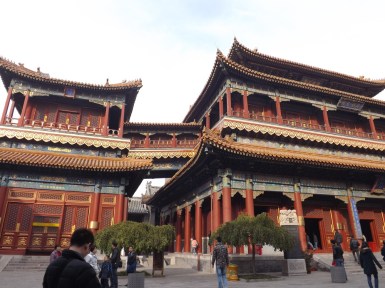
Built in the 17th century, this spectacular temple is home to the tallest statue of Maitreya – the future Buddha. The statue is carved from a single piece of sandalwood. One of our guidebooks stated that it is 18 metres tall, another, 16. But the breathtaking carving is actually 26 metres tall; a certificate from the Guinness Book of Records verifies this. Many icons and effigies are in the five large halls, some of them appear garish, some scary, one is a vivid blue some (dare I say it) even appear a little comical.
Unfortunately photography is not permitted inside the temple buildings.
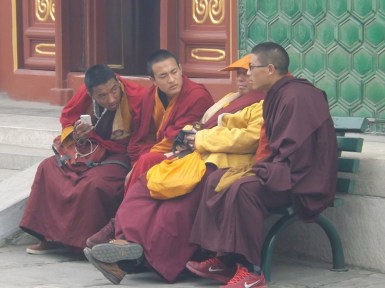
Courtyards with trees and ornate incense burners separate the five halls. Monks and tourists mingle and relax here. Some of the monks are dressed in brown robes. Others wear burgundy ones with orange or red shawls and the yellow hat that indicates that they belong to the Gelugpa Sect of Tibetan Buddhism.
It was in this temple in 1995 that the current Chinese Panchen Lama was sworn in.
As we left the temple we saw that it was just after 3pm and the four of us knew we were running out of time. We rushed to the nearest metro station, Pete and Anne just managed to get on the train before the doors closed; we caught up with them at the next station where we had to change lines. However, unfortunately by the time we reached Prince Gong’s mansion, it was closed. This preserved mansion is apparently one of the best examples of a royal residence in China. The surrounding hutongs were buzzing and many rickshaw drivers were touting for business. We continued to the Hou Hai Lake and Dave and I decided to stop for a beer. We arranged to meet up with Anne and Pete again at 6am the following morning. They were continuing with the ‘must see’ list and were therefore going to the Drum and Bell Tower. Unfortunately as I mentioned yesterday, they found it closed and learnt that it had been for five months.
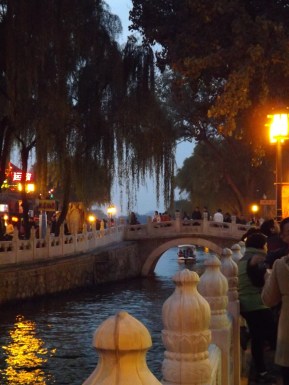
We sat on the roof of a bar watching the world go by enjoying what would turn out to be the most expensive beer of the whole trip. We could see the silver ingot bridge; many people were strolling slowly enjoying the pretty setting. It is now 4.30pm and we have been on the go for nine hours. We have not managed to tick off everything on our ‘must see’ list but we have seen some fabulous sights and very much enjoyed it all. Our thirst quenched and feeling a little rested we walked around the Hou Hai Lake. It is very pretty, swaying branches of willow trees overhang the lake. As darkness falls the neon lights, which I find unsightly and rather gaudy in the daylight hours, begin to reflect in the lake and look lovely. Many of the bars and eateries have live music and they seem to competing to be the loudest.
We decide to return to Wangfuyiang Street to have dinner. The taxi stops opposite the night market, directly outside a nice looking restaurant so we decided it was meant to be and went inside. We ate a tasty meal of duck, and ‘veal with cress’, (the cress turned out to be celery), and a big dish of noodles. We added a couple of big beers to our order and the total cost was just 180 Yuan (about £18).
Whilst walking back to the Double Happiness hotel, we saw some people dancing outside a shop; lots of people were outside St Joseph’s church and also in front of the metro station too. These people were doing various different activities, tai chi, different forms of dancing etc. Perhaps the area doesn’t have a park so the people gather for their daily exercise in these places instead. We didn’t see anyone when we walked down the same street on Saturday evening but perhaps classes are only held during the week. It was good to see the locals enjoying themselves.
As we passed the public loos down the hutong where our hotel was I decided to have a peek inside. This was after all my last opportunity to do so, as we would be leaving the city early in the morning. There were four stainless steel squat toilets. I only had a very quick glance, they appeared to be clean but a couple of things were definitely missing – walls and doors! These squat loos were without a partition between them. A friend had warned us about the public loos and advised us never to miss a chance of ‘going’ in a hotel or restaurant. ‘Even if you don’t feel the urge,’ she had instructed us to ‘at least try’.
Back at the hotel we packed our suitcases and were in bed just after ten o clock.

 lindaruddstravels.com