Wednesday 26th November 2014
Jokhang Temple Kora – Ramoche Temple
Our bacon was black and very crispy again this morning. A couple of days ago we asked Pete and Anne if theirs was extremely well done too. Pete answered ‘yes, it gets worse every day, I think they cooked it on our day of arrival and refry a portion each day’. He was joking, but perhaps he was right!
We thought about our friends and guessed that they would be well on the road to Everest Base Camp by now. In the early days of planning this trip, when Base Camp was first mentioned as a possible ‘add on’ Dave and I had planned to go too. However, when I realised how many hours it was sat in a car on extremely twisty roads for just a short time at Base Camp, and as I am occasionally prone to travel sickness, I changed my mind.
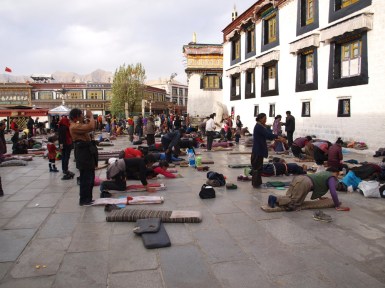
It was bitterly cold at 8.30am as we walked into Barkhor Square. I was just about to mention how cold my fingers were when I felt ashamed, how could I complain? I saw the long queue of faithful pilgrims patiently waiting to be allowed to enter the Jokhang and I thought that these people stood waiting were probably much colder than I was.
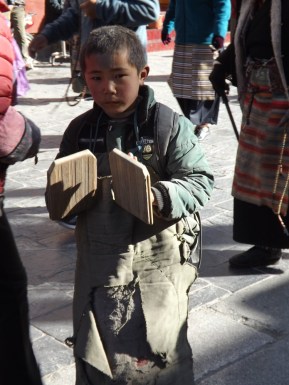
We saw and photographed a beautiful young boy who was prostrating his way around the kora. He was holding onto wooden shields that hopefully would protect his young hands from the harshness of the cold pavement and his many prostrations. We walked the kora mingling among the faithful Buddhists, some spinning their prayer wheels as they circumnavigated the sacred temple.
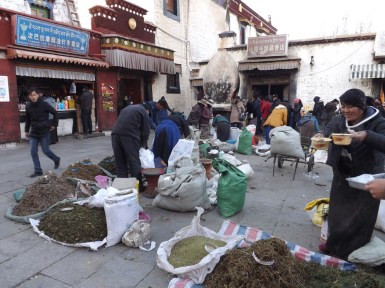
After a few wrong turnings we found the Ramoche Temple. Outside the temple, there were piles of aromatic incense for sale. We assumed that many of the piles were juniper, which is burnt in the huge incense burners. Some folk were purchasing it and throwing it immediately into the incense burner in front of the temple.
There are four of these huge incense burners around the Jokhang Temple, one at each of the cardinal directions. Juniper incense burns constantly.

The Ramoche Temple was originally built in the 7th century and is the sister temple to the Jokhang. From its courtyard, we entered a small room on the left, which had hundreds of butter lamps burning. Ooh it was lovely and warm and I removed my gloves to let my hands thaw a little. The floor was very slippery. There were three young males in their late teens sat in the room and one of them was doing some needlework. I asked if I could see it.
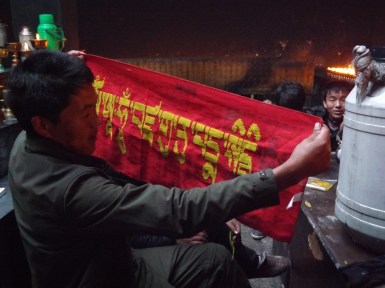
He held it up and showed it to me, it was a cross-stitch. He was stitching a mantra in yellow onto a bright red background. ‘Om Mani Padme Hum?’ I enquired. ‘Yes!’ he exclaimed, the three youngsters looked at each other in surprise that I had recognised the sacred mantra. ‘Om Mani Padme Hum’ one of them repeated, correcting my pronunciation. I took a photo of the cross-stitch and thought how nice it would be to stitch one.
Feeling warmed, we ventured back out into the extremely cold courtyard, we walked across it, past some people faithfully prostrating and entered what we believed to be the main door to the temple. Many people were walking across us. We were in a dimly lit circular passage, a kora. We walked the temple’s small internal kora before entering the main assembly hall through another door. Around forty monks were sat chanting, we proceeded to walk around the hall in the traditional clockwise direction. We saw a long queue and assumed that it would be for the pilgrims who wished to touch the sacred statue of the eight year old Jowo Sakyamuni. Dave and I agreed to walk past the queue and view the image from a short distance. However, not far from the end of the queue we realised that the revered statue was inside a tiny chapel and the queue was to enter the chapel. We started to make our way back to the beginning of the queue but a small group of Tibetans pulled us in front of them. Dave partly returned the favour by reaching some khatas for them. The khatas were hung high above the donation box that the pilgrims had placed their offering in and they were not tall enough to reach them. The white silk scarves would be placed upon the revered statue. The chapel’s entrance had a heavy metal curtain across it. The beautiful treasured statue was embedded with precious jewels. The temple also houses many other sacred and rare Buddhist objects.
Back in the main courtyard we followed a sign pointing to ‘Main Kitchen’ but we quickly turned tail when a large dog started to bark loudly and came running towards us.
We wandered back down the small side streets again, passing many shops selling thick warm fleeces at just 50 Yuan.
We stopped at the Snowlands Hotel and Restaurant for a hot coffee before continuing to Barkhor Square and the Jokhang Temple for the second time this morning. We didn’t have much time left but we wanted to walk the kora one last time (this lifetime).
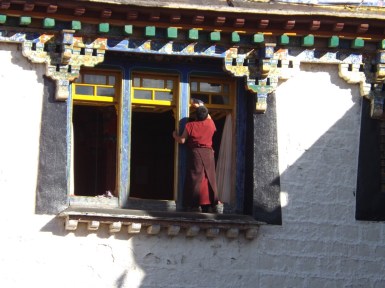
As we passed the Jokhang, we noticed a young monk balanced precariously on a window ledge on one of the higher floors of the temple. He was busy cleaning the windows. The monks have many duties to perform in addition to their religious studies.
We said that if we spotted a likely shop for a cross-stitch kit we would have a look. A few minutes into the kora, I said to Dave ‘Let’s not bother looking, let’s just enjoy the kora, if it’s meant to be I’ll find one’.
A short while later, still following the kora, we walked to the left of one of the tall poles covered in hundreds of colourful prayer flags, and hanging outside one of the nearby shops was some needlework. A quick peek inside revealed some cross-stitch kits. We asked the shop keeper for his help as some of the Tibetan writing (like ours) is more fancy than others, he pointed to one which apparently said ‘Tashe Delek’ the second one in a different colour said the same. He then showed us one with the mantra Om Mani Padme Hum; it was on a red fabric. I saw a blue one, which had the mantra and also the ying yang symbol, and a lotus flower. When the shopkeeper produced the same in red, my mind was made up and I purchased it.
Soon a lot of these shops will close down for the winter. Many of the hotels will shut their doors too, indeed the hotel that we had originally chosen for our stay in Lhasa informed our tour company that they were closing just a few days before we set off from home.

It was an emotional farewell to Barkhor Square, The Jokhang Temple and it’s awe-inspiring kora and people – a place that at one time I didn’t think I would get to visit in this lifetime. We took one final photograph with the aromatic juniper smoke billowing across the square from the huge incense burners. This square, Lhasa, all the amazing places we have visited here in Tibet and the Tibetan people will stay in our hearts forever.
The man at the hotel placed a khata around our necks as he bid us farewell and wished us a safe journey.
On the journey to the airport we chatted to Dawa about our morning and how very cold we were walking the kora at 8.30am. We mentioned how concerned we felt for the elderly and disabled people. He informed us that the temperature at 8am this morning was minus 8 degrees Celsius. ‘But’ he added ‘the elderly people don’t need much sleep at their age, they are happy walking the kora early in the morning and it is good exercise for them.’ Our guide doesn’t like to see beggars apart from the elderly or disabled who are needy. He says that some of the beggars come from the countryside to the town, as they don’t want to work. ‘If they work they earn maybe 100 Yuan a day, if they beg some days they can make three times this amount’. Dawa told us that the pilgrims who prostrate around the kora are not begging, although usually they are given money. Perhaps the people who give them money can’t prostrate or don’t wish to and it is similar to someone of the Christian faith saying ‘say a prayer for me.’
About 40 kilometres outside of Lhasa we saw two young men prostrating, Dawa said that they would prostrate all the way to Lhasa and its revered sites.
Due to some roadworks we were taking a longer route to the airport. We passed no less than five fish burial sights. There were painted pictures on the nearby rocks of ladders, possibly depicting a stairway to a hopefully better life or to nirvana.
It was sad to say our goodbyes to our friendly guide at the airport. We exchanged email addresses and offered to help him with any English language queries. We added that when his son is a little older and writing English we would exchange emails with him too, to hopefully help him improve his language skills. We promised to pass Dawa’s details on if we heard of anyone wishing to travel to Lhasa, although we said that it was unlikely. He has one guided tour booked for next month but admits that the winter months are usually difficult and alternative work is not easy to find as the tourist places and the construction work all finish for the winter.
While waiting in the airport’s terminal, a young Taiwanese couple approached us and asked if we could recommend a good guide.
We most certainly can!
We are lucky!

 lindaruddstravels.com