Tuesday 25th November 2014
Tashilumpo Monastery – The Friendship Highway
Kyichu Hotel Lhasa
Today as we arrive at the Tashilumpo Monastery it is bitterly cold. The four of us are well wrapped up in layers and warm jackets but Dawa is wearing just a thin leather jacket. He continually rubs his hands in an attempt to warm them.

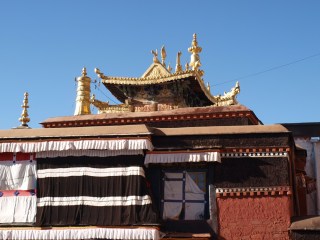
This monastery is the traditional seat of the Panchen Lama, the Dalai Lama’s teacher. Tashilumpo is one of the six largest monasteries of the Gelugpa school of Tibetan Buddhism (which is also known as the Yellow Hat Sect).
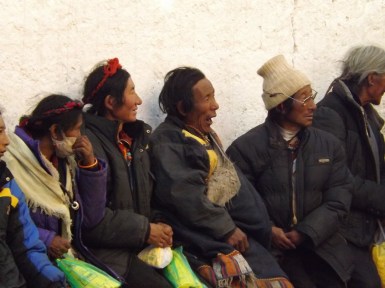
This revered monastery has over sixty chapels, which are home to numerous precious Buddhist icons. Narrow cobbled lanes separate the many chapels and other buildings within this monastery’s vast grounds. Pilgrims queue and some jostle to enter the sacred chapels, eager to finally be able to pay their respects at the holy shrines. We visit the tomb of one of the Panchen Lamas; it is crafted from many kilos of gold and inlaid with turquoise and other precious stones.
Dawa explained that only the bodies of the Dalai Lamas and the Panchen Lamas are entombed, high monks are cremated and the remainder of the Tibetan population have either sky or fish burials.

At one of the entrances to one of the many chapels there is a swastika symbol inlaid with the semi precious stone, turquoise. The Sanskrit word for this ancient symbol that has been used for thousands of years means ‘well being’ or ‘good existence’. In Buddhism the swastika is a symbol of good fortune and eternity.
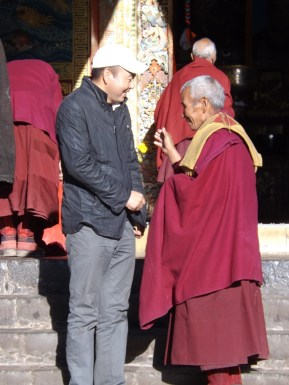
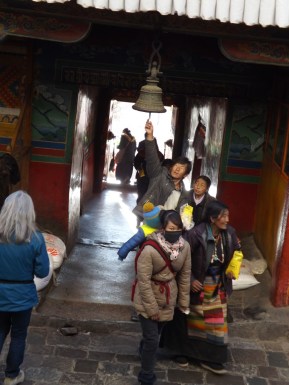
A happy scene was Dawa chatting with an elderly monk who taught one of his friends, they were obviously pleased to see each other. Our lovely guide spoke with a few of his old friends at the monastery.

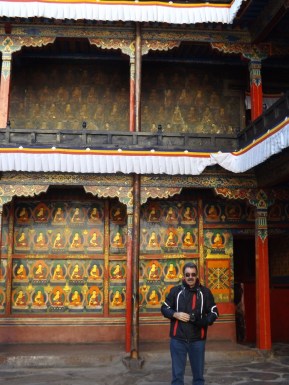
We saw monks of all ages at this large monastery. Two very young monks, perhaps just twelve years old were larking around. One of them hid and when the other youngster rushed by him he grabbed him and then they happily chased each other laughing and smiling around the courtyard as the older monks, some pilgrims and ourselves watched them. It was a lovely scene.
In one of the chapels two young monks in their late teens were cleaning the floor. One of them had the biggest mop that we had ever seen, the other had two polishing cloths under his feet and he was chanting as he slid slowly around the chapel polishing the floor.
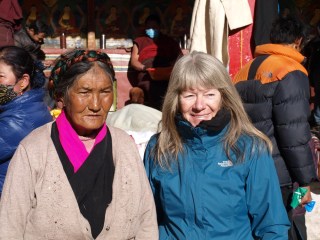
Many people stared at us at this monastery; ‘it is unusual to see foreigners here’, Dawa explained. Some of the Tibetan people appeared to be very old and we asked our guide what life expectancy was here in Tibet, we were surprised to learn that it is just 60 years old. Some of the people appear to be much older. Dawa said that we should ask someone their age; he said that they would not mind and he approached a lady who looked about 70 ish. She counted on her fingers and then told Dawa that she was in fact just 59 years of age.

I had read about the market in Shigatse. It was apparently held in the shadow of the town’s dzong (fort). The Potala Palace was modelled on this dzong. The dzong was destroyed in 1961 and has only just been rebuilt; its interior is just an empty shell at present. According to the article I had read, the market would be full of the tall Tibetan Khampa men selling mainly knives but also a few other items. Dawa said that he would drop us off at the market and meet us again just fifteen minutes later; he said that this would be enough time. Dawa was right, the time was enough, and there were no nomadic tall Khampa people who adorn their hair with semi precious stones. Many of the stalls were selling meat, carcasses of sheep were hanging up and huge pieces of yak meat were being roughly hacked. The other stalls merchandise was jewellery, maj jong sets, prayer wheels and statues of Buddha.
While we were at the market Dawa had met up with another guide and driver who had arrived in a land cruiser vehicle to take Anne and Pete on the next part of their adventure. They will travel to Shergar for the night and an early start tomorrow is planned when they will be driven to Everest Base Camp. We said goodbye to our lovely friends on a street corner in Shigatse, telling them to stay safe and agreeing to meet up again in a few days time at home in Crete… which seems like a million miles away.
It was just midday, Dave and I agreed with Dawa that it was too early to have lunch so we agreed to stop in a couple of hours. We therefore immediately started the 280 kilometre journey back to Lhasa along the Friendship Highway. Due to the speed checks it was expected to take around six hours.
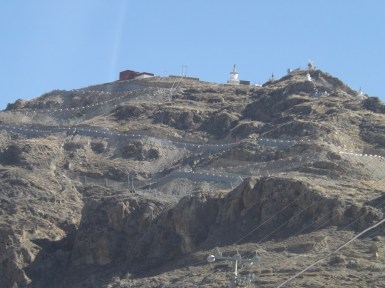
Dawa pointed out a ‘Sky Burial Site’ high upon a hill. Our guide told us that no relatives or friends of the deceased attend the sky burial. The body is cut into small pieces and left for the vultures. The vulture being a carrion bird does not kill any living being. Buddhists therefore believe that it is good karma to give the body that is no longer needed, to them.
Dawa added that if a person was rich, the body can be transported to the site of ones preference, but it is more usual that if one lives near a mountain he will have a sky burial and a fish burial will take place if one resides close to a river. The Tibetan people do not like the idea of burial. ‘It wastes land’ remarked Dawa ‘and also if the death is due to an illness, poison from the body may go into the ground and harm the insects.’
Dawa told us that Buddhists do not usually eat small animals. However, on a very rare occasion if someone is ill, they may kill a chicken or a rooster and make some soup but only the person who is ill will eat this soup. There are many wild rabbits in the Tibetan countryside, these are culled but never eaten.
We stopped to check in at one of the many speed checkpoints along the Friendship Highway. Dawa got out of the vehicle to show the paperwork to the waiting official. Our guide returned looking extremely serious and informed Lobsang that we had arrived three minutes before the earliest specified time. 100 Yuan(£10) is the fine for driving faster than the speed regulations and arriving just one minute earlier. 200 Yuan for two minutes and 300 Yuan for three minutes. There is also an accumulative points system were in addition to the fine, a speeding driver also acquires points. If one acquires 12 points, the person would lose their licence and the driving test would have to be taken again. Poor Lobsang! Then Dawa’s face lit up with his big smile and he started to laugh! He was teasing our driver! I told Dawa that he shouldn’t tease as perhaps because of his teasing, in his next life he will come back with an ugly face (I wanted to joke that in his next life he may have a face like Lobsang, but I wasn’t sure if it would be taken as a joke), Dawa laughed harder.
Dawa suggested lunch and said that he knew a good place to stop for yak meat and potatoes; we said it sounded good as long as it wasn’t hot and spicy. We stopped at a place that reminded me of an old western movie, a one street town. Half a dozen shops and eateries lined this one street town either side of the highway. Some people were eating outside the restaurant where Lobsang swung the vehicle into a small space adjacent to an old minibus.
The interior was almost full and we made our way to the only available table. The table was low and the hard wooden benches were covered with grubby looking animal skins.
As we sat down a Tibetan man at the opposite side of the square shaped room picked up his video camera and filmed Dave and I for a few seconds. I smiled and waved and then picked up my camera and took a photograph of him. He returned the smile and also the wave. Shortly after, the man and the people he was with left the building and clambered into the old minibus outside. I wondered where they were heading; perhaps like us they were visiting some of Tibet’s mystical and marvellous sights.
I confess that I was a little worried about eating in this place, it didn’t look too clean and my stomach is not the strongest!
Dawa, for the second time today, told us that many people from the countryside had never before seen foreigners, hence the many stares we were receiving.
Unfortunately the yak meat was served in a curry sauce, yak meat with diced potatoes in curry served on a bed of rice. Dave doesn’t like curry, Dawa looked concerned and asked if he would like some noodles instead, Dave thanked him but declined and said that he wasn’t really hungry anyway. The curry was mild so although not a great lover of curries myself, I could eat it and I thoroughly enjoyed it (negative thoughts of cleanliness and stomach bugs vanishing). Lobsang soon wolfed down his small portion and then ate Dave’s. He then disappeared and returned a few moments later with a carrier bag. A joint of cooked yak meat was in the plastic bag and our friendly driver proceeded to carve a piece off with his penknife, which he took from his pocket. He offered a piece of meat to Dave and myself and then finally to Dawa. He took his cooked meat back to the vehicle and returned with two biscuits which were more or less the same size and shape as a pack of cards. He told us that they were Chinese army ration biscuits and that after you eat one, you do not feel hungry for many hours. He was clearly concerned that Dave had not eaten lunch. Both Dave and I tasted the biscuits and then popped them into our bag for later.
Dawa surreptitiously pointed out a family who had just arrived in the eatery, they were much darker skinned than the Tibetans whom we had seen so far and our guide said that they were from North Tibet.
Before we left I asked if there was a loo, Dawa told me that they were not clean and suggested that I use a natural one. When I looked enquiringly at him, he said ‘perhaps behind a tree or a rock?’ I nodded in agreement and he said that they would stop on the road somewhere.

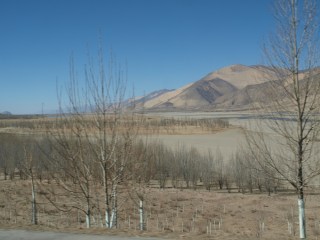
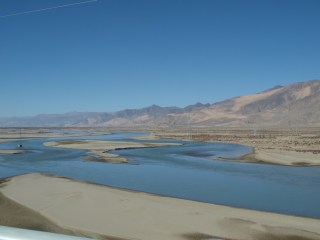
We relaxed again in the vehicle, enjoying the constantly changing scenery. We saw many flocks of what we believed to be ducks, geese and storks along the route back to Lhasa.
An hour or so after our lunch stop, Lobsang stopped at a place where there were three or four shops selling refreshments and the usual couple of trinket stalls.
Dawa told us that we could stretch our legs for ten minutes or so. He pointed us in the direction of the public loos but once more, as predicted, they were very bad so ‘natural ones’ were located.
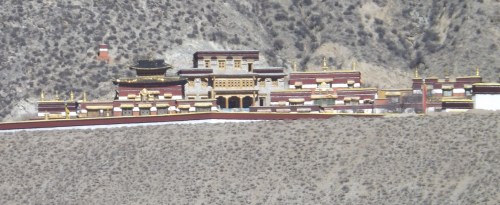
Back on the road again Dawa pointed out a monastery perched on the mountainside belonging to the Bon Faith. I asked if we had time to visit it but our guide replied ‘no, as it is a difficult road to get to’. He also added that he had never been there and as a Buddhist he would not enter a Bon monastery, I was surprised…
We continued chatting to our friendly and informative guide on the journey back to Lhasa. He told us that all Tibetan children had the opportunity to go to school since the Chinese came to Tibet.
We mentioned that we had heard or maybe read somewhere that the Buddhists in Tibet don’t kill the animals that they eat but that the Muslims do it for them. Dawa looked quite alarmed, ‘no!’ he said, ‘the lower class do the butchering.’ This was the first that we had heard of a class system. ‘We wouldn’t purchase meat from a Muslim, they sometimes mix it, it could be beef or donkey or horse so we never touch it. They don’t come to our restaurants and we never go into theirs.’ He continued to say that every year he purchases half a yak, portions it and freezes it; this is enough meat to feed himself and his family for a year. He added that it is best to eat just one animal, instead of buying a kilo from the shop one week and another kilo another week, as that would be from another animal. Purchasing half a yak meant that he was contributing to the killing of one animal only, although he did say that he was aware when he eats yak meat in a restaurant it is from a different animal.
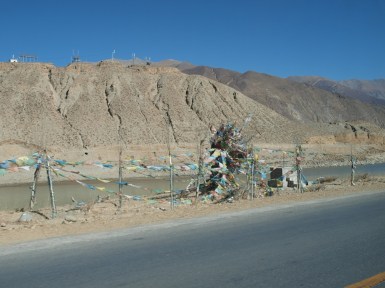
While we were still travelling back to Lhasa, Dawa had a call from Anne and Pete’s guide to tell us all that they had arrived at Shergar. We hoped that their hotel was reasonable as things apparently can be ‘very rustic’ when you travel further than Shigatse.
They had thankfully finally got their permits to visit Everest Base Camp. The earth’s highest mountain is known in Tibet as Chomolungma, which translates to ‘Goddess Mother of the Mountains’.
We finally arrived back at the Kyichu Hotel at around 6.30pm; we immediately turned the heating on in an effort to ease the extreme coldness in the room. We both had hot showers, which we agreed were sheer bliss! We left the heating on and left some clothes, that we would wear to sleep in, on the floor to be warmed by the under floor heating system before we headed out for dinner.
We ate sweet and sour pork and shabaleb bread and drank a ‘Lhasa Roof of the World’ beer in the cosy ‘Lhasa Kitchen’ restaurant. Our bill totalled 67 Yuan – that is just £6.70.
After our meal we returned to our now warm room and once more sorted our suitcases, this time in preparation for the long journey home tomorrow.
Earlier, Dawa had enquired if we would be resting tomorrow morning. No! We will most certainly not be resting; we are in Lhasa,Tibet, why would we want to rest? Our alarm is set for 7.15am and our intention is to have breakfast as soon as it is available at 8am
Then we plan to do the kora around the Jokhang before visiting the Ramoche Temple which is the ‘sister temple’ of the Jokhang.
Unfortunately from 10pm there were extremely loud banging noises, at 10.45pm I opened the door and immediately the noise was even louder. The window in the corridor was open and I looked down and saw about fifteen men (I called to Dave that there were millions!) with some type of mallet in their hands and they were demolishing a concrete building, wall or something and breaking the huge slabs up into smaller pieces. We tried calling to them to ask if they would please stop, but it was impossible, they couldn’t possibly hear us above the continuous din. I grabbed my jacket and went downstairs and made my way across the dark courtyard and into the main building. Two teenage girls were sat huddled together just inside the building giggling and playing on their telephones. I complained to the man on reception about the noise. He said that the work was being done on a street and that the work could not be done during the day. He said that it should take them about another 20 minutes. Knowing that the Tibetan 20 minutes is as long as the Greek 20 minutes I asked him if he would please come and see what was happening so that he was totally aware of the situation. We didn’t get far across the dark courtyard before we heard a huge crash as more concrete fell. On hearing the noise himself, he immediately said that he would put a halt to the work. I went back upstairs and Dave and I watched out of the window as a small pick up truck reversed into the alleyway, it’s reverse warning bell now replacing the previous din. The men started to shovel the rubble into the truck. We returned to our room and the scraping noises of the shovels and the crashes of the rubble landing in the truck continued. We heard another truck arrive some time later and then it went quiet for a while before starting again. Clearly they had not stopped. We tried to ignore it, as best we could. We couldn’t just ring the reception, as the telephone was not working yet. We were in the new wing that wasn’t completed, but had paying guests… but hey we are in Tibet!!

 lindaruddstravels.com