Monday 24th November 2014
Jokhang Temple Kora – Yamdrok Lake – A Spectacular Glacier
Gyantse – A Traditional Tibetan Family Home – Shigatse Hotel
I had a quick cup of tea and left Dave still in the hotel’s dining room eating his breakfast. I wasn’t hungry, well, not for food. I wanted to walk the kora around the Jokhang and I had to be back at the hotel for 9am as Dawa and Lobsang were meeting us at 9.30am.
As I walked to Barkhor Square, I felt that I could be almost anywhere. Small children holding tightly onto their mother’s hands with brightly coloured bags on their backs were making their journey to school. When I turned the corner and went through the security check and into Barkhor Square, it was like entering a different world. Numerous pilgrims were already queuing to gain entrance into the most sacred of Tibet’s temples. Countless more pilgrims were prostrating in front of the Jokhang
A lot of these pilgrims had travelled for many days and some would have walked miles to come to Lhasa to visit the revered sites. I had resolved not to stop and take photographs. I wanted to feel and absorb the atmosphere. However, I changed my mind to take a photograph that showed the end of the queue, and how far into the kora the faithful were queuing. There must have been hundreds of Tibetans patiently waiting on this freezing cold morning.
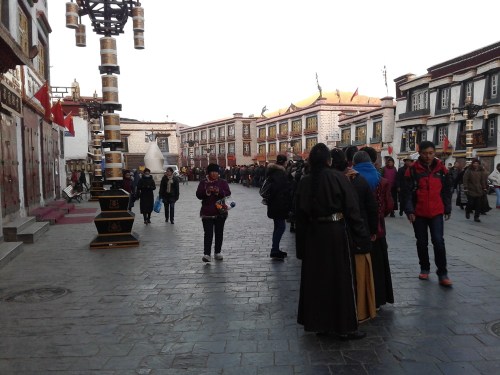
Apparently only Tibetans are permitted entry into the temple in the morning. I stopped only once more to hand some Yuan to an old lady who was begging. We saw quite a few people offering cash to pilgrims who were prostrating and also to some older folk who were begging when we walked the kora on previous occasions. The note that we saw most offered was the equivalent of 100th of a Yuan; one Yuan is the equivalent of 10 pence sterling. This small denomination note was also placed onto thangkas, and sacred statues in the temples. As I handed the elderly woman some cash, another woman close by noticed. She was stood with an older lady who was perhaps her mother; the younger of the women grabbed my arm. I gently removed her arm and turned to walk away as a Chinese policeman approached the woman. I walked on but turned to ensure that the policeman was not harassing her.
While circumnavigating the kora with the devoted pilgrims I saw two amputees, both young men had lost a leg below the knee. They both appeared to be alone and both carried their crutches in their backpacks as they prostrated around the sacred kora. It was an emotional walk around the Jokhang kora. I was back at the hotel before 9am.
We set off on our 300 km (186 mile) journey to Shigatse shortly after 9.30am. This city lies south west of Lhasa and is home to the Tashilumpo Monastery, the traditional seat of the Panchen Lama. Dawa explained that there would be a number of speed checks throughout the journey. He told us that we would have to stop at a checkpoint and take a ticket, which would state the current time. We would then be unable to check in at the next speed checkpoint, 90 km away until a minimum of 2 ½ hours had passed. So the speed limit during this part of the journey would be just 36km (22 miles) an hour. As one would expect, many people drive quicker and then just sit in their vehicle or stop for a drink at one of the few cafes along the roadside and wait for the time to pass.
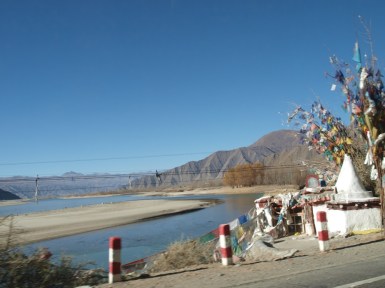
We soon left Lhasa behind and as we travelled through the Tibetan countryside, we saw some pilgrims walking along the roadside. They would be making their way to Lhasa to visit the city’s revered sights. Dawa pointed out a fish burial site. Here in Tibet there are sky burial sites and fish burial sites. Our guide explained that it depended where the deceased had lived as to which method would be used. Dawa added that it is very unusual for Tibetans to eat fish, as most believe that they are the embodiment of their ancestors’ souls.
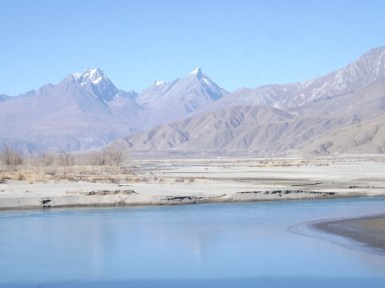
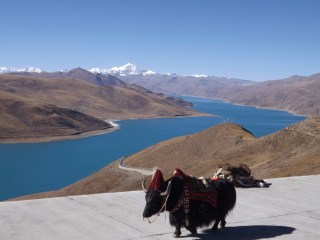
The passing scenery was beautiful, blue skies, mountains, and narrow meandering rivers. We drove through small villages and saw the locals going about their daily lives. Further on, we came to a modern road and steep gradients and hairpin bends led us to the stunning Yamdrok Lake. We stopped for a while at this spectacular lake with its turquoise waters which is one of the three largest sacred lakes in Tibet.
The freshwater lake lays 4440 metres (14,570 feet) above sea level. (Good job Dave and I had continued with the high altitude sickness tablets!). A couple of locals stood with a yak that was dressed up for tourists to photograph, for the cost of a couple of Yuan. Once again we were lucky and we were the only people there. In the distance we could see snow capped mountains standing majestically above this large beautiful turquoise lake.
A visit to the public toilets at the lake brought back memories of the film ‘Slumdog Millionaire’. We were accustomed to the lack of doors and partitions now but it was a scary scene going through my mind as the filthy tiled floor seemed extremely thin and the deep cavernous drop below was only a fragile tile away. These toilets have been dubbed the worst toilets in the world on the Internet.
We stopped at a small town named Nagarze for lunch and once again we were served a very tasty meal. However, there were a couple of unusual dishes (to us) offered on the menu, one was ‘rotten meat’ and the other was ‘vermicelli with grandma’. We had noticed an elderly grandma sitting near to the entrance but we decided that she looked a bit tough. Needless to say we ordered neither of these dishes.
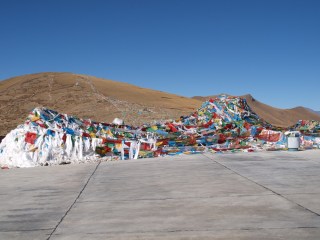
Our next stop was a spectacular glacier. At the foot of this imposing glacier there is a revered chorten. It is bitterly cold and the many colourful prayer flags are blowing in the wind. I know I keep saying it but we are really so fortunate, once again when we first arrived at this awesome place we were alone. We spent some time appreciating the beautiful and serene setting. A short while later, some Tibetans arrived, and prostrated in front of the sacred chorten.
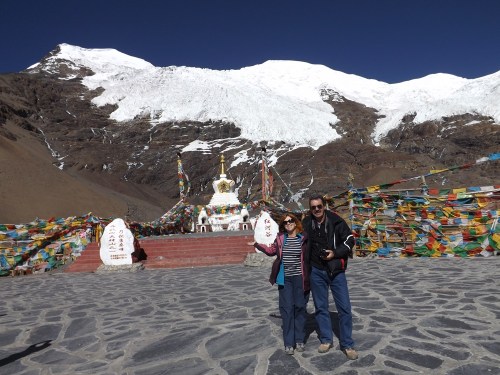
We continue on our drive to Shigatse and Dawa points out a turn off which leads to the Sikkim border in North West India. The Indian State is located in the Himalayas and is bordered by Bhutan and Nepal as well as Tibet.
We stop for a short while at the small town of Gyantse to photograph the dzong, (fort) which is apparently one of the best-preserved dzongs in Tibet.
Dawa told us that it was quite usual in the Tibetan countryside for a woman to have three husbands. ‘This is often for economic reasons, three men help with all the work that needs to be done’ he added. He said that his mother had three husbands and gave birth to ten children. His father passed away when he was aged seven but he still had two ‘uncles’ he told us. Three of Dawa’s brothers are married to the same woman; he tells us that this also often happens. Dawa asked if we would be interested in visiting a traditional family home and of course we all jumped at the opportunity. We stopped at a large family house on the edge of a village. There was a yak and also some cattle in the yard. Our guide said that this house, which was 500 square metres, belonged to a well off farming family. Dawa showed us some of the ground floor, one room had hay in it for the animals, and another was used for storage. We saw bags of barley and a pile of sheep’s wool.

Stairs led up to a large square area that had lots of plants. The transparent plastic roof made it a bright and light place; washing was hung up drying. When we entered the spacious kitchen, a toddler and his grandfather were there, Dawa introduced us to them. The cupboards that lined one of the walls were beautifully hand painted with different scenes. The kitchen’s oven used dung or wood for fuel. A baby was gurgling on one of the long couches that covered the length of the large room. The toddler’s mum arrived and we were shown the family’s chapel, a room that every Tibetan home has.
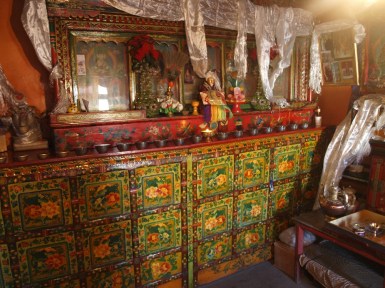
Offerings stood on the hand painted shrine cabinet; small containers of water were amongst them. Dawa explained that the offerings did not have to cost much, as long as they came from the heart. A few white khatas hang from the wall above the shrine. The house had a large ceremony room, its wooden beams were still bare, hand made brightly coloured cushions were scattered on the long settees. This room will be used maybe only three or four times a year for perhaps a wedding celebration or for the New Year ceremony. We were offered barley beer, yak butter tea and cheese. We were not shown any bedrooms but we did see piles of thick throws neatly folded in a couple of the large rooms.
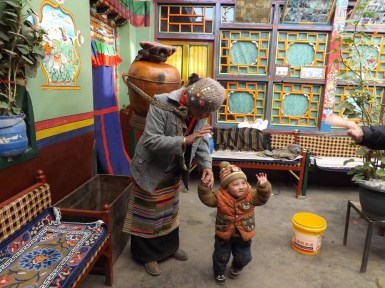
The young mother strapped a large urn onto her back and held her son’s hand tightly as they waved us goodbye before she went back to her work. It has been absolutely amazing to gain this insight into traditional life here in the countryside in Tibet.
It was 6.30pm when we reached the aptly named ‘Shigatse Hotel’. The hotel reception areas were lovely, one of which had an ornately decorated ceiling and there were beautiful thangkas hanging on the walls. It has been a long and tiring day but truly wonderful.
Our evening meal was disappointing; we were served fatty pork, chicken wings, other bony bits and pieces along with eggs in gelatine and some spicy dishes in the very cold dining room. We were the only guests for dinner. However, there was still plenty to eat, Dave and I ate rice, noodles and yak meatballs. It made a nice change for Anne and Pete to have some spicy dishes as although we always stressed that only two of us disliked hot and spicy dishes invariably we were served with non-spicy meals. After dinner we went to our rooms to put the air conditioning on so we could get warm.

 lindaruddstravels.com