
Sunday 23rd November 2014
Jokhang Temple Kora – Jamkhang Temple – Meru Nyingba Monastery
Potala Palace – Jokhang Temple
Ani Tsankhung Monastery
It’s 9.40am and we are at the hotel waiting for Dawa and Lobsang. I cannot believe how much we have already seen today! Dave and I walked the kora around the Jokhang Temple early this morning. We joined the many pilgrims wrapped up against the freezing cold. There is a huge prayer wheel inside the small Jamkhang Temple and many devotees were walking around it and spinning it. A tall, smiling Tibetan man indicated to us that we should step in front of him and join the circle. We returned the smile and nodded our thanks to him as we did as he offered. These people are lovely. The whole experience makes you feel so humble. It is very emotional.
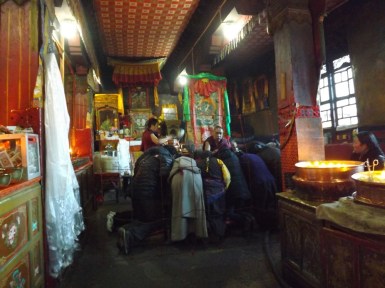
The 15th century temple also houses the two-storey image of the Maitreya – the future Buddha. We climbed the stairs to view the head of the Buddhist effigy. Pilgrims were patiently queuing for a blessing. Monks were pouring oil onto their bowed heads and waving what appeared to be a short handled besum over them. Once again a couple of the devotees indicated that we could join the queue in front of them. A young man said ‘Welcome to Lhasa’ and we responded with a ‘Tashe Delek.’
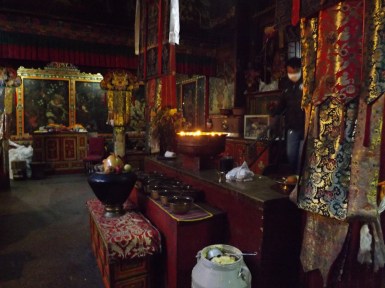
We then visited the Meru Nyingba Monastery, the entrance was in a courtyard where a few locals were selling bottles of water and other essentials. For the equivalent of £1, we were permitted to take photographs inside the monastery. There was a small assembly room and many interesting Buddhist relics. A monk wished us ‘Good Morning’ and we answered once more with ‘Tashe Delek’. This time however the monk advised us that it was more correct to say a different word. We recalled when we had first asked Dawa how to say hello, he too had told us a different word which pronunciation we didn’t quite grasp. He had then suggested that we use ‘Tashe Delek’ as an easier alternative.
There was another small monastery in the same courtyard. This one had numerous small identical drawings of Buddha in the lotus position. They were painted onto a very dark red wall and at first glance the wall appeared blank. A seated monk was banging a drum and simultaneously a cymbal was crashing. Another monk was ringing a small bell. As we exited the room, a young man who was behind a makeshift stall selling bottles of water pointed to us to go upstairs. We found another very small chapel, a rotund monk was sat cross-legged chanting and swaying on a pile of cushions, a younger monk was chanting quietly and moving his mala (a set of beads used to count while repeating a mantra).
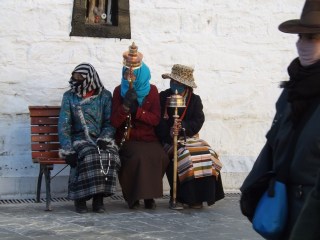
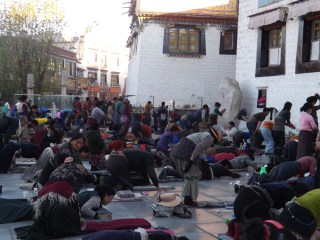
We continued walking around the kora and we stood for a while watching the faithful prostrate in front of the Jokhang Temple. A young Tibetan man in traditional dress approached us and using sign language asked if his friend could take a photograph of us with him. This was the first Tibetan that we had noticed with a camera. We returned to our hotel marvelling at the wonderful sights we had seen.
So it is now 10am and we have just met Dawa and Lobsang to go to the Potala Palace. Wow! As I said before I am amazed at all that we have seen so far this morning and now we are going to the Potala Palace!!
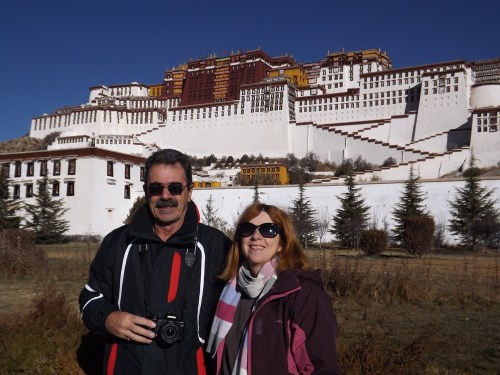
Puffing, panting and trailing behind Dave, Anne and Pete, I made my way up the many flights of stairs. I felt so much better today so it really took me by surprise. Local people, older than myself were walking past me. The symptoms of altitude sickness can affect anyone, fit (like me) or unfit, young (like me!) or old.
This palace was built in the 7th century and extended by the 5th Dalai Lama in the 17th century and subsequently became the main residence of the Dalai Lamas.
The thirteen storied building has two parts, one that is known as the red palace and the other as the white palace. There are more than one thousand rooms. The red palace was used for religious ceremonies; the white palace was the winter living quarters for the Dalai Lamas. The offices of the Tibetan Government were also situated in the white palace. Today, however, the Potala is classed as a museum. There are numerous ornate and colourful chapels. We visited the jewel-encrusted tombs of some of the previous Dalai Lamas. We gazed at many beautiful murals and slowly followed the Tibetan people through the rooms that we were permitted to see.

There were many people walking the kora around the Potala Palace. We asked Dawa what he did on his day off, ‘I usually walk the kora around the Potala Palace with my family’ was his reply.
After lunch we visited the Jokhang Temple. This temple is the most revered temple in the whole of Tibet. Once again many people were prostrating in front of the temple.
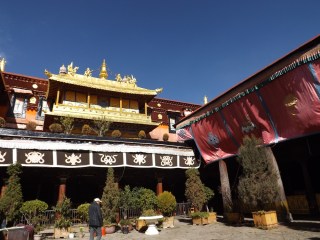
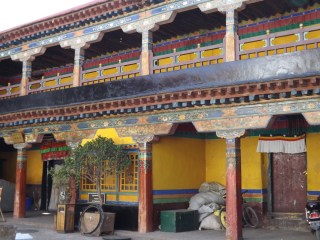
One of the reasons for the construction of this temple was to house the sacred statue of Jowo Shakyamuni, the Buddha, as a 12 year old. This is the most revered icon in the whole of Tibet. Nowadays one must peer through a padlocked metal curtain to see the magnificent effigy. However the curtain was open when we arrived. ‘Do you want to go in?’ Dawa enquired. ‘Yes’ we cried and he held the heavy curtain open for us.
We quickly entered the small chapel and gazed at the beautiful statue, which is encrusted with jewels and believed to have been blessed by Buddha himself. How lucky we are! The interior of the temple is dark and the air is thick with incense smoke, the many burning butter lamps give off a little heat.
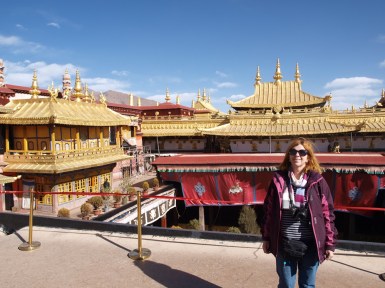
We climbed up to the roof of the Jokhang. We are seeing the roof of the world from the roof of the Jokhang! Wow! The view is amazing; the Potala Palace can be seen in the distance. We can see the many prostrating pilgrims below us and the young and the old who are walking the kora.
Before Dawa went home, he took us to a large handicraft shop. There was a beautiful hand painted thangka at a cost of £10,000.
Dave and I walked into Lhasa’s Muslim Quarter. The men all wore white hats; their mosque had a green dome.
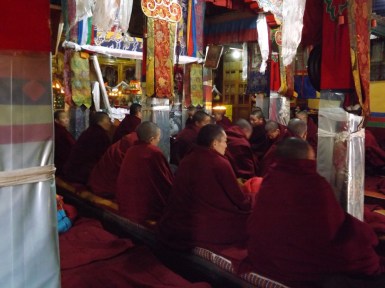
We continued wandering the maze of Lhasa’s old town streets until we came to the Ani Tsankhung monastery, which is a Buddhist Nunnery. We purchased our tickets and entered the courtyard. A nun was washing laundry at an outside tap; I commented to Dave that the water must have been freezing. There were numerous plants in pots in the courtyard. To the side of the courtyard, we could see the nuns living quarters. There are apparently one hundred nuns living here today.

We entered the temple to find the nuns chanting. One nun smiled at us and told us that it was permitted to take photographs. This monastery is built on the site where the 7th century Tibetan king Songtsan Gampo meditated. The Tibetan word Tsankhung translates to hole or cave. This king introduced Buddhism into Tibet and was also responsible for the construction of the Jokhang Temple.
As we were leaving the monastery, the nun was still doing the laundry and I thought how harsh life must be but thinking again probably not. For the devout it must be an extremely happy and peaceful life.
As we headed back to our hotel we saw the two girls whom we had seen at the Norbulingka yesterday with their family. Dressed in western clothes including bright pink puffa jackets, their hair tied in long plaits; they held the hands of perhaps their Grandma who wore traditional Tibetan wear. Together they were walking the kora, the girls waved at us and blew us kisses.
We returned to our hotel. A short while later, we met up with Anne and Pete and we went to a nearby eatery together for our evening meal.

 lindaruddstravels.com