Saturday 22nd November 2014
Norbulingka Palace – Old Village – Sera Monastery
Barkhor Square – Jokhang Temple Kora
Thankfully both Dave and I have had a really good night’s sleep. Apart from feeling a little breathless, we feel okay. We have breakfast and Pete and Anne go for a walk to Barkhor Square. Although we would really like to go, we think it would be better if we go back to our room and rest for a while before we start the day’s sightseeing. If we manage to do what is on our schedule today, we will be more than happy, we will see how the day progresses.
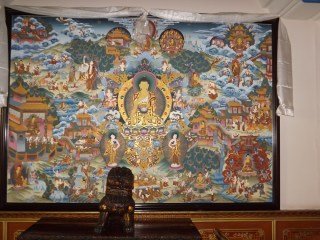
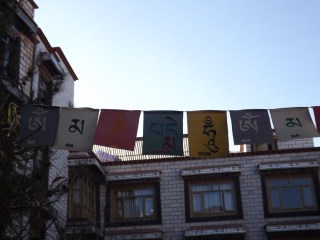
There is a beautiful thangka on the wall in the hotel’s reception; two white khatas have been placed on it. In the courtyard of the hotel, colourful prayer flags with the renowned mantra Om Mani Padme Hum printed on them blow gently in the breeze.
Dawa and our driver Lobsang meet us at the prearranged time and we set off to our first stop of the day, the Norbulingka Palace. This is the summer palace of the Dalai Lamas.
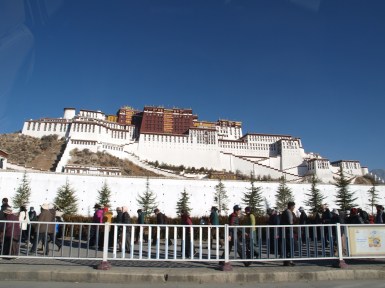
During the short ten-minute drive we catch our first glimpse of the spectacular Potala Palace. Wow! This is on our itinerary for tomorrow. Due to the many flights of stairs, it is advised that you wait until you are a little more acclimatised to the lack of oxygen before visiting the Potala Palace.
The seventh Dalai Lama built the Norbulingka Palace in the 1750’s. It became the summer residence for the Dalai Lamas until the forced exile of the current fourteenth Dalai Lama.
In March 1959 dressed as a soldier, the Dalai Lama fled from the Norbulingka to seek refuge in India. The palace was shelled the following day.

The complex of buildings is surrounded by gardens. There is a separate summer palace for each of the Dalai Lamas. We visited 3 or 4 of these colourfully decorated dwellings but we were not permitted to take photographs inside the palaces. There was a Tibetan family with four children who kept smiling and waving at us as we wandered around the buildings and gardens. We of course smiled and waved back and they posed together for a photograph for us.
We stood for a few minutes outside the current Dalai Lamas Palace and watched the many green parakeets that were flying around.

Dawa commented that he had not seen the birds when previously visiting the palace. This palace was the highlight of our visit to Norbulingka. There is a huge mural, which includes a painting of the current Dalai Lama. Apparently this is the only picture of the Dalai Lama in Tibet today. We viewed the head of Tibetan Buddhism’s, bedroom, bathroom, conference room and meditation room.
Across the road from the Norbulingka was the old village of Lhasa. A few years ago I had read the book ‘A Hotel on the Roof of the World’ by Alec Le Sueur. I had recently read it again as had Dave, Pete and Anne. The book tells the story of managing the ‘Holiday Inn’ (now the Lhasa Hotel) in Lhasa and living in Lhasa in the late 1980’s and early 90’s. The book mentions the village behind the hotel.
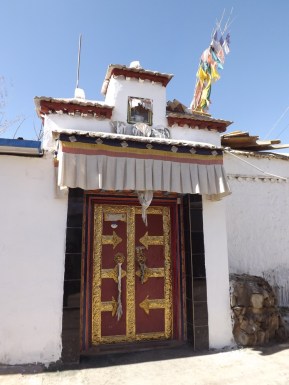
We walked around the small village. Quite a few Tibetans were sat outside the tiny shops chatting. They acknowledged us with smiling faces and cheery hellos. It was cold but the sun was shining and the sky was blue. We passed two tiny butchers with meat hanging up at their glassless windows. Most of the doors were richly decorated. Many were decorated with a material frill at the top and richly embellished with gold coloured painted patterns.
Brightly coloured prayer flags were flying from the majority of the white single storied buildings.
We drove past the imposing Potala Palace again, on our way to the old town and a restaurant named ‘Lhasa Kitchen’ for lunch. We decided to order a few dishes and share them. We ordered fried yak, yak and potato stew, yak sizzler and cheese mommos. The mommos are traditional Tibetan dumplings and were delicious, as were all the other dishes that we ordered.
We enjoyed watching Tibetan life on the 20-minute drive to the Sera Monastery. Sera Monastery is a teaching monastery and is dedicated to the Gelugpa Sect also known as the Yellow Hat Sect of Tibetan Buddhism. Sera is Tibetan for wild rose. Apparently when the monastery was being built during the 15th century the hillside behind was covered in wild roses.

We walked around the prayer wheels, spinning them in turn multiplying our prayers. They were situated below a tall white chorten (stupa in Sanskrit). Many people were visiting the monastery. Dawa explained that as the date was 30 in the Tibetan calendar, the day was auspicious. Therefore more merit would be gained for visiting the monastery on this day. There was a long queue and Dawa told us that families were waiting for their children to be blessed. The children had black marks put on their noses by the monk that blessed them.

Each afternoon the younger monks can be seen practising their debating skills. This captivating practise is both noisy and energetic. In addition to the word battles, various gestures including stamping the foot and slapping the hand simultaneously are part of these debates.
We saw a nun prostrating in front of the debating monks, she was with two companions, one male who was constantly rotating his prayer wheel and an older female.


This monastery includes an assembly hall, three colleges and thirty-three houses. It is the second largest monastery in Tibet.
Before the Chinese invasion there were 5000 monks at this monastery, today there are just 400.
In the foothills at the side of the monastery we saw a beautiful colourful Buddhist painting on a huge rock. Tiny hermitages can be seen higher up on the hillside.

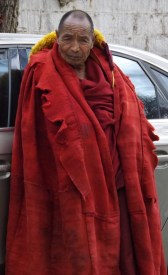
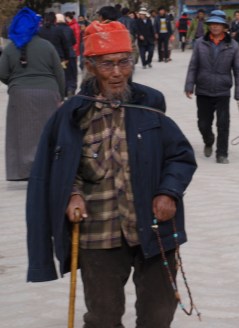

There are a few Chinese tourists visiting the monastery and we have spotted a maximum of six Europeans or Americans. The majority of visitors to Sera today are Tibetan.
Dawa and Lobsang dropped us back at our hotel – Kyichu, there is also a river in Lhasa with this name, which translates as the River of Happiness, and therefore we must be staying in the Hotel of Happiness!
Happiness is a good way to explain how we feel right now as we stand in Barkhor Square. Pete and Anne commented that it felt different to their time here this morning when it was freezing cold and the shops were still closed. There were many pilgrims walking the kora around the revered Jokhang Temple. The word kora comes from a Tibetan word meaning circumambulation or revolution.


The circumambulation is usually around a sacred site or object. It is both a pilgrimage and a meditative practise. Often koras are walked while spinning prayer wheels, reciting mantras or prostrating. This kora is around the most sacred temple in Tibet, the Jokhang Temple.

We mingled with the pilgrims and walked the kora. I felt emotional; it was like stepping into a different world. Some people were prostrating their way around the kora. There were old people with weathered faces and sticks, some alone, some with a friend, holding each other’s hands. Two young girls prostrated around the kora, one behind the other, they wore long aprons protecting their clothes. Their small hands slipped into handmade wooden protectors. One young man was prostrating with his calves tied together. We wondered if this gained him extra merit. The Tibetan people are mainly dressed in traditional clothing but we do spot some Tibetan families in Western dress.
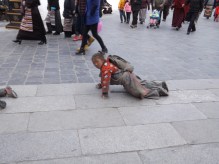
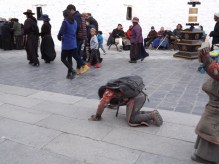
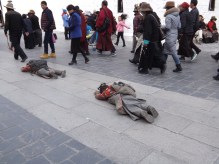
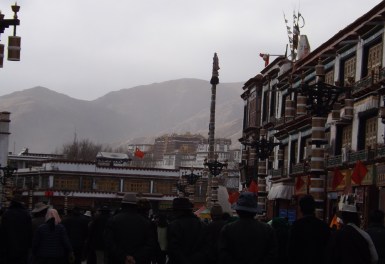
Part way around the kora, there is an amazing view of the Potala Palace in the distance.
We encounter quite a few stares as some Tibetans have never seen people from the west before. A few people nodded to us and greeted us with a traditional ‘tashe delek’, meaning good fortune, blessings or simply hello.
We returned to our hotel and relaxed for 20 minutes before getting ready and meeting up with Anne and Pete again for dinner. This evening we ate at the Snowland Restaurant, another recommendation from our guidebook. We were back at the hotel again by 9.30pm. What an incredible day we have had.

 lindaruddstravels.com